Review of Dracula (1958) by Blake P — 12 Jun 2013
If you're a horror enthusiast, then most likely the phrase "Hammer horror" will have a special place in your heart. If you've never heard of the groundbreaking studio, I suggest you listen to me, in hopes that you'll get enticed to watch one of their films. While the world of horror in the '50s was quick and fun (but pretty dated by today's standards), it wasn't necessarily scary. Shocks and thrills were either limited to Hitchcock or a nuclear inspired sci-fi pic that you'd forget just a day later. Thank god for Britain, the country that founded Hammer Studios. First making their huge public appearance with the groundbreaking version of "Frankenstein," which wasn't a remake but an artistic rendering of the classic frightener, the studio instantly became known for their baroque visual and subtle jolts.
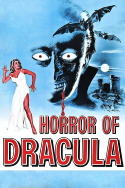
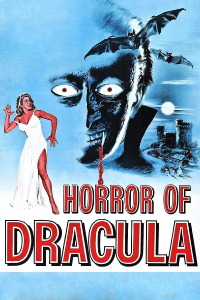
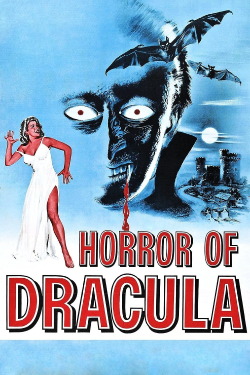
After "Frankenstein," they traveled to the next big horror figure, Dracula, with 1958 film "Horror of Dracula." While the archetypal 1931 version revolved around Bela Lugosi's phenomenal portrayal of the Count, this one, filmed nearly three decades later, throws away the influence of the Transylvanian accented caricature of a villain and black-and-white photography. What goes in its place is luscious color, gothic thrills, and a quiet sense of eeriness that manages to chill today. It achieves what few horrors can in that it's equally beautiful as it is haunting.
As for the story, it's quite familiar to anyone who knows literature, plays, or movies. Jonathan Harker (John Van Eyssen) is traveling to the castle of Count Dracula (Christopher Lee), posing as a librarian. In truth, Harker is setting out to kill the Count, who is actually a vampire. But as all film openings, things do not go as planned: Harker destroys one of Dracula's "brides," and doesn't get away with it.
After Harker's unfortunate demise by the Count (and if this is a spoiler, you must live in a hole), Dr. Van Helsing (Peter Cushing) begins to attempt to find Harker; when he descends upon Dracula's spooky castle, he finds that not only is Harker not dead, but he has transformed into a vampire. Helsing stakes him before he can cause damage, but his problems with Count Dracula are far from over. The latter is desperate to avenge his "bride," and decides to not only bite Harker's fiancé Lucy (Carol Marsh), but also her brother's wife, Mina (Melissa Stribling).
Stylistically filmed and mood based, "Horror of Dracula" surpasses the 1931 "Dracula" greatly. It doesn't necessarily follow the book it's based on, but when it comes to sheer filmmaking, "Horror of Dracula" sets a standard. You can easily see where it influenced horror maestro Mario Bava, as there is less focus on dialogue and characters and more on how everything looks and how it makes the viewer feel. Personally, I don't need a logical plot or excitement to enjoy a film-- for me, it's all about tone.
And "Horror of Dracula" succeeds in this way. It's relatively short, but packs a huge punch, maintaining to make us shiver throughout but always surprise us. One of the most important components is Lee's performance. Though relatively small and without dialogue, Lee constantly manages to terrify us. It doesn't contain the operatic grandeur of Lugosi-- he instead plays the titular villain with a more sinister façade, someone a little less charming and a lot more ominous. When he enters a room, you can't help but feel a strong sense of terror, and when he leaves you begin to feel anxious that he'll be back soon.
"Horror of Dracula" is a fantastic horror film. It looks good, feels good, and does its job.
This review of Dracula (1958) was written by Blake P on 12 Jun 2013.
Dracula has generally received positive reviews.
Was this review helpful?