Review of Chimes at Midnight (1965) by Mike M — 24 Mar 2011
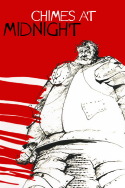
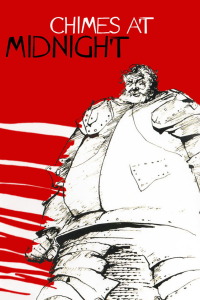
Though Welles is mindful enough of the texts (and Shakespearian mores) to cast Gielgud as Bolingbroke, and to use Ralph Richardson as his narrator, his focus isn't on the castles - between "Kane" and "Ambersons", he'd already done the downfall of kings - but on the kinds of taverns and bawdy-houses the director had been fond of frequenting off-screen; and in assuming the role of Falstaff, the writer-director-star restructured the entire series of history plays (not to mention the title) around his expanding belly, effectively recrowning himself in the process: the assumption throughout is that we'd far rather hang out with this Player King than with the pinched and sneering Gielgud.
.. On a conceptual level, one senses Welles responded less to the high art of the Bard than to his low blows, something perhaps closer to the gutter he found himself in. Visually, however, there's enough evidence to suggest how Welles's cinema actually benefitted from being removed from the American studio system.
Dynamically shot and edited, possibly to hide the meagre resources left at its director's disposal, it has the invention and immediacy of so much oppositional world cinema of the period. The battle sequences, in particular, are right up there with "Potemkin" and "The Round-Up" in a compositional sense, and have the urgency not of hidebound drama, but something like "The Battle of Algiers" on horseback.
Its idiosyncrasies may count against it overall, but it's a solid leftfield contender for the title of Best Filmed Shakespeare - and would have been a far more dignified way for Welles to have shuffled off the stage than all those aborted ad campaigns of the 70s and 80s.
This review of Chimes at Midnight (1965) was written by Mike M on 24 Mar 2011.
Chimes at Midnight has generally received very positive reviews.
Was this review helpful?