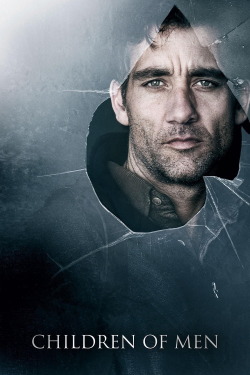
Review of Children of Men (2006) by Andrew L — 03 Mar 2016
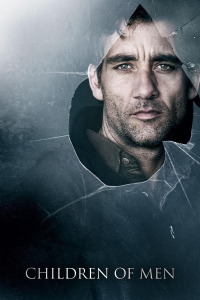
What if in a mere eleven years, mankind was on the edge of dying out, with no hope in sight? This is the world Alfonso Cuarón explores in Children of Men. Starring Clive Owen, Julianne Moore, and Michael Caine, the film portrays Britain in a dystopian future during the year 2027. Women have been infertile for nearly twenty years, and nobody knows why. Theo (Clive Own) is thrust into action by his ex wife Julian (Julianne Moore), who needs his help in aiding a young African woman named Kee. A mashup of Sci-Fi, action, and drama, Children of Men asks it audience to never surrender hope, no matter what the obstacles are.
Interestingly, Cuarón delays in developing the idea of holding onto hope, not even showing a glimpse of anything redeeming in nearly the first forty minutes. Britain is the last country with a somewhat stable government, but it's beginning to lose control. Its citizens live aimlessly, knowing their generation will be the last of humanity. Theo is one of these citizens, and like the rest of society, he's given up on life.
The films opening shot features Theo walking into a coffee shop one morning. No one is in line, however, as everyone is watching the TV announce that the youngest person in the world, Diego, had just died. While everyone is shocked, with some even crying, Theo seems completely indifferent. He quickly navigates through the crowd, taking advantage of the distracted customers. Right away, the audience gets a glimpse into how little hope Theo has. The youngest person in the world dying has no impact on him, even though other people are clearly in mourning. At one point, he even seems annoyed by coworkers grieving, and ends up using Diego's death as a means to get out of work for the day. Later on, Theo tells his friend Jasper (Michael Caine) that most days he feels like "shit" and has lost all feelings, even giving a small hint at the consideration of suicide. At the beginning of the scene, you also hear a portion of Ruby Tuesday by Franco Battiato. Besides "Goodbye, Ruby Tuesday", the lyrics "Dying all the time. Lose your dreams and you, will lose your mind. Ain't life unkind" are also heard; a small subtle nod by Cuarón to humanities impending extinction. Not even a minute later, the audience is introduced to a horrifying machine. Called Quietus, once it's consumed the user quickly passes out, and then proceeds to die in their sleep. The fact that the government provides suicide kits for their citizens goes to show just how grim the situation is. With the next few scenes, though, a small glimmer of hope resurfaces.
A little while after the scene with Jasper, Theo finds himself in his cousins house. When entering, he walks down a hall with the statue David at the end of it. One of Cuaróns possible reasons for including this here has to do with the creation of David. The statue was created during the renaissance, and one of its recurring themes centered on people doing the most with their lives and overcoming any tests. This is a bit of foreshadowing on Cuarón's part, giving a hint of what kind of journey Theo is about to embark on. Theo spends some of the next scenes with Julian, and in the process meets Kee. He also hints to Julian how money may not have been the only reason for helping her, and he's curious about whether or not they'll have a future together, once the job is done. They exchange in some playful banner, and even play an old game for Kee, showing there is still clearly affection between the two of them. Unfortunately for Theo, any hope he has in reconciling with Julian quickly evaporates in the next couple scenes.
Within a few seconds, the group is suddenly ambushed by a massive mob. In the ensuing pandemonium, Theo, Kee, Kee's caretaker (Miriam) and Julian's friend Luke are able to drive away. Julian, though, is shot and dies a few moments later. This absolutely devastates Theo. Confused and upset, he breaks down sobbing a short while later. This is where Theo hits rock bottom; any hope he had left in the world died with Julian. Once the group arrives at their safe house, Theo is eager to depart. Unbeknownst to him, Julian's death is one of three major twists that occur over the next couple scenes. One of which fundamentally changes Theo.
The next twist in the story has the most profound impact on Theo. Kee speaks to Theo alone, and reveals that she is pregnant. Dumbstruck, Theo is left in awe as he finally realizes what is at stake. It is also briefly inferred before this scene that most animals seem to like Theo, even hostile ones. This shows Cuarón's intentions of Theo playing a shepherd like role, meant to guide and help Kee. Further adding to this is the fact that Kee revels her pregnancy to Theo in a stable surrounded by animals, which is similar to the birth of Jesus. Jesus's birth was viewed by many as a miracle, and a sign of a new age. This gives the impression that Kee's child could have the same impact that Jesus did on the world. This is also where Cuarón first introduces the idea of never losing faith. Even when humans are faced with insurmountable odds, they can still find a way to defy them.
Theo's renewed sense of hope is yet again dealt another blow, when he learns that Luke and the rest of Julian's organization coordinated her death. His newfound faith gives him the drive to help Kee and Miriam escape. The trio finds refuge at Jaspers house, who's overcome with joy at the sight of a pregnant woman, showing how much hope Kee's pregnancy inspires in people. Luke is able to track down the group though, and Jasper distracts him while the trio sneaks away. Theo's faith is again tested as he watches Luke gun down Jasper. However, it was Jasper's newfound belief in hope that aided him in keeping the trio's location secret from Luke.
A few scenes later though, Kee begins to go into labor, and Miriam gives herself up to a soldier in the hope of protecting Kee. Following that, Theo and Kee are able to rent a hotel room, where Kee proceeds to give birth to a baby girl. However, Luke quickly resurfaces and is able to steal Kee and the child from Theo. He pursues them to a nearby building where a firefight is ensuing between rebels and the British government.
Over the next six minutes, the camera follows Theo's breathtaking entrance and subsequent search for Kee into the building in a single shot. Cuarón wanted the audience to feel a sense of realism, like they are there with Theo. The use of shooting in a single take also helps ramp up the suspense and intensity of the scene. Theo successfully finds Kee and the baby, and they begin to exit the building, narrowly avoiding a tank blast that results Lukes death.
Their departure from the building is where Cuarón decides to bring to center the theme of never losing hope. As Theo and Kee slowly walk through the building, its' inhabitants are overcome with shock and joy at the sight of a child. Many of them begin to weep, and are left speechless by the miracle. Others begin to sing, reaching their hands out to touch what represents humanities new future. Rebel soldiers immediately stop firing upon sight of the child, and they whisper small blessings while passing by. British soldiers order an immediate cease-fire, and begin bowing and kneeling to the child and her mother. This brings back the reference to Jesus, as people are inspired and ecstatic about the sight of the child, ass they see hope. For just a few minutes, all the chaos in the scene stops. Everyone is fixated on the baby, and how the once bleak future, is not so bleak anymore. Cuarón brings the audience rushing back to reality though, as an RPG blast punctuates the peacefulness. For a few brief minutes, the audience is able to witness the potential miracles the baby can have for the human race. Even though just for a short time, the fact that everyone stopped fighting in respect of the child shows how humanity still has hope as a species.
Theo, Kee, and the child safely make it to nearby boat, which they then use to await the arrival of an even bigger cargo ship, which will provide protection and care for the group. While awaiting the arrival of the cargo ship, Theo revels he's been shot, and passes unconscious a few moments later. For just a few moments, with Theo incapacitated, the cargo ship nowhere in sight, and Kee being all alone, that lingering sense of hopelessness creeps back into the audiences mind. Cuarón is testing the audience, to see whether or not they will lose hope again. Fortunately, the ship emerges from the mists.
One of the final shots of the film shows the ships name, Tomorrow. I think this is an obvious node by Cuarón to look forward to the next day, to have hope. The final words of dialogue, spoken by Kee to her child, "we're safe now, we're safe" finally allows the audience to rest. They can have faith knowing that Kee will be safe.
Humanity is facing a somber future, Women are infertile, and have been for almost twenty years. Britain is one of the last stable governments, although it's beginning to show signs of collapse. Alfonso Cuarón delves into this country and its citizens, many of who are on the brink of an uprising. Cuarón makes use of many different characters, certain shots, bits of dialogue and alive background to help explore his ideals about never relinquishing hope, no matter how dire the situation is.
This review of Children of Men (2006) was written by Andrew L on 03 Mar 2016.
Children of Men has generally received very positive reviews.
Was this review helpful?