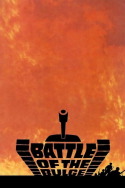
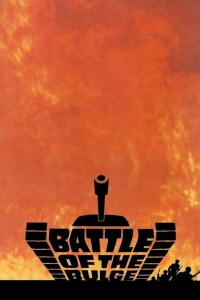
Review of Battle of the Bulge (1965) by Van R — 03 Jun 2010
?Swiss Family Robinson? director Ken Annakin orchestrates some massive combat sequences in his sprawling, big-budgeted epic ?Battle of the Bulge? with 80 tanks loaned to him from the Spanish Army. Henry Fonda, Robert Shaw, Robert Ryan, Dana Andrews, Charles Bronson, Telly Savalas, Ty Hardin, and George Montgomery are among the stars in this name-dropping cast. This traditional World War II opus depicts the eponymous battle from the perspectives of both the United States Army and the German Wehrmacht. The officers here are all honorable men who deserve to be in command and nobody wants to kill them because they are either cowardly or incompetent. Moreover, ?Battle of the Bulge? divides the villainous Germans up into two groups: the regular army troops and the murderous S.S. troops who murder 50 American G.I. that they capture in Malmedy. Mind you, despite its superb production values and all those tanks, ?Battle of the Bulge? is not a classic, but it ranks as a good, solid war movie. The principal shortcomings are obvious, even at first glance. Henry Fonda?s protagonist isn?t your ordinary Army officer. Instead of being a regular combat officer in the front lines, like Charles Bronson?s Major Wolenski, Fonda plays a Lieutenant Colonel who spends his time trying to convince his superior officers that the Germans have one last battle left in them. Our self-sacrificing hero witnesses the approach of the enemy tanks and then later flies over enemy country in a spotter plane. Nevertheless, despite clocking in at 169 minutes, ?Battle of the Bulge? is pretty exciting stuff with good performances, and tanks galore. Unfortunately, you can spot the miniature model tanks, even though they look really good. The best thing about this big war movie is the Allies don?t turn the tide until the last half-hour when the U.S. Army commander comes up with a strategy to defeat the Germans.
Annakin and scenarists Philip Yordan and John Melson focus on five groups of characters in this explosive, weather-ravaged historical escapade. The Battle of the Bulge proved to be Hitler?s last desperate gamble to reverse his waning fortunes after the Allies had landed at Normandy and broken through Fortress Europa. The Germans discovered a chance to counterattack against an American army that thought they would finish the war by Christmas. Over the battlefield gathered clouds and the German High Command took advantage of all this cloud cover to launch a spearhead against Allied troops and divide the Allies in two while making a thrust to the port of Antwerp. Initially, the attack was a colossal success and the German Army not only caught Uncle Sam by surprise, but it also struck panic in the soldiers. In the first set of relationships, Lieutenant Colonel Kiley (Henry Fonda) has to prove to an incredulous General Grey (Robert Ryan of ?Billy Budd?) and Colonel Pritchard (Dana Andrews of ?The Devil's Brigade?) both that the Germans still have enough fight left in them. Kiley is the only officer who believes that the Germans pose a threat. Second, imperious German tank commander Colonel Hessler (Robert Shaw of ?Custer of the West?) and his batman Conrad (Hans Christian Blech of ?The Longest Day?) have a contentious relationship. Hessler is a clench-jawed Teutonic warrior from head to toe, while Conrad is a peace-loving subordinate who frets about the future of his children under an aggressive madman like Hessler. Third, veteran U.S. Army Sergeant Duquesne (George Montgomery of ?Masterson of Kansas?) struggles to protect his young, naïve superior officer, Lieutenant Weaver (James MacArthur of ?Hang?em High?), from himself and the enemy. Fourth, German Lieutenant Schumacher (Ty Hardin of ?P.T. 109?) and his U.S. Army military police impostors screw up the Army?s retreat. Fifth, a U.S. Army tank commander, Sergeant Guffy (Telly Savalas of ?Genghis Khan?) divides his time between his tank crew and his black market girlfriend, Louise (Pier Angeli), who wants to go into business with him permanently. None of these relationships are particularly memorable. The best two occur between officers and their immediate subordinates: Sergeant Duquesne and Lieutenant Weaver as well as Colonel Hessler and Conrad. The enmity between Kiley and Pritchard never sizzles like it should have. One of the most atmospheric scene is a chorus of young German tank commanders singing and stomping their feet to a war song.
Ultimately, ?Battle of the Bulge? succeeds as a big-budget war film because Annakin puts everything on the screen. The sight of all those tanks?even if they are technically too modern for the 1940s?is what makes this movie work. Annakin takes advantage of the Cinerama process for some scenes. The best scene involves an American artillery piece being hauled by rail at breakneck speed to the Allied forces. The train rushes headlong through the landscape and we are literally perched on the front as the locomotive charges down the rails. A German tank awaits the fast-moving train at the end of a tunnel and blows it up. Annakin was no stranger to big-budget war movies since he has been one of the several directors on "The Longest Day." The speech that Bronson's Major Wolenski delivers to Kiley about how his men feel that Germany should be turned into a pasture for buffalo represented the way some of President Franklin Roosevelt?s cabinet felt about the future of Germany after the war. The scene where Colonel Hessler reprimands his superior officer for the behavior of S.S. troops is good, too. Composer Benjamin Frankel provides an atmospheric score, and lenser Jack Hildyard makes it look like an extravaganza.
This review of Battle of the Bulge (1965) was written by Van R on 03 Jun 2010.
Battle of the Bulge has generally received positive reviews.
Was this review helpful?