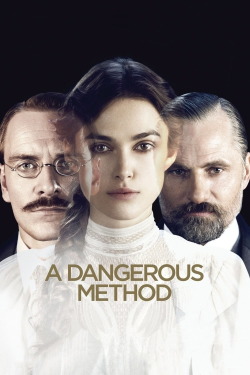
Review of A Dangerous Method (2011) by Edith N — 07 Jun 2012
In Which Jung Is the First X-Man.
This movie should have been much better. It's a David Cronenberg movie that isn't all David Cronenberg-y. I mean, we see some of Keira Knightley's body, but there isn't that weird Cronenberg body horror thing going. And, yes, it's about some of the people who really developed the field of modern psychology, but it's not the weird psychological horrorshow Cronenberg prefers. It's Michael Fassbender having about the greatest year any actor has ever had. It's Viggo Mortensen playing a minor but significant role that would encourage serious hamming it up from a lot of people but that he's playing straight. And it's about the best acting I think I've ever seen from Keira Knightley, who isn't a bad actress but who is mostly used for her body (more on which anon). And yet there simply isn't anything to this movie. It doesn't go into much detail about anything. It's as though someone stole the script for an excellent movie and replaced it with a dull one.
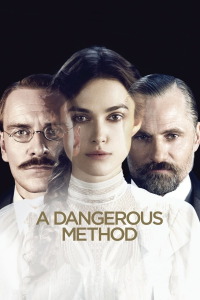
Fassbender is Carl Jung. He is working in a mental hospital in Zurich, the Burghölzli. One day, a beautiful young Russian woman, Sabina Spielrein (Knightley), is hauled in screaming. There is something seriously wrong with her, and Jung begins treating her using the famous talking cure of Sigmund Freud (Mortensen). It turns out she is hoping to become a psychologist herself, if only she can get better. Jung treats her, but he also falls in love with her. Jung is married to Emma (Sarah Gadon), who is a typical woman of her age, class, and era. How much is Jung willing to risk for Sabina? Will it damage her beyond repair? At the same time, there is the conflict between how Jung and Freud think patients should be treated. There is also the fact that Freud basically wants everyone to agree with him, and the very idea that Jung is striking out on his own builds resentment. And, you know, that's about it for story.
Okay, I admit it. My problem with this movie is not that it doesn't have much story. I would quite cheerfully watch the movie where Mortensen as Freud and Fassbender as Jung argued the relative merits of their two systems of analysis. And that's even though I think Freud was about ninety percent wrong and Jung about seventy percent wrong. Not the point. The two actors do an amazing job, and the conflict between them is great theatre regardless. The issue, however, is that this movie doesn't give you enough information to really understand what that conflict is. It kind of implies that Freud is mad at Jung for having psychic powers. And it's true that the biggest issue I have with Jung is his acceptance of all kinds of nonsense along those lines. (Did you know that Jungian astrology is a thing?) Not that I think Freud is totally grounded in reality, either. But the movie doesn't get enough into what much of anyone thinks for it to matter. In short, it is [i]shallow[/i], albeit in an intellectual way and not an emotional one.
I also thought some of the religious stuff was a little odd. Would a pre-World War I person refer to a conflict between Jew and Aryan? Wouldn't it make a lot more sense if she'd said "Gentile"? Freud talks about how all religion is a delusion, but at the same time, he tells Sabina not to trust an Aryan. Which, again, is not the word I think he would have instinctively used. Yes, the "Jewish thing" is historically important; after all, Sabina Spielrein was killed by the Nazis. (Though her husband was killed in the Great Purge, which probably had little to do with his ethnic origin.) It's also true that I don't know how much importance Freud put in his own Jewish origins. He was hounded out of Germany and on Hitler's list of those to be killed in an invasion of the UK, but I think Hitler was projecting his dislike of what Freud said on the fact that Freud was a Jew. Or something. And even with all that, the movie mentions it but mostly ignores it, paying less attention to it than the people themselves would have.
And, yes, Keira Knightley. She did a good job here, a better one than I would have anticipated of her. She's one of the reasons I am able to give this movie the marginally positive review I am. (It's also simply a lovely film.) Can I just take a minute, though, and express my bewilderment that she's a modern sex symbol? This is really not the era wherein someone with her figure ought to be considered hot. The poster for that terrible [i]King Arthur[/i] she was in is (justly) reviled for airbrushing her chest to give her bigger breasts, but even on that poster, she's pretty flat. At most a B-cup. Don't get me wrong. I think she's really quite lovely. I'm certainly not trying to say that all women should have enormous breasts. Her figure works for her, and it [i]really[/i] works for some of the period clothing she's wearing. It's just a little confusing to me, given that her figure can best be described as "boyish," that she's a sex symbol in an era where, well, a B-cup is considered flat.
This review of A Dangerous Method (2011) was written by Edith N on 07 Jun 2012.
A Dangerous Method has generally received positive reviews.
Was this review helpful?