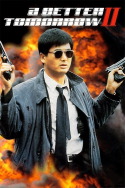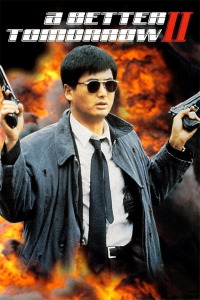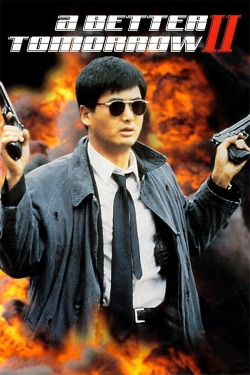
Review of A Better Tomorrow II (1987) by Jonathan B — 20 Sep 2012
There is no way A Better Tomorrow II can live up to the original because it would not be fair; the first A Better Tomorrow is, hands down, a superior film. The original A Better Tomorrow is certainly better with its stronger character development, a more convincing plot, and a compelling script. So I will place A Better Tomorrow II outside the shadow of its predecessor and judge it by its own merits.
While both films share obvious similarities (most notably, with the thematic content), they also have their obvious differences. While A Better Tomorrow delivers plenty of good action, I personally found that film to be much more of a serious drama and character study. Meanwhile, A Better Tomorrow II is a much more action-oriented flick. While it does have plenty of (melo)drama and some character development, A Better Tomorrow II is much more suitable as a rollicking fast-paced thrill machine that takes a while to get started, but afterwards, never quits. While I do not consider A Better Tomorrow II to be objectively better than the original, I did enjoy it more as an all-out entertaining film that'll blow you away. As they say, no guns, no glory...
The film begins with Ho (Ti Lung) having nightmares about the events which took place in the previous film. He wakes up, realizing that he is still troubled by his former life as a criminal trying to go straight. Meanwhile, Ho's younger brother, Kit (Leslie Cheung) is working undercover as Billie, flirting with Peggy (Regina Kent), the daughter of Lung (Dean Shek), a wealthy gang boss -- and Ho's former mentor. The police have reason to believe that Lung's shipping business is merely a camouflage for an illegal counterfeiting ring so they have sent Kit to try to crack the case.
Ho is very much upset over this, accusing the police of jeopardizing Kit's life. You see, while Ho is apparently reformed, Kit is still Kit: bold, brash, and sometimes reckless. Ho also goes undercover (much to the chagrin of his younger brother) and realizes that Lung indeed, has gone straight. In a memorable scene, Lung meets Ho and the two talk about the redemption of one's soul. Lung talks about how he legitimately wants to go clean, how he wants to leave his criminal past behind. It is interesting to note how these two have parallel lives (Ho himself worked in the counterfeiting business before deciding to quit).
Unfortunately, the path to redemption is a difficult one for Lung. Before long, Lung finds himself accused of a double homicide. Ho is forced to send Lung to New York until the whole predicament dies down. But in New York, things could not have been any worse as scores of assassins try to finish him off. The assassins succeeded in killing Lung's friend Sam (along with several civilians), and consequently, Lung is completely traumatized to the point that he cannot even feed himself. It is then that we meet Mark's twin brother Ken (Chow Yun-Fat, who also played Mark in the first A Better Tomorrow), the manager of Four Seas Restaurant who feels obliged to take care of Lung. Mark must somehow find a way to tell the catatonic Lung to snap out of it...
Back in Hong Kong, we eventually learn that it is Lung's former partner, Ko (Kwan San), who is behind the nefarious criminal activities and has been using Lung's shipping business as cover. Ko and the bad guys also sense Billie to be a snitch and indeed they are right so Ko tells Ho to shoot this cop dead. Now Ho must make the ultimate choice: either shoot his own brother, or confess...and risk execution.
A Better Tomorrow II has its share of flaws though none so significant as to deter one's enjoyment of this movie. For starters, this film has some major plot holes. For example, the chance meeting between Lung and Ken is one of the most ludicrous moments in this film ever contrived. It looks as if one day, Ken for some reason just decides to visit a mental hospital and is casually strolling through its corridors until he sees someone he recognizes (or probably just pities). Ken then sees Lung at his catatonic state (often acting epileptic), and perhaps feeling sorry for this pathetic soul, Ken decides to take him home. What also really peeved me is how the filmmakers neglected to talk about Lung's psychological background. Had there been some sort of explanation for Lung's mental illness, (perhaps a childhood trauma) maybe I would have shown more compassion for him.
I suppose we can blame the substantial plot problems on the film's editing. Rumor has it that this film was severely cut from two hours and forty minutes to just under two hours. Director John Woo and producer Tsui Hark were each assigned to edit half of the movie separately so perhaps there were conceptual differences after all.
The most grating weakness though, is Dean Shek's uneven performance, and unfortunately, he is the central character in this movie. He is not downright awful (heck, sometimes he did a very good job), but he often disheartens me. When Shek is not acting catatonic, he shows a whiff of competence. He makes a valiant attempt at portraying a sympathetic gangster with a change of heart. But when he does act mentally dilapidated, I wanted to yell, "What the hell is wrong with you?" right at the screen. It is frustrating; sometimes Shek (as Lung), acts like he is some mental patient straight out of a Marquis de Sade opus. But since his background is primarily in comedy, I suppose he was indeed cast against type here. (Ibid: Dean Shek was having financial problems at that time so perhaps the filmmakers opted to have him be in the center stage.).
"You don't like my rice? You don't like my rice?" Now, on to the good stuff. The humor in A Better Tomorrow II works surprisingly well and the highlight is the (in)famous rice scene. This is one of those rare instances where we get to see a more humorous side to Chow Yun-Fat (he would eventually learn how to fine tune his comedic skills as the title hero in God of the Gamblers) as well as listen to him speak English (unless his voice was dubbed). The lowdown? A Mafiosi boss derides the fried rice and grabs Ken's attention. Ken tells the boss, "I give you nothing man. I won't give you shit." Then the Mafiosi boss threatens to blow up the Four Seas Restaurant unless Ken pays the protection money. Ken replies by giving him a quarter...
You have to see the shockingly funny conclusion to this scene yourself. All I can say really is that I admit it was amusing watching Chow Yun-Fat as a manically over-the-top Ken who seems to enjoy insulting and infuriating the gangster. Throughout this scene, I silently chuckled at the conversation between these two characters.
If you have not figured it out by now, I am a loyal John Woo fanatic, and seldom has his action movies disappointed me (with an exception here and there). Simply said, the action sequences in A Better Tomorrow II manage to blow away its predecessor in every way possible. Watching this film is essentially like watching a comic book adventure brought to life: itâ(TM)s full of invigorating visuals and action scenes so outrageous that they border on surrealism.
Want a sample of a true action sequence? The first major sequence is a gunfight inside a derelict apartment. As various mobsters try to zero in on Ken and the hapless Lung, the former fights fire with fire. Ken responds by slowly blasting away the bad guys one by one while trying to shield Lung. This is simply an amazing sequence; it is tautly choreographed and exciting, guaranteed to raise the temperature surrounding you. What is also stylish about this sequence is how it is filmed. When you see a bad guy biting the bullet, the film apparently slows down. Yet, once we cut back to Ken trying to terminate his opposition, the pace is back to normal. However, the most indelible image in this scene is when Ken slides down a staircase (on his back!) while pumping lead into a well-armed assassin.
But wait a minute...I have yet to mention the climax, which moves so dizzyingly fast that you will barely have any time to catch your breath! Imagine four heroes -- fueled by vengeance -- deciding to storm the villain's mansion like there is no tomorrow. With guns, machine guns, a battleaxe (!), grenades, and even a katana as part of their arsenal, the avenging quartet are ready to fight till the end. This results in an orgy of bloody and chaotic mayhem. Can you believe it? Neither can I.
As for John Woo, he never ceases to amaze me. He always tries his best to top himself with each subsequent action sequence. Borrowing liberally from the likes of Sam Peckinpah and Sergio Leone, Woo has a knack for adding innovation into his action set pieces (the showdown between Ken and an enigmatic sharp-shooting assassin during the climax is an awesome twist to the one-on-one standoff motif). John Woo is like a conductor who takes pride in meticulously orchestrating his bullet symphony.
With the exception of Dean Shek's erratic (but admittedly noble) performance, the rest of the actors in A Better Tomorrow II are very good. Chow Yun-Fat does a fine job as Ken. Although it is sometimes scary to see Chow Yun-Fat portray Ken in very much the same way he portrays Mark -- even though they are obviously two separate identities -- he succeeds nevertheless. No matter which character Chow Yun-Fat portrays, he still manages to maintain a strong screen presence. I think it is safe for me to say that Chow Yun-Fat is the kind of actor any guy would want to idolize.
Leslie Cheung continues to show growth as a talented actor who would endanger his own life just to get the job done. Although his character is a bit reckless at times (and has even made some very stupid decisions), Cheung succeeds in making him still likable and sympathetic. Ti Lung is also solid as Kit's older brother. Although his acting has not really improved that much from A Better Tomorrow, we do get to see him return to his martial arts roots during a crucial fight scene.
Generally speaking, John Woo does a decent, but not exactly a great job touching upon the common themes found in many of the movies belonging to the "heroic bloodshed" (action films which operate like tragic operas) sub-genre. Since this is his sophomore project, it is understandable in that he is still learning the tricks of the trade here (though some may argue that John Woo has stepped down a bit, in that the thematic content in this sequel is not as strong as the first one). One of the recurring themes in this movie is betrayal; in that someone who may be your most trusted friend can one day end up being your greatest nemesis. Lung himself became the victim of betrayal when his once-trusted associate, Ko, turned his back on him.
The difficulty of achieving redemption (a common theme in many "heroic bloodshed" movies) is also discussed in this movie. Lung himself is basically a bad guy with the heart of gold. He knows that jettisoning his criminal past is not easy, but he knows that he must in order to start anew. Finally, there is the importance of brotherhood, and the rapport between Kit and Ho -- though not as noteworthy or potent as I expected -- reinforces that theme.
A Better Tomorrow II is a masterpiece of aesthetic ultra-violence. Make no mistake; this is the definitive guy movie (the female characters have inconsequential roles). In spite of the film's lapses in plot and logic, A Better Tomorrow II is an action picture which will make genre fans orgasmic. This is a can't-miss movie with some of the wildest action scenes ever conceived. Only John Woo can direct a bloody opus of this magnitude.
This film no doubt has its share of rough spots. The melodrama -- which is sadly in lieu of actual emotional content found in the original -- can be a little exaggerated and some parts of this movie are simply full of nonsense. Also, this film is not quite as refined as many of Woo's later works such as Bullet in the Head and Hard Boiled (both of these films have much more elaborate action sequences).
A Better Tomorrow II may not have the poignancy of the original, but it is infinitely more entertaining. Put your mind and logic on cruise control and enjoy this film as an all-out spectacle.
If anything, A Better Tomorrow II is a prelude of great things to come from a legendary auteur in the making. This film has certainly validated John Woo as a reckoning force in action cinema.
This review of A Better Tomorrow II (1987) was written by Jonathan B on 20 Sep 2012.
A Better Tomorrow II has generally received very positive reviews.
Was this review helpful?