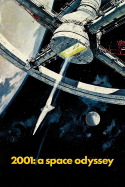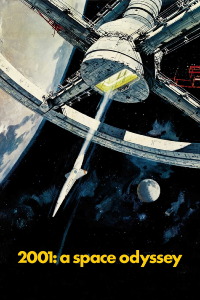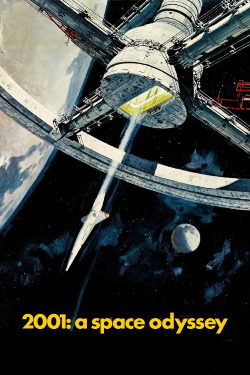
Review of 2001: A Space Odyssey (1968) by Cinemassacre — 13 Mar 2016
When Stanley Kubrick and sci-fi specialist Arthur C. Clarke first conceived the idea of making a Cinerama film, neither had any idea that it would run into a project of several years. Shooting actually began late December, 1965, in England and continued, if one counts added footage and retakes, until early this year. Much of the lengthy shooting time, of course, is attributable to the detailed special effects the story made necessary. Keir Dullea, for instance, completed another film (“The Fox”) and did a Broadway play (“Dr Cook’s Garden”) between completion of his role in “2001” and its current release.
Was all this painstaking research and work worthwhile? There will be many filmgoers, fortunately for Metro, who’ll think it was; there’ll be others who won’t see this in the finished handiwork of Kubrick and his staff. A major achievement in cinematography and special effects, “2001” lacks dramatic appeal to a large degree and only conveys suspense after the halfway mark. Despite the enormous technical staff involved in making the film, it is almost entirely one man’s conception and Kubrick must receive all the praise – and take all the blame.
The plot, so-called, uses up almost two hours in exposition of scientific advances in space travel and communications, before anything happens. The surprisingly dull prolog deals with the “advancement of man,” centering on a group of apes (the makeup is amateurish compared to that in “Planet of the Apes”). An important prop is also introduced but so sketchily that many viewers will scarcely note, and promptly forget it–a huge black monolith is shown briefly (to reappear light years later as the key to possible life on planets other than Earth).
The little humor is provided by introducing well-known commercial names which are presumably still operational during the space age: the Orbiter Hilton hotel, refreshments by Howard Johnson, picture phones by Bell, and Pan Am space ships (although one shown is carrying only a single passenger). A computer named Hal that can talk is, initially, good for a laugh but when it turns out to be the villain, this attitude quickly changes. Hal (voiced by Douglas Rain, although originally done by Martin Balsam) is one of the film’s best effects and surprisingly acceptable, considering reaction to it is based on the use of a voice.
Dullea and Gary Lockwood, as the two principal astronauts, are not introduced until well along in the film. Their complete lack of emotion becomes rather implausible during scenes where they discover, and discuss, the villainy of the computer. Except for William Sylvester, as the scientist who reveals the project to investigate possibility of life on another planet, the other human roles are little more than walkons.
Kubrick and Clarke have kept dialog to a minimum, frequently inserting lengthy passages where everything is told visually. One inside joke is the remark by a femme Russian scientist that her husband is busy elsewhere doing underwater exploration (Clarke’s real-life hobby). Scientific advances appear much further along than would seem possible for the 33 intervening years until 2001. The only earth shots shown are interiors transmitted over picture phones or closed-circuit TV but, incongruously, Earth citizens are shown dressed and acting 1968 while the scientists (even in their casual attire) wear stylized space-age garb.
Film ends on a confused note, never really tackling the “other life” situation and evidently leaving interpretation up to the individual viewer. To many this will smack of indecision or hasty scripting. Dullea, after being subjected to a wild celestial ride through a series of galaxies that create a psychedelic effort on both him and the audience, finds himself in a room decorated in a style familiar to Earth although the implication is that he’s on Jupiter. After confronting himself in various advance stages of age, he finally succumbs to the power generated by the black monolith (still unexplained) which has reappeared. The ending shot blends a planet with an orb-shaped view of an embryo, possibly suggesting the rebirth of civilization in another universe.
Ray Lovejoy’s editing, generally good, too often holds views to the point of losing interest while other scenes are chopped abruptly, sometimes with no explanation. This suggests some wholesale and rather hasty cutting decisions on the part of Kubrick. The 160-minute running time, still overlong, could be shortened sufficiently by some slicing in the lengthy introduction to make the intermission unnecessary.
But “2001” is not a cinematic landmark. It compares with, but does not best, previous efforts at science fiction; lacking the humanity of “Forbidden Planet,” the imagination of “Things to Come” and the simplicity of “Of Stars and Men,” it actually belongs to the technically-slick group previously dominated by George Pal and the Japanese.
This review of 2001: A Space Odyssey (1968) was written by Cinemassacre on 13 Mar 2016.
2001: A Space Odyssey has generally received very positive reviews.
Was this review helpful?