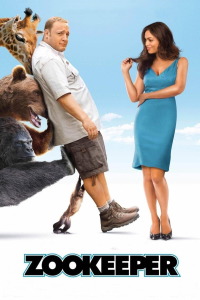
Review of Zookeeper (2011) by Shiira — 18 Aug 2011
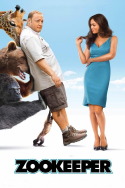
The gorilla sits in front of a wall, stoically, without movement or sound, never turning once while Griffin tries to befriend the large ape with fresh food and a tire. At the Franklin Zoo, Bernie has a reputation for being wild.
Ten years ago, he attacked a zookeeper, so the authorities took away his view. No longer showcased as a star attraction, Bernie resides in a cell-like pit where the dispirited animal has been brooding ever since.
If only the gorilla could have told his side of the story. Unfortunately, zoo officials had nothing to go on except for the testimony of its lone English speaker, so they leveled Bernie's open-aired home, the one that overlooked a faraway T.
G.I.F., and replaced it with a food stand. What would the beast say in his defense? Finally, that time arrives when the animals, fearing the departure of the kindly zookeeper, reveal their bilinguality to Griffin, whose staying is contingent on wooing back his ex.
With the moratorium lifted, following the lion's lead on talking to humans, Bernie recounts his physical abuse at the hands of Shane, who slipped and fell without any malice on the gorilla's part. The unkind zookeeper carried a longstick.
What if he did more than prod Bernie? Sworn to a code of silence, the hirsute beast wouldn't be able to stop Shane with words. Foremost, the word NO. Aside from, perhaps, "Babe", rarely has there been any reason for a live-action talking animals movie to exist.
Giraffes, monkey, lions, what have you, just end up looking ridiculous, and kind of creepy, when they're subjected to computer-generated ventriloquism. That's the irony of "Zoo", the 2007 documentary about an extreme horse lover society which came to light after a man died of fatal post-coital injuries sustained from interspecies intimacy.
As the female narrator points out, a horse can't give its consent, lacking both the cognitive ability, and, obviously, speech, to do so. If only life could only imitate the banal cinematic art, just this one time, for clarification purposes, since the filmmaker reserves judgment on the question of whether these sex mavericks are moral or not.
The audience needs to hear it from the horse's mouth, concerning the reciprocation of romantic love, in a language they can understand. That's because the men of "Zoo" have cultivated the fantasy in which horses yearn to be their b*tches; to be human, making the zoophiles guilty of the same anthropomorphism we see at the movies, even in the non-talking ones.
Similar to the flightless Antarctic birds from "March of the Penguins", the men project onto the horses, the very attributes which make us human, with the slight difference being that in "Zoo", it's the subject, not the filmmaker, who shapes the rhetoric.
Identified simply as "H.", the ranch hand insists that "you're connecting with another intelligent being who's happy to be involved," uncannily echoing the sentiments of a child molester who mistakes hubris for compassion.
(Both horse and child have no say in the arrangement.) We need "Zoo" to be a talking animals movie, because who is the horse going to tell, but other horses, about the abuse or lack thereof.
In the book "The Reality Effect: Film Culture and the Graphic Imperative", a meditation on our first filmed century, cultural critic Joel Black writes about sex, or rather, the suggestion of sex, in classic cinema, where the screen would fade out just as the two lovers get set to consummate their love.
Like "Casablanca", the filmmaker leaves it up to the moviegoer's imagination, in regard to the specifics of the deceased man and the stallion, rendezvouing by moonlight inside the hippodrome.
Show the unshowable, and the f*cked-up romanticism would be lost, not so dissimilar to the way hardcore pornography would destroy the idealized love between Rick and Ilsa, with sex's literality and utter visceralness.
In "Zookeeper", Bernie's story is mitigated by the omission of a flashback, a psychical diegesis, which gives the gorilla the subjective means to bowdlerize his victim narrative, therefore regulating the comedy genre by sublimating orifices into metaphor: he wants to drive(the car key penetrating the ignition), indicating a need for control.
(In "Congo", Amy shows no such perversion, choosing her own kind at the end.) As Bernie slow-dances with a T.G.I.F. waitress, zoophilia, the moviegoer realizes with a start, can work both ways.
The animals want it too. Stephanie is objectified by the wildlife, since she's the focal point in their animal minds, projecting their essence onto Griffin, whom they live vicariously through, and vice versa, when the "manimal" pees into a potted plant at a wedding, marking his territory like a wolf.
This review of Zookeeper (2011) was written by Shiira on 18 Aug 2011.
Zookeeper has generally received mixed reviews.
Was this review helpful?