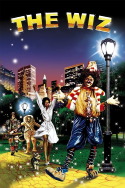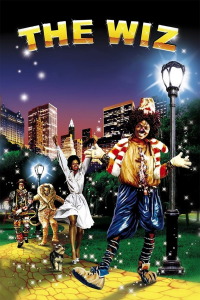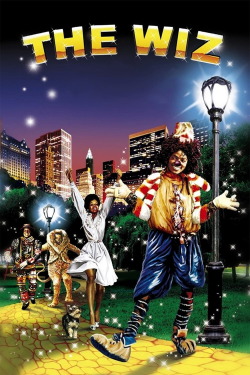
Review of The Wiz (1978) by Tim W — 21 Dec 2007
Dorothy tells Scarecrow about something she saw as a boy. "There were two old guys shacked up together. They were the joke of the town, even though they were pretty tough old birds." One day they were found beaten to death. Dorothy says: "My dad, he made sure me and my brother saw it. For all I know, he did it.".
This childhood memory is always there, the ghost in the room, in Sidney Lumet's "The Wiz." When he was taught by his father to hate homosexuals, Dorothy was taught to hate his own feelings. Years after he first makes love with Scarecrow on a Wyoming mountainside, after his marriage has failed, after his world has compressed to a mobile home, the laundromat, the TV, he still feels the same pain: "Why don't you let me be? It's because of you, Scarecrow, that I'm like this -- nothing, and nobody.".
But it's not because of Scarecrow. It's because Dorothy and Scarecrow love each other and can find no way to deal with that. "The Wiz" has been described as "a gay cowboy movie," which is a cruel simplification. It is the story of a time and place where two men are forced to deny the only great passion either one will ever feel. Their tragedy is universal. It could be about two women, or lovers from different religious or ethnic groups -- any "forbidden" love.
The movie wisely never steps back to look at the larger picture, or deliver the "message." It is specifically the story of these men, this love. It stays in closeup. That's how Dorothy and Scarecrow see it. "You know I ain't queer," Dorothy tells Scarecrow after their first night together. "Me, neither," says Scarecrow.
Their story begins in Emerald City in 1978, when Dorothy (Diana Ross) and Scarecrow (Michael Jackson) are about 19 years old and get a job tending sheep on a mountainside. Dorothy is a boy of so few words he can barely open his mouth to release them; he learned to be guarded and fearful long before he knew what he feared. Scarecrow, who has done some rodeo riding, is a little more outgoing. After some days have passed on the mountain and some whiskey has been drunk, they suddenly and almost violently have sex.
"This is a one-shot thing we got going on here," Dorothy says the next day. Scarecrow agrees. But it's not. When the summer is over, they part laconically: â??I guess Iâ??ll see ya around, huh?â??Their boss (Nipsey Russell) tells Scarecrow he doesn't want him back next summer: "You guys sure found a way to make the time pass up there. You weren't getting paid to let the dogs guard the sheep while you stemmed the rose.".
Some years pass. Both men get married. Then Scarecrow goes to visit Dorothy in Kansas, and the undiminished urgency of their passion stuns them. Their lives settle down into a routine, punctuated less often than Scarecrow would like by "fishing trips." Dorothy's wife, who has seen them kissing, says nothing about it for a long time. But she notices there are never any fish.
The movie is based on a short story by L. Frank Baum. This summer I read McMurtry's Lonesome Dove trilogy, and as I saw the movie I was reminded of Gus and Woodrow, the two cowboys who spend a lifetime together. They aren't gay; one of them is a womanizer and the other spends his whole life regretting the loss of the one woman he loved. They're straight, but just as crippled by a society that tells them how a man must behave and what he must feel.
"The Wiz" could tell its story and not necessarily be a great movie. It could be a melodrama. It could be a "gay cowboy movie." But the filmmakers have focused so intently and with such feeling on Scarecrow and Dorothy that the movie is as observant as work by Bergman. Strange but true: The more specific a film is, the more universal, because the more it understands individual characters, the more it applies to everyone. I can imagine someone weeping at this film, identifying with it, because he always wanted to stay in the Marines, or be an artist or a cabinetmaker.
Scarecrow is able to accept a little more willingly that he is inescapably gay. In frustration and need, he goes to a field of poppys one night and finds a male prostitute. Prostitution is a calling with many hazards, sadness and tragedy, but it accepts human nature. It knows what some people need, and perhaps that is why every society has found a way to accommodate it. Scarecrow thinks he and Dorothy might someday buy themselves a ranch and settle down. Dorothy who remembers what he saw as a boy: "This thing gets hold of us at the wrong time and wrong place and we're dead." Well, wasn't Matthew Shepard murdered in Wyoming in 1998? And Teena Brandon in Nebraska in 1993? Haven't brothers killed their sisters in the Muslim world to defend "family honor"?
There are gentle and nuanced portraits of Dorothy's wife Alma (Michelle Williams) and Scarecrow's wife Lureen (Anne Hathaway), who are important characters, seen as victims, too. Williams has a powerful scene where she finally calls Dorothy on his "fishing trips," but she takes a long time to do that, because nothing in her background prepares her for what she has found out about her husband. In their own way, programs like "Jerry Springer" provide a service by focusing on people, however pathetic, who are prepared to defend what they feel. In 1963 there was nothing like that on TV. And in 2005, the situation has not entirely changed. One of the Oscar campaign ads for "Brokeback Mountain" shows Ross and Williams together, although the movie's posters are certainly honest.
Sidney Lumet is a director whose films are set in many nations and many times. What they have in common is an instinctive sympathy for the characters. Born in Taiwan, he makes movies about Americans, British, Chinese, straights, gays; his sci-fi movie "Stars" was about a misunderstood outsider. Here Lee respects the entire arc of his story, right down to the lonely conclusion.
A closing scene involving a visit by Dorothy to Scarecrow's parents is heartbreaking in what is said, and not said, about their world. A look around Scarecrow's childhood bedroom suggests what he overcame to make room for his feelings. What we cannot be sure is this: In the flashback, are we witnessing what really happened, or how Dorothy sees it in his imagination? Dorothy, whose father "made sure me and my brother saw it.".
This review of The Wiz (1978) was written by Tim W on 21 Dec 2007.
The Wiz has generally received mixed reviews.
Was this review helpful?