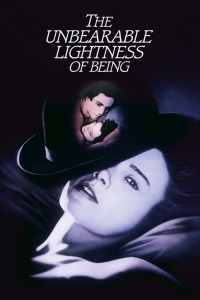
Review of The Unbearable Lightness of Being (1988) by Blake P — 10 Jul 2016
One hears of existentialism on a grand level and is more prone to shuddering and backing away than to inching inward in interest. Musings about the meaning of life, especially within the constraints of a film that's deeply into its own philosophies, are never much fun to encounter in the cinema - escapism, after all, is what most are seeking, not doom and gloom or, if we're treading down even darker paths, undulated tragedy. Being 170 minutes and endlessly understated, "The Unbearable Lightness of Being" is the casual viewer's nightmare. But for the cinephile who appreciates the rich and the cerebral and the tastefully carnal, there perhaps isn't a better dramatic epic to repose in the triumph of.
As a cross between informally analytical and unabashedly thrill seeking when it comes to movie-watching, I found "The Unbearable Lightness of Being" to be a slow but ravishingly languid psychosexual drama, as sometimes fatiguing as it is regal and effortlessly erotic. It's a movie so perfectly designed and so perfectly acted that I find myself appalled at my own reaction: it's exemplary filmmaking, and yet I see it as impenetrable and maybe even a little cold to the touch.
It's possible that my own recoiling is a direct result of the way the movie's ideas are much more empirical than its emotional content. As it takes place just as the 1968 Prague Spring was beginning to take off, anatomizing the effect the conflict had on domestic life at its peak, it studies the broad relationship between war and peace while also questioning the psychological impact adamant self-indulgence can have on a person once it begins to wane.
Because "The Unbearable Lightness of Being" is adapted from the Milan Kundera novel of the same name, the intellectual conceptions don't always make for consuming cinema. Culminating realism and highbrow psychological facilitations are engaging to a point, but in the ambit of a nearly three hour film, the drama is what should exhilarate, and the movie sometimes frustratingly refrains from the crashing of catharsis necessary to counteract its infinite mutedness.
The film finds its anti-hero in Daniel Day-Lewis, who, in "The Unbearable Lightness of Being" is Tomas, a dashing brain surgeon as skilled with the scalpel as he is with the opposite sex. A womanizer who seems to predominantly spend his free-time seducing and then ditching beautiful femmes, his life is drenched in pleasure and, in response, drains his existence of any real meaning. When we first meet him, he's still entrenched in a rocky relationship with Sabina (Lena Olin), a free-spirited artist who seems to have everything in common with Tomas. But in reality, their sex is a lot more lucrative than their conversation, therefore rendering Tomas's only real kinship as something slightly artificial.
But as he continues on his trek of meaningless bedding, he meets Tereza (Juliette Binoche), an innocent young waitress he encounters while away on business. Though she's far less world weary than the earthy Sabina, Tereza carries a virtuous spark that hypnotizes Tomas. They quickly become bedfellows and, as time slowly wanders on, they marry, much to our surprise.
Marriage, though, doesn't suit Tomas, who continues seeing other women. But when the Soviet Union invades Czechoslovakia, his and Tereza's relationship strengthens, not because Tomas suddenly becomes monogamous but because both come to realize that having each other in a world of torment is much better than loneliness. As things calm down, however, Tereza begins having doubts, and Tomas begins seeing Sabina again, which can only forge a woeful path.
Involving subplots blossom, too, most notably including Sabina's affair with a good-hearted (and married) university professor (Derek de Lint), and the association between Tereza and Sabina, who find sexual tension whirring between them any moment they're in the same room. The former is convincingly grievous but the latter is galvanic, climaxing with a brilliantly executed sequence that concerns the women taking sexy photographs of one another for Tereza's photography portfolio.
Even with its wide-ranging theatrics, though, "The Unbearable Lightness of Being" is too long and slowly paced to ceaselessly hold our attention. But its leading actors are lambent and restlessly sultry, and the cinematography by Sven Nykvist is thrivingly voluptuous in its warm and its color (and his comparatively documentary-like lensing during scenes of civil war is breathtaking). Its a sensual and stirring epic gorgeous in its artistic merit but nonetheless inaccessible in its emotional output. I'm mixed, to say the least, but that shouldn't suggest that I can't recognize it as virtuoso filmmaking.
This review of The Unbearable Lightness of Being (1988) was written by Blake P on 10 Jul 2016.
The Unbearable Lightness of Being has generally received positive reviews.
Was this review helpful?