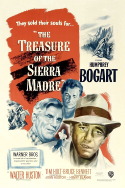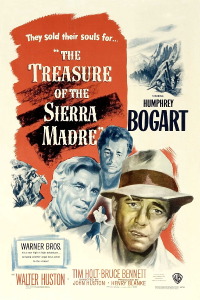
Review of The Treasure of the Sierra Madre (1948) by Jim W — 28 Jul 2010
A film about a shady down-and-outer made crazy by greed, The Treasure of the Sierra Madre is barren and downcast, the nicest character in it dies protecting men who were about to kill him, and the ending is not just a downer but like the universe peeing on the protagonist's hopes, creating a chancy undertaking not as an object in itself but as a determination, sort of a yardstick of its characters. It concerns an ethical disconnect between a foresighted old man and Dobbs, an unreasonably suspicious middle-aged man, with a young man coerced into dividing solidarity. It tells this story with enthusiasm and Huston's insatiable appetite for male brotherhood, and it periodically cracks itself up, sometimes because it's amusing, other times sourly double-edged. It transpires on a high, thickety, oven-baked terrain, mostly desert, save for the three gold prospectors, yet clans of bandits and villages of Indians actualize when needed.
The nerve center of the movie takes place on the faces of mountains, which the title names while the characters never do. They are so vulnerable in this terrain that only the old man's seasoned intuition and iffy Spanish get them through. They begin as partners, but the second they unearth real gold, Dobbs grows eager in his greed, submitting they divide their gains three ways, every night. Soon they're hiding their gold separately, and there is a long night when Dobbs awakens in the tent to find the old man gone, and then the young man rouses to find Dobbs gone, until the old man sees the turn has come back around to him and so why don't they get some sleep since they have work to do tomorrow.
"I know what gold can do to men's souls," Howard says early in the movie. He plays a diplomatic placater, agreeing with Dobbs' unreasonable ideas as he knows they will make little difference when all is said and done: Either they'll make off with their gold, or they won't. Listen to the way the senior Huston talks, bullet-time, without pause, as if he's summarizing an old story and doesn't have time to waste on detail. He does a much talked-about dance when he eventually discovers gold, playing the archetype of a gray prospector, but see how his eyes are periodically quiet even when he's playing the fool. He deduces every situation, knows his choices, tries to slow Dobbs' breakdown.
Bogart shows not a semblance of star ego in the role. He plays a character who declines firmly as the narrative progresses. The movie has never really been about gold but about character, and Bogart bravely makes Fred C. Dobbs into a lamentable, terrified, mercenary man, so out-of-sorts we begin to sympathize with him. The other two characters get somewhat what they deserve at the end of the film, and with less gratification for the audience. As the stories of the other two men dissolve into formula, Fred C. Dobbs somehow moves to a higher plane of tragedy. Hearing things in the night, despairing for a drink of water, wobbling under the desert sun with the gold he coveted so obsessively, Dobbs is the tragic hero brought down exactly by his weaknesses. There is a merciless, unadorned realism in these scenes that brings the movie to frankness and reality.
This review of The Treasure of the Sierra Madre (1948) was written by Jim W on 28 Jul 2010.
The Treasure of the Sierra Madre has generally received very positive reviews.
Was this review helpful?