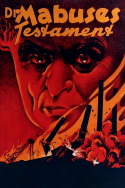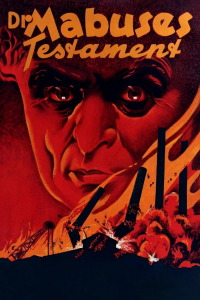
Review of The Testament of Dr. Mabuse (1933) by Mel V — 02 Mar 2005
Fritz Lang?s [i]The Testament of Dr. Mabuse[/i], a pulpy, expressionistic, crime thriller/police procedural, derives its "classic" status in large part from the historical moment surrounding production of the film. [i]The Testament of Dr. Mabuse[/i] was made as the Nazis under Hitler and Goebbels, the minister of propaganda, obtained near-complete control of German politics, society, and culture. Lang?s film was immediately banned from exhibition in Germany, due to its depiction of a Germany ridden by crime, poverty, fear, and terror, as well as Lang?s portrayal of its fictional, central figure, Dr. Mabuse, a criminal mastermind obsessed with the destruction of German society. Outside of its value as a historical, cultural artifact (and vivid set pieces), however, as cinema, [i]The Testament of Dr. Mabuse[/i] has more than its share of shortcomings, including leisurely pacing that undermines any kind of immediacy or urgency, an unnecessary, stilted romantic subplot, and a meandering storyline with a weak mystery at its core.
[i]The Testament of Dr. Mabuse[/i] opens inside a cluttered attic, as the camera pans, then travels across the room, briefly examining the room's varied contents. Objects shake and roll, due to heavy machinery located immediately below the attic. As the camera finishes its journey across the room, it (and the audience) finds a desperate-looking man, wiping his brow, obviously afraid of being discovered. His escape from the attic is short-lived, as a gang of thieves pursue across the city. The film then segues into introducing the main character, Inspector Lohmann (Otto Wernicke, reprising his role from Lang?s previous film, [i]M[/i]), a portly, cigar-smoking, work-obsessed detective with a love for German opera.
A fateful call to his office drives Lohmann into investigating the disappearance of a former associate. The trail of his missing associate leads him to a mental asylum run by an equally obsessive psychiatrist, Dr. Baum (Oscar Beregi, Sr.). Baum?s most famous patient is no other than the Dr. Mabuse (Rudolf Klein-Rogge) himself. Mabuse, first seen a decade earlier in Fritz Lang?s [i]Dr. Mabuse, the Gambler[/i], is a former, brilliant criminal mastermind (with the power to turn men?s minds to his will) turned near-catatonic resident of the mental asylum. Apparently, his double life as a respectable bourgeois doctor and criminal, has led to a permanent, irrevocable mental breakdown. Mabuse spends his hours in a near-catatonic state, staring into open space. Even in this state, however, a part of his mind remains active, planning new crimes (and writing a manifesto), all of them written down on reams of paper. Dr. Baum is understandably fascinated, even awed by Dr. Mabuse. The men are, in some respect, mirror reflections of one another. Dr. Mabuse?s plans for new crimes are mysteriously ferreted out of the asylum, and into the hands of a still active criminal enterprise.
Lang then introduces the audience to the members of Dr. Mabuse's gang, as they discuss the relative success of their crimes and the enigmatic nature of their benefactor and his plans, which make little sense to them. As their plans grow from conspiracy to theft, fraud and ultimately, murder, one of the criminals, Thomas Kent (Gustav Diessl) balks. In Lang?s world, even criminals have a moral code (or, at least, some do). Kent?s reluctance to participate in murder makes him a potential target for the hit squad inside Dr. Mabuse's gang, Section 2-B. Kent is presented as fully rehabilitated, but his criminal past means that employment opportunities are few, at least legal ones. In Lang's world, economic depression has led to the swelling ranks of criminal gangs (Kent?s attempts at obtaining legal work are presented as futile). Kent also functions as one-half of the romantic subplot, with the one-dimensional Lilli (Wera Liessem) as the other half. The scenes between the two characters are the most conventional, least engaging in the film, and also the most predictable, with the subplot hinging on a clichéd redemptive love angle.
All trails, however, continue to lead back to the mental asylum and Dr. Mabuse, whose obvious incapacitation leads in only one direction: someone has borrowed Dr. Mabuse?s identity, taking Mabuse?s writings as the basis for a series of criminal acts. It?s here, briefly, where Lang?s film ventures too close to an implicit critique of Nazi ideology. Mabuse is seen, ghostlike, speaking to his impersonator, spouting phrases and slogans that bear a close, uncomfortable resemblance to Nazi ideas. Critics point to this extended scene in particular for [i]The Testament of Dr. Mabuse[/i] banning in Germany, and while there?s some merit to the claim, contemporary viewers might find less than meets the eye (and the ear). Dr. Mabuse talks about an ?empire of crime,? but it bears only a passing, tangential resemblance to Nazism's utopian ideals. Dr. Mabuse?s ideas lead not into a a remaking of the German nation, as Nazi ideology intended, but to a violent, nihilistic end. Mabuse?s ideas do, however, match Nazi methods (i.e., fear and terror). Certainly, Dr. Mabuse?s involuntary incarceration, and his near-constant writing echoes Hitler?s own incarceration in the 1920s (where he wrote [i]Mein Kampf[/i]).
As a shadowy supergenius/criminal mastermind with almost supernatural abilities, the "man behind the curtain" (there's even a nod to the creator of [i]The Wizard of Oz[/i], both in a character's name and in Dr. Mabuse's preference to remain unseen), the character of Dr. Mabuse foreshadows the colorful villains in the James Bond novels and films, which Dr. Mabuse precedes by several decades. As a pulpy crime thriller, gripping set pieces are in abundant supply (e.g., the opening scene inside the printing press, a tense scene inside a locked room, complete with a ticking time bomb, and an automobile chase scene at the climax). As in the James Bond novels and films, the villain chooses to dispatch his adversary slowly and indirectly, thus allowing the hero a chance (and sometimes a means) of escape, but also offering the audience the opportunity to savor and enjoy the slow-building suspense, followed by the inevitable denouement. At the end of his career, only two years before the first James Bond film, Fritz Lang directed his last film, [i]The Thousand Eyes of Dr. Mabuse[/i], with Gert Fröbe as a police inspector. Frobe went on to play of the most memorable Bond villains in [i]Goldfinger[/i].
[i]The Testament of Dr. Mabuse[/i] looks toward the future of cinema, through Lang's imaginative use of sound (especially in the opening scene, as the rythmic pounding of an unseen machine contributes to a character?s mental disorientation), but also backward in time, in Lang?s use of expressionistic light, shadows, and in one memorable scene, a room full of oblique angles and half-shadows (to represent the interior state of a mental patient). The combination of expressionistic lighting and the crime genre (and its close relative, the police procedural), of course, formed the basis for [i]film noir[/i], with German directors, Lang for one, and German cinematographers (e.g., Karl Freund), leaving Nazi Germany for Hollywood before the Second World War.
Where [i]The Testament of Dr. Mabuse[/i] falls short of expectations, however, is in the superfluous, digressive, romantic subplot, and in the mildly engaging central character, Inspector Lohmann. As [i]The Testament of Dr. Mabuse[/i] unfolds, Lohmann displays singularly unspectacular detective skills. There?s little imaginative flair in his methods or in his mundane, obvious leaps of logic. Worse, Lang gives away the identity of the villain to the audience early in the film (and even before then, it's obvious from the character's near hysterics), leaving the audience several steps ahead of Lohmann for the duration of the film, making the police procedural aspects in the film less than compelling viewing.
This review of The Testament of Dr. Mabuse (1933) was written by Mel V on 02 Mar 2005.
The Testament of Dr. Mabuse has generally received very positive reviews.
Was this review helpful?