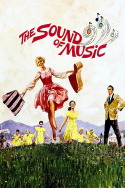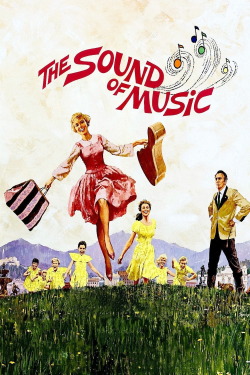
Review of The Sound of Music (1965) by Chris M — 19 Dec 2013
Who would have thought that the most popular and beloved movie musical ever made turned out to be based on a true story? And not just any true story, a true story that is in some way related to the events of World War II. On paper, taking such a story and transitioning it into musical form would sound like a recipe for disaster. But in the case of director Robert Wise's Oscar-winning "The Sound of Music" (1965), it somehow miraculously comes together very well. It helps that the story itself is a credible one to be put to music seeing that it involves singers. Also, if there's terrific scenery, cinematography, and music to accompany a plot like this, it's all the more reason to celebrate its triumphant success.
Julie Andrews delivers two enjoyable performances in a row (after her Oscar-winning turn in "Mary Poppins" (1964)) as Maria, a free-spirited Austrian nun who seems out of place alongside her fellow nuns. She is sent by Mother Abbess (Peggy Wood) to become the governess of seven children for the widowed Captain Georg von Trapp (Christopher Plummer). His strict disciplinary order in his house becomes a bit excessive for Maria, especially when it comes to the children. After she takes the children out to play and teaches them how to sing, the Captain reluctantly lets down his defenses and eventually becomes enamored with her. However, he's already set to be engaged with a wealthy socialite from Vienna by the name of Baroness Elsa Schraeder (Eleanor Parker). Furthermore, Austria is being taken over by the Third Reich and the Captain is being forced to fight in the German Navy. How will everything pan out for Maria, the Captain and his children?
To reveal anything else regarding the main narrative would involve major spoilers for those who have yet to see it. I've heard that this film doesn't accurately follow the true events it was based on (particularly that the Captain wasn't that strict, some of the names were changed, their property wasn't that massive, one of the characters is fictional, etc.). I've also heard complaints from critics saying that the film is "too sweet" as if implying that there's hardly anything at stake for our main characters save for the Nazi invasion in the final act. And frankly, I'd be lying if I said I didn't see or understand where they might be coming from. But at the same time, I have to be honest and say that I didn't mind.
First of all, you have to realize that this is a difficult kind of film to make. We're talking about a movie musical that is based on a true story, two separate things that shouldn't really be combined. Imagine a musical centered on the Boston Tea Party. Sounds impractical on paper, doesn't it? In the case of "The Sound of Music" which centers on Austrian singers escaping their Nazi-occupied country, it actually works. It helps that it's about singers since it warrants these songs being incorporated into this narrative as the children make progress on their singing skills for the music festival in the climax. Second of all, I felt like the way they handled the love triangle between Maria, the Captain and the Baroness was actually pretty subtle. Instead of being as over-dramatic as a soap opera, it feels as plausible and elegant as something like "Downton Abbey".
When it comes to the film's music, all I can say is that it's Richard Rodgers and Oscar Hammerstein. No matter what Rodgers and Hammerstein musical you see, whether it's "Oklahoma!", "Carousel", or "The King and I", you can bet that the best part is going to be the music. With songs like the immortal opening title tune, the charming "Sixteen Going on Seventeen", the inspiring "Do Re Mi" (inspiring in that finds a way to basically teach people how to sing), and the epic "Climb Every Mountain", we see this dynamic duo at the peak of their power. There's a good reason why these famous songs have been around for such a long time. They're catchy, well-written, executed perfectly by the singers singing them, and are simply filled with joy and passion all around. If the reprise of "Climb Every Mountain" in the film's final scene doesn't move you, I'm not sure what else will.
The cinematography in "The Sound of Music" is some of the best you'll ever see in film history. Remember in my review of "Bambi" (1942) when I mentioned that forests remind me of that film since it had that deep an impact on me? Well, I experienced an identical reaction with "The Sound of Music" in that mountains and lakes remind me of the Trapp family climbing up the mountain together in the end as well as the mountain, lake, and gardens in the back of the Trapp estate. When the epic scale and grand beauty of the landscapes in Austria are captured as excellent as they are here, these heavenly images will stay with you for as long as you live.
To be completely honest, I'm really rather surprised by how well "The Sound of Music" holds up many years after its release. We all know how outstanding the music is, how scenic the images on screen are, and how good the performances and singing by Andrews, Plummer, and the child and teenage actors are. But the story and the way it's told is very surprising mainly because of how much it grew on me. As I better understood the risks of taking a story that happened in real life and translating it into a palatable musical, the more I appreciated what the filmmakers accomplished. It was a treat and a pleasure to revisit "The Sound of Music" again, and I'm fairly certain that it won't be my last.
This review of The Sound of Music (1965) was written by Chris M on 19 Dec 2013.
The Sound of Music has generally received very positive reviews.
Was this review helpful?