Review of The Snake Pit (1948) by Rodolfo R — 03 Jul 2004
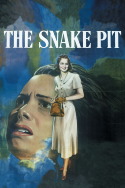
In [i]A Bill of Divorcement[/i], Katharine Hepburn repeatedly utters the statement, "There's insanity in my family." I have never been able to hear her utter that line without giggling. I have nothing against the mentally ill, she just delivers the line with such melodramatic gravity that I can't help myself. Today, I find the need to write the line for myself, for insanity runs in [u]my[/u] family. There has been something wrong with one of us in each generation, going back at least 5 generations. My grandfather was treated for his depression with shock therapy. I never really gave this fact much thought as it happened about 30 years before I was born and never knew him to be anything other than wonderful. However, today I watched Olivia de Havilland receive the same treatment in [i]The Snake Pit[/i] (1946, 20th Cent Fox) and I couldn't help but think of him. I don't know when he went through the process (he died a few years ago, so I can't ask him), but the conditions were probably similar to (or worse than) those depicted in the film.
This is my second pass through [i]The Snake Pit[/i]. I feel a special kinship with the film for two reasons. One of my heroes, Arthur Laurents, worked on the script without credit and wrote extensively about the experience in his autobiography, [i]Original Story By[/i]. The other reason I love this film, yet find it so difficult to watch, is that I have been through my own escapades in mental illness (I am currently in negotiations to turn my story into [i]Ice Capades in Mental Illness[/i]).
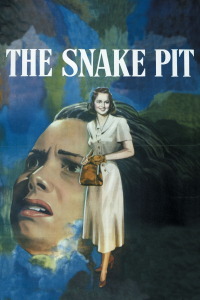
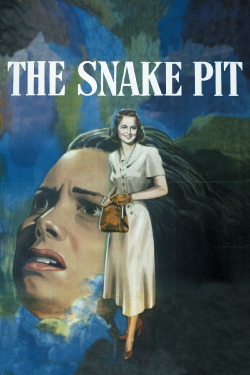
The plot is simple: Virginia Cunningham (Olivia de Havilland) has a nervous breakdown and is sent to a mental hospital for treatment. What makes this film so remarkable is not so much what it gets right (which is a lot), as what it doesn't get wrong. Voice-over is used throughout the film to give, well, voice to Viriginia's thoughts, allowing the audience to get a clearer understanding of why things aren't quite right from her point of view. We don't just hear doctors talking about her progress, we actually get a sense of Virginia's pain through this entree into her mind. What makes the device brilliant is that we don't hear her mind screaming for 105 minutes. We just get vocal windows into her state of being when the story absolutely calls for it. (The film won an Oscar for Best Sound).
There are some strong visual motifs as well. When Virginia is being interviewed to establish whether or not she is ready for release (she's not), she ends up being interrogated by a total dickweed (of course) and suffers a major relapse. Through the magic of editing, a lightning bolt appears to strike though her head, and the next shot is of her drowning in an ocean (which turns out to be a bathtub). While the imagery is melodramatic, the sight of her struggling for air establishes her mental state perfectly. I don't know if I can credit this to director Anatole Litvak, cinematographer Leo Tover, editor Dorothy Spencer or all three of them. It doesn't matter - it works.
The only time the film actually falters is at the end. Virginia gets well. This is not how mental illness works. A person with a mental disorder can control the condition with therapy and, now medication. But they don't get cured. They can become functioning members of society, but they don't get cured. They can be portrayed by Russell Crowe in Oscar-winning movies, BUT THEY DON'T GET CURED!!!
Even worse, this movie is apparently where Hitch got his brilliant idea to explain away Norman's behavior at the end of [i]Psycho[/i] because that's exectly what Litvak does here. (Laurents hated the idea. Go Arthur.).
As far as the script, I liked it except for the ending and the Bitch Nurse. When Virginia finally gets to Ward 1 (the last before release), she finds herself locking horns with the Bitch Nurse who has been promoted since administering shock treatment at the beginning of the film with more attitude than necessary. I realize that every heronie needs an antagonist, but her mental illness seemed enemy enough.
De Havilland was nominated for an Oscar for this film, but lost to Jane Wyamn for [i]Johnny Belinda[/i], which I'd have to watch again to decide who was better.
This review of The Snake Pit (1948) was written by Rodolfo R on 03 Jul 2004.
The Snake Pit has generally received very positive reviews.
Was this review helpful?