Review of The Searchers (1956) by Cameron J — 12 Jun 2014
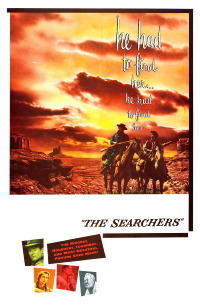
Ladies and gentlemen, John Wayne and the Searchers, the latest hot pop sensation! This does sound of like a 1960s band, and as sure as sunshine, there was, in fact, a Merseybeat scene band named The Searchers, which isn't to say that that was last time in which this film got ripped off. Oh no, by that, I don't so much mean that this had a huge impact on the formula of the western film, as much as I mean that John Wayne and John Ford were far from making similar types of western film after this, because those John boys sure did know their westerns. They won't officially come out and say it, but this just as to be the fourth installment in Wayne's and Ford's "Cavalry 'Trilogy'" (Yeah, sure it was just a trilogy), because it's Wayne in the same role, in which we find Kirby Yorke... or Nathan Brittles in the Civil War, or rather, "after" the Civil War. Hey, Ford can at least make a western that isn't necessarily about war, although Wayne just can't get off of the "pilgrim" thing, because even though he doesn't really ever call anyone "pilgrim" here, he's hanging out with Native Americans about as much as one. ...Well, if nothing else can be said about Ford and Wayne, they're at least better at coming up with material than me, or at least good material. So yeah, this film is a whole lot more watchable than this opener is readable, but, with that said, it's not like Hollywood allowed this film to really flesh out its material.
There is some genuinely weighty dramatic material here, and it is often betrayed by some safe avoidance that was common for the time, and by cheesiness which plagues much of the dialogue, as well as certain subtlety lapses, typically in the form of histrionics. This naturally romantic narrative makes the sentimentality a little easier to embrace, but melodramatic material continues to cloy, at least when stressed through the aforementioned subtlety issues, and even tonal issues. This story has some fluffier aspects, even with the Hollywood superficialities taken out of account, and when the Hollywood superficialities further lighten up the lighter aspects, the shifts into heavier elements all-out jar, resulting in a certain distancing tonal inconsistency. Pacing inconsistencies are also distancing, as the film slam-bangs exposition in some places, and outstays its welcome in others, and such a formula is not simply exhausting at times, but convoluting of a structure that is even conceptually overblown to begin with. There are many subplots and narrative layers, maybe too many, at least to handle very comfortably, with all of the inconsistencies, which, as I said, convolute the structure of the film it finds itself jarring frequently, from one segment to another, until it becomes difficult to figure where exactly the final product is heading. The focal unevenness is a huge problem, perhaps the biggest in the final product, as it, more problematic than I can easily explain, crafts an aimless narrative whose being dragged through other inconsistencies and superficialities leave the drama to run a serious risk of collapse into underwhelmingness, in my controversial opinion. Of course, at the end of the day, while I don't find the film nearly as effective as most say, I do find it rewarding as a generally inspired execution of generally intriguing subject matter.
As much as I criticize the narrative for being so convolutedly overblown with layer, upon layer, upon layer, and as much as I complain about the natural melodramatics of this romantic epic, Alan Le May's story concept, introduced in the source novel of the same name, is a grand affair, whose sheer dynamicity and scope are adventurous, and whose often weighty dramatic aspects carry a certain human intimacy that the performances help in selling. A lot of performances are dated, generally to the point of simply not being as effective as they used to be, and sometimes to the point of being pretty cheesy, but on the whole, most everyone's charisma stands the test of time, and that particularly goes for John Wayne and Jeffrey Hunter, whose chemistry and individual charm make them mighty endearing leads. As for the more dramatic elements to generally simply charming acting, they're reasonably effective enough to help in complimenting a sense of intimacy, as surely as a sense of adventure goes complimented by tasteful art direction. James Basevi's and Frank Hotaling's art direction is surprisingly subtle in this much less civilized portrayal of the Old West, but it has some decent production value, and plenty of excellent taste in locations, whose diverse grandness is near-awe-inspiring by its own right, and captured stunningly by grand cinematography. Winton C. Hoch's cinematographic excellence does not end with impressive scope to broad lensing, as the Technicolor palette is often breathtakingly rich, bouncing colors with a lushness that is about as lively as a score by Max Steiner which, for its conventions, has a lovely sweep which sustains a lively entertainment value that is driven by direction. John Ford's direction has become seriously dated over the years, but to say that it's lost is reward value is quite a ways off, as his orchestration of the style makes for some compelling action sequences, but mostly establishes a pretty solid and entertaining scope, tightened up by some intimately thoughtful elements that cut through the subtlety issues to bite pretty firmly, with tension and resonance. As a pseudo-epic portrayal of clashes within Post-Civil War Old West cultures, the film seemed to be a touch ahead of its time, and while the times, with the help of timeless storytelling issues, caught up too much for comfort here, the final product is inspired enough to reward the patient as an entertaining and compelling western adventure.
When the search is done, certain Hollywood superficialities and histrionics, as well as glaring inconsistencies in tone, pacing and, most of all focus, threaten the reward value of a conceptually worthy drama which is still done plenty of justice by the charismatic acting, immersive art direction, lovely score and cinematography, and generally compellingly tight direction which make John Ford's "The Searchers" a plenty entertaining and engaging, classic western epic.
3/5 - Good.
This review of The Searchers (1956) was written by Cameron J on 12 Jun 2014.
The Searchers has generally received very positive reviews.
Was this review helpful?