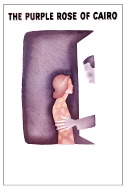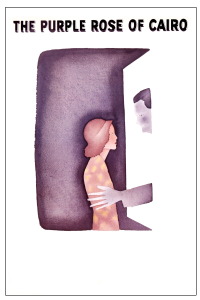
Review of The Purple Rose of Cairo (1985) by Shawne ~ — 10 Apr 2004
TPROC, I imagine, is one of those films you grow to love more and more on each subsequent viewing. Don't get me wrong--I love it now, and think it's possibly one of the cleverest, and yet most bittersweet, romantic comedies I've ever seen. But I do also feel that I have yet to really connect with the characters in a way that would raise this film above an 8 for me. I spent most of the time admiring the sheer audacity and brilliance of Woody Allen, in creating a film that is basically all conceit. Its plot is built on an outrageously pretentious idea in the first place, one that had me, at least, just semi-reeling from through the whole movie.
I know it sounds like a bad thing when I say it like that, but it's really not. So seldom these days are we so shocked by a movie--one with zero special effects, might I add, aside from the brilliant writing twist employed by Allen which forms the film's main plot point--that when we are, it's a sobering, almost distancing experience. That this film was made in 1985 serves even more as a credit to Allen than movies (read: blockbusters) do Hollywood.
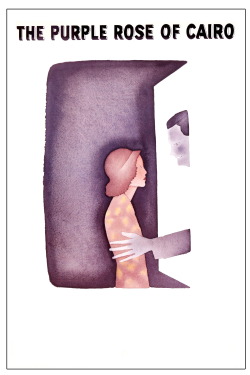
Before I completely lose the thread of my review: TPROC is about the drab, pained life of Cecilia (Mia Farrow), stuck in a deadend waitressing job and financially supporting a husband who's never around and beats her up when she is. She escapes into the world of celluloid: movies and movie stars are her release, a trip into the light fantastic where her problems seem to melt away--yes, like lemon drops, perhaps, away above the chimney tops. (I seem to have lost the thread, right about there. Anyway.) She watches [i]The Purple Rose Of Cairo[/i], a film in which the minor character Tom Baxter (Jeff Daniels), an adventurer, suddenly spots Cecilia in the audience... and in a leap of faith more literal than any a romantic hero has ever taken, jumps off the screen to be with her. Allen eschews the opportunity to make it all psychological; rather, he treats this as a real occurrence, and milks it for all it's worth, as the moviehouse's management gets increasingly frustrated and the rest of the characters left floundering on the screen become increasingly frazzled without the rest of the movie to go through. Tom romances Cecilia, confidently and smoothly, because it was "written into his character" for him to do so. Enter Gil Shepard (also Daniels), the actor that gave Tom life. He wants Tom back onscreen, to protect his own image and reputation. But little did he expect to meet Cecilia... and little did Cecilia expect to become prey to the advances of both fictional Tom, and real-life Gil.
The entire film is exceedingly clever, especially with its wry observations about the very nature of Tom's character. He doesn't bruise, nor does his hair get mussed, even after he's been roughed up by Cecilia's husband Monk (Danny Aiello). He speaks in movie couplets, romancing Cecilia with the most melodramatic words to sweep her off her feet. Perhaps my favourite little subtlety is that Tom kisses exactly as movie heroes of the 1940s used to kiss: oddly, firmly close-mouthed. And yet Cecilia proclaims it a 'perfect' kiss. When a batch of hookers led by Emma (Dianne Wiest in a walk-on role) find Tom at an amusement park one day, they are drawn to his endearing innocence--he knows only what his character knows, and all he knows is that he can't make love to anyone but the person he loves--Cecilia.
Movie love is properly sent up as well. When Tom kisses Cecilia deeply, beautifully almost, he suddenly turns... "Where's the fadeout?" he chirps. When Cecilia goes on the fictional town with Tom, their date is told the way dates of all classic movies went, with a cheap montage of the actors dancing while the neon names of bars are super-imposed over them.
But perhaps the best part of TPROC is the final message it leaves us with: a sort of perfect mixture of real-world home truths and the tiniest touch of movie magic. At the end of the movie, Cecilia seems to have no one--she's all alone. As Cecilia herself realised, real life doesn't always end in the happily ever after. That Allen recognised this, and allowed Cecilia to choose Gil in the end--real-life over reel-life, as it were--made the subtle point that, however much one escapes into the movie world, real life is always waiting. And one must always choose real life in the end. But, in a hauntingly effective final sequence, a despondent Cecilia finds herself back in the moviehouse. A lingering close-up on Farrow, intercut with scenes of Fred Astaire and Ginger Rogers creating movie chemistry to the tune of [i]Cheek To Cheek[/i] in Top Hat, follows her expression from one of depressed absentmindedness, to revived interest, and finally, to a kind of muted joy. Yes, as much as real life is always there for us, so are the movies--so are the escape valves, and the "temples for the cowards of life".
Almost any movie buff who loves films and the characters therein as much as Cecilia did will see a little of themselves in her, and understand a little of the magic that Allen pulled out of his top hat in this film.
This review of The Purple Rose of Cairo (1985) was written by Shawne ~ on 10 Apr 2004.
The Purple Rose of Cairo has generally received very positive reviews.
Was this review helpful?