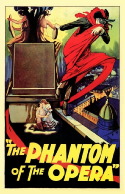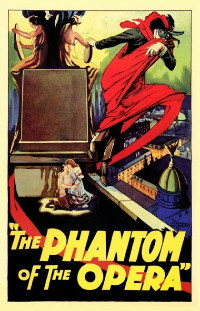
Review of The Phantom of the Opera (1925) by Matthew R — 23 Feb 2011
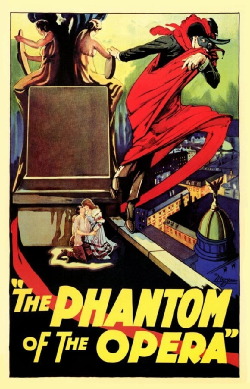
The original Lon Chaney version of the classic horror story may not be the best introduction to silent films for anyone unaccustomed to the style and pacing of pre-Vitaphone melodrama. Modern audiences are cautioned to approach it as they would any antique museum piece, forgiving the now faded visual splendor and dated histrionics to better appreciate the age and rarity of the artifact itself.
Set in 1890s Paris, "The Phantom of the Opera" is the story of young soprano Christine Daae (Mary Philbin), who with the help of an unknown tutor, has gone from being part of the chorus to become the understudy of Carlotta (Virginia Pearson), the Prima Donna. On the first night of Opera's new season, Vicomte Raoul De Chagny (Norman Kerry) assists to the show in order to see Christine, whom he loves very much. To Raoul's surprise, Christine tells him that their relationship can't continue as it gets in the way of her career, and that she must follow her tutor's orders in order to become the best singer in Paris. As this happens, strange letters have arrived to the Opera House's new management, demanding that Christine must sing the main role instead of Carlotta. Fear begins to spread among the crew of the Opera House, as it is believed that the Phantom of the Opera is more than just a superstition.
Adapted to the screen by Elliott J. Clawson, Raymond L. Schrock and the usual army of writers that would write and rewrite the many treatments of the script, the 1925 version of "The Phantom of the Opera" is surprisingly one of the most faithful to Leroux's novel. While numerous posterior versions (from Universal's own 1943 remake to the famous musical version) have played mostly on the romance aspect and the tragedy of the title character, the screenplay for this movie remains true to the novel's origins in Gothic literature and keeps the story of the Phantom deeply rooted in the horror and mystery sides of the story. The Phantom is sympathetic, yes, and the love triangle is still present, however, here he is also the complex murderous sociopath who's closer to what Leroux intended him to be. A touch of comedy is added to the script, although never too much to deviate from the atmosphere of the story.
As many have said before, it is ultimately Lon Chaney's performance what makes this version of Leroux's story to be so wonderful and enjoyable. Wonderfully over-the-top, Chaney truly becomes the misunderstood monster he plays with great talent and powerful presence, to the point of overshadowing everyone else in the cast. Still, the beautiful Mary Philbean manages to deliver an effective performance as Christine Daae, portraying the character's naiveté in a very natural and believable way. Sadly, the same can't be said about Norman Kerry, whom as Raoul is definitely the weakest link in the cast. Arthur Edmund Carewe makes a short yet very important appearance as the mysterious Ledoux, and while small, he makes his role a very memorable one. Snitz Edwards is the film's main comic relief, and while annoying at times, he gets the job done. But there's something even more memorable than Chaney's performance and the amazing art design in "The Phantom of the Opera", and that is the incredible make-up that Lon Chaney himself designed for his character which is probably the best one he ever did in his prolific career. Despite being limited by the technology of his time, Chaney designed with great creativity the now iconic "skull face" of the Phantom, just as monstrous and grotesque as Leroux intended it, proving once and for all why he earned the nickname of "The Man with a Thousand faces". Still, not everything is perfect in this movie, as while editor Maurice Pivar certainly did a wonderful job at the titanic labor of putting everything together, at times the fact that it was made by many different directors can still be felt in the pacing of the film, but still, it's unnoticeable for most part of the film.
In the end, this adaptation of "The Phantom of the Opera" is often considered as the best, and while that probably has more to do with the fact that there hasn't been a "definitive version" yet, one can't deny that this classic of the silent era has stood the test of time like few movies in history. This version of Leroux's novel is a must-see for every fan of horror.
Story: B.
Acting: A.
Direction: A-.
Visuals: B.
Overall: B+.
***1/2 out of 4 stars.
This review of The Phantom of the Opera (1925) was written by Matthew R on 23 Feb 2011.
The Phantom of the Opera has generally received positive reviews.
Was this review helpful?