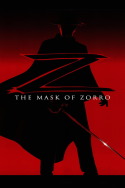
Review of The Mask of Zorro (1998) by Nick M — 30 Sep 2011
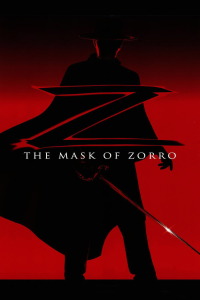
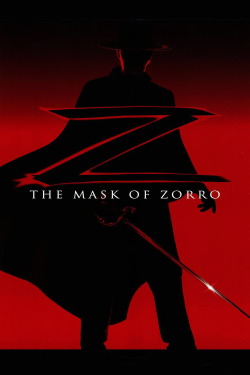
The Mask of Zorro is an action film/period piece about the legendary Mexican/Hispanic (pardon my inaccuracy) masquerader. That legend is overblown to epic proportions in Martin Campbell's summer blockbuster, which revitalized the American image of Zorro and heightened Antonio Banderas's relatively unknown career. I'm no purist on the Zorro legacy, but I'm certain that the film makes several proud homages to the original folklore.
Set in 1820 during Mexico's reign for independence, the film depicts Zorro's last ride against impeaching his mortal enemy, Don Rafael Montero. The film makes it fairly obvious that there's a good guy and a bad guy--as do most action films--but because this is Zorro (virtually a costumed superhero), the gratuity works. Shortly thereafter, we discover that Zorro's persona is unmasked by his arch-rival that same day and everything precious in Diego de la Vega's life is taken from him. Technically, this would be a spoiler but it happens so damn early in the movie that it's literally the head-starter of the premise.
Twenty long years later, de la Vega escapes to seek revenge on Montero (who has returned to the California territory, boasting of a new lee on life). Unfortunately he also has custody of de la Vega's daughter, Elena (played with enticing velocity by Catherine Zeta-Jones), and for this very reason, de la Vega cannot muster the strength to murder his old rival in cold blood--or, at least, in front of his daughter who's never away from her "father's" side. But in spite of this conundrum, de la Vega finds hope in the form of a drunken thief named Alejandro Murieta--who has a vendetta all his own. It's tricky to reveal why de la Vega would pick any drunkard off the street to supersede his image as Zorro without giving away spoilers--but let's say that it has something to do with a debt owed a long time ago in the film's prologue. For an action film where we've already seen more characterization than the average Stallone flick, this plot device suffices. Long story short, the two team up to take down Montero and reclaim Elena to her true father.
The Mask of Zorro may run off of a cliche storyline (virtually revenge, served twice), but it's the actors, the action, the sets, the music, and the energy that altogether make this film monopolize. Antonio Banderas and Anthony Hopkins have a surprisingly effective chemistry as student and master; Banderas and Zeta-Jones's onscreen presence worked so well that both the actor and actress admitted to being sexually aroused by one another. The film's villains are far from ambiguous but never become archetypal or campy--on the contrary, they're appropriately threatening. The action is cleverly placed throughout the film, allowing for the drama and adrenaline to find a convincing equilibrium (and in those mild respites, further character development evolves). I'm also further impressed, for once, to find a period piece/action film that ISN'T an Indiana Jones movie. No, Zorro is an icon of his own.
Martin Campbell has proved on numerous occasions that he is a capable director, and The Mask of Zorro is a perfect example of that. My only gripe is the film's ominous doom to stardom--which paradoxically would spawn a critically panned, and financially meek, sequel.
This review of The Mask of Zorro (1998) was written by Nick M on 30 Sep 2011.
The Mask of Zorro has generally received positive reviews.
Was this review helpful?