Review of The Man Who Laughs (1928) by Greg D — 16 Feb 2008
It has been awhile since I have seen a movie as old as The Man Who Laughs, the oldest movie I have seen recently being The Petrified Forest which was released in 1936. Of course, movies changed a lot in those 8 years including the widespread use of sound. While I have seen many silent movies and unlike maybe some in our modern times have found no trouble in enjoying movies without sound, I was still concerned. I have to admit I was a bit worried that because I had not seen a silent film, or a film on the cusp of sound like The Man Who Laughs in quite some time that I might not be able to find myself as easily engaged by the film.
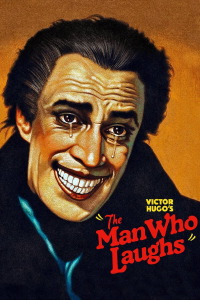
My concerns vanished as I was instantly engaged and enthralled by this story. It is a story that begins in England in 1690 with the brutal murder of a British lord by his royal enemies after learning that his son has been disfigured by a gypsy surgeon. The result is a young boy, alone and with a deformity in which is face is permanently affixed in a wide and hideous grin. The story follows this boy as he is taken in by a philosopher who turns this young boy, named Gwynplaine into an attraction, traveling from town to town making profit from his disfigurement and taking care of the naive young orphan. The philosopher and make-shift father figure for Gwynplaine also cares for a baby Gwynplaine found in the arms of her dead mother, presumably dead from exposure during a harsh winter. This young girl, Dea is blind and the three of them, with their dog look after each other. As Dea grows she falls for Gwynplaine, but he feels unworthy of her love, for he views himself as a freak.
The most valid criticism for this movie is a plot that borders on melodramatic at times and is often contrived, including the Lassie-like leading by the skirt of Dea by the above mentioned dog, who is loved by those in Ursus's traveling show.
The most remarkable aspects of the film however out-weigh any criticism, just or otherwise. The crowning achievements being the incredible performances and the heart warming, yet ill-fated love story between Gwynplaine, as played by the famous German actor Conrad Veidt and Dea, as played by the silent star and 1920s Hollywood beauty, Mary Philbin.
Amongst the notable performances is Olga Baclanova (who bears a striking resemblance to a young Madonna in this film) who plays a scandalous young Duchess who's existence throws a monkey wrench into the love affair between Gwynplaine and Dea. Her scenes with Conrad Veidt were infamous and lewd for the time and modern audiences will be amazed by how much skin she shows as we witness her bathing, seducing Gwynplaine and partying at the local fair.
Also notable is Brandon Hurst who appears as the villainous jester to the King who assists in the death of Gwynplaine's father and his disfigurement. Perhaps the most sinister character in the film, his performance is sufficiently dark and twisted, and quite enjoyable to watch!
Cesare Gravina plays Ursus, the compassionate manager who supports both Gwynplaine and Dea with the profits of his traveling show. Gravina's character is vibrant and theatrical and enjoyable to watch.
Mary Philbin breaks your heart as the poor naive blind orphan. She is a simple girl who has fallen for a man that perhaps no other woman could love. She is overwhelmed by the world around her and helpless were it not for the care of Ursus and the love of Gwynplaine. Her performance still continues to bring heartache to audiences who sympathize with the plight of this unfortunate and beautiful young woman. It is no wonder she was such a huge star of the 20s. Her last role in movies was in 1929 in After the Fog which was released the same year she turned 27. She soon withdrew from public life after her parents refused to let her marry the love of her life because he was Jewish. Her family being staunch Catholics. She soon abandoned her film career and lived a life of self-enforced celibacy. She lived alone, secluded from the outside world for the most part, in the same house she lived in during the 1920s until she was rediscovered to be alive in the 1960s. She began to suffer from Alzheimer's in the 1970s and died in Huntington Beach California in 1993. One wonders what she might have accomplished with her career had she not retreated from Hollywood so young in her life.
The crowning performance however in The Man Who Laughs is Conrad Veidt, who convincingly plays two roles in the film, both Gwynplaine's father (who only appears in the film for a short time) and Gwynplaine. It is only on close inspection or research that one can tell he is both characters in the film. Despite the fact that this German born actor did not speak English when The Man Who Laughs was shot and despite the fact that he had to wear a set of prosthetic teeth that forced his mouth into a smile with the use of tiny hooks his performance is absolutely masterful. With simply the use of his body language and eyes he is able to bring to life this character and invoke emotions in the audience. He is a naive and simple character who finds himself wrapped up in political and social pressures beyond his control, but his character grows through his hardships and through the separation that occurs between him and his only true love, Dea and becomes a man, transformed by adversity. This journey is expertly conveyed by Conrad Veidt who perhaps is best known by film enthusiasts for his performance in The Cabinet of Dr. Caligari, a film lauded as a German horror masterpiece. Veidt however, played roles in well over a hundred movies during his 27 years as a screen actor.
The Man Who Laughs has many connections to pop culture. Apparently Conrad Veidt was even supposed to play Dracula, the role that instead was played by Bela Lugosi. Also, the ambitious and costly undertaking to make this epic film, The Man Who Laughs, was inspired by the success of such silent classics as The Hunchback of Notre Dame and Phantom of the Opera. It is also said that Bob Kane's inspiration for the look of the Batman's most infamous foe The Joker was inspired by the character Gwynplaine.
Conrad Veidt died in 1943, but not before his appearance in another important and ominous role in a movie that many consider the ultimate classic film and perhaps one of the most influential and critically acclaimed films of all time, Casablanca as Major Strasser, the despicable Nazi. He acted in one more movie after Casablanca and soon died of a heart attack.
The Man Who Laughs is masterfully shot with great attention to detail. The cinematography being inspired and executed in a German expressionistic style. German films of the time were significantly darker then the vast majority of American films and emphasized shadow, rather then light. Director Paul Leni achieved the impressive look and feel of the film by collaborating with some wildly talented film legends. Gilbert Warrenton was the cinematographer, Jack Pierce (best known perhaps for his work on Frankenstein) executed the make-up and Charles D. Hall functioned as the art director. The Man Who Laughs is a big budget Hollywood film shot and released on the cusp of sound. It is filled with magnificent performances by outstanding actors, and despite the grand scale and exorbitant budget is filled with a lot of heart and emotion. The Man Who Laughs holds up impressively well, even 80 years after it's initial theatrical release.
This review of The Man Who Laughs (1928) was written by Greg D on 16 Feb 2008.
The Man Who Laughs has generally received very positive reviews.
Was this review helpful?