Review of The Man Who Laughs (1928) by Damon K — 19 Oct 2009
The story revolves around a man called Gwynplaine played by the great Conrad Veidt. His father is Lord Clancharlie who has recently returned to his lands from a forced exile in order to see his son. He is discovered and captured by the local ruler and eventually consigned to death by torture. In a particularly sadistic move, before he is put to death he is informed that his son has been given to an infamous band of gypsies known as the Comprachicos. They use surgeons to perform operations on children in order to affect permanent comedic expressions who they then sell off to sideshows and aristocracy in need of jesters. Lord Clancharlie goes to his grave bemoaning the fate of his son and prays to God to look after him.
As luck would have it King James of England has had enough of the Comprachicos presence. He orders them to leave the country under pain of death. The comprachicos, fearing that young Gwynplaine could be used as evidence against them no matter where they go, abandon him on the wintry shore as they flee the country and sail off to parts unknown. Confused and alone, Gwynplaine wanders through the countryside in the harsh winter storm. He comes across a woman who has died of exposure but notices that the baby she cradles is still alive. Instinctively he takes the baby and continues on through the storm.
Eventually he comes across the small wagon house of Ursa the philosopher/entertainer and his faithful dog. Horrified by Gwynplaine's condition and pitiful of the small girl he is carrying who he realizes is blind, he takes them both in and decides to raise them as his own. The years pass and Gwynplaine and the girl he found now known as Dea have grown to adulthood and have fallen in love. But although Dea loves Gwynplaine unconditionally, he still keeps her at arms length and refuses to allow her to touch his face as he is keenly and painfully aware of how hideous and foolish he appears to the common man.
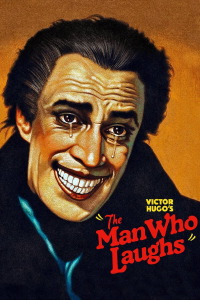
Ironically, Gwynplaine and Dea have become a big part of Ursa's travelling entertainment show and Gwynplaine has made quite a name for himself as "The Laughing Man". Although he is famous, his permanent visage elicits nothing but laughter and no matter what his true feelings are at any given moment all people can do is point and laugh at him. He is treated kindly by Ursa and he clings to Dea for comfort but this is always tempered with an inner anguish that he strives to keep from his loved ones. But eventually somebody from his past realizes who he must be and because of his connection to the court and the danger his existence could cause a series of events are put into motion that will forever change all of their lives.
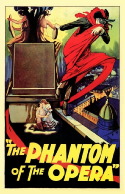
The Man Who Laughs is a perfect meeting of several elements that combined to create quite a stellar picture. Although sound was creeping into the world of film, the great director Paul Leni was keen to direct another silent film in the vein of Hunchback of Notre Dame. The success of Hunchback easily greenlit Leni's project and he was allowed a very large budget for the time and he assembled quite a cast of outstanding performers and technicians. Mary Philbin as Dea had just come off of Phantom of the Opera to great success and, although the part was of Gwynplaine was originally hoped to be filled by Lon Chaney, studio alliances would not allow it but instead they got the great Conrad Veidt who had starred in The Cabinet of Dr. Caligari in 1920 and who was quite available.
The movie itself in plot is very much a dramatic film and Veidt playing against his normal role of the heavy villain instead took up the role as the sad victim in Gwynplaine. The plot is tightly focused and relatively free from an excessive amount of lengthy ambiguous mood narratives that are sometimes the trademark of German horror expressionism. Yet despite this the film is heavily steeped in gothic and the German expressionistic aesthetic as a natural surrounding despite the relative simple narrative. This imagery is so pervasive that although the story would have you believe it is a simply melodrama one comes away so heavily affected by the tone that it comes across as a legitimate horror film.
The acting by Conrad Veidt and Mary Philbin is just nothing short of incredible. Although their roles are just so chock full of tragedy and intense drama, their actions and reactions, particular towards each other, come across as quite natural and relatively free from excessiveness that can easily come out with characters and situations of this nature. Mary's reactions are just so spot on and rather surprising at times that you never really question her emotional reactions despite the extreme nature of their situations. Conrad Veidt is just flat out amazing! He had to wear a very painful device which contorted his face to the point that he could not talk and in effect paralyzed the entire bottom portion of his face. Yet despite this limitation he conveys an amazing amount of emotions with his eyes and although these are at times not noticed by people in the film, it is very obvious to the viewer just exactly how Gwynplaine truly feels.
A gorgeous film to view and a pleasure to watch due to the great acting I can't recommend this movie enough. About the only negatives that I can bring to bear is some of the common man shaking his fist at society and the aristocracy that tends to litter Victor Hugo novels. It's not terribly by any means but it does come across as a little heavy-handed and preachy in spots. Then there's the fact that the ending of the movie is quite a different from the original ending of Hugo's novel. Yes the movie has a happier ending and it's still quite satisfying, but the original would have really felt like a powerful full circle in the life of Gwynplaine's life if they kept it. Regardless it is still a stellar movie that I highly recommend.
This review of The Man Who Laughs (1928) was written by Damon K on 19 Oct 2009.
The Man Who Laughs has generally received very positive reviews.
Was this review helpful?