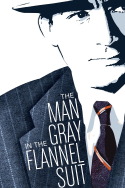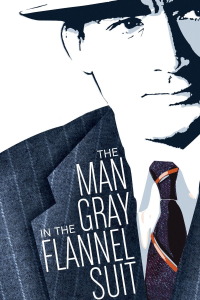
Review of The Man in the Gray Flannel Suit (1956) by Monsieur R — 21 Sep 2017
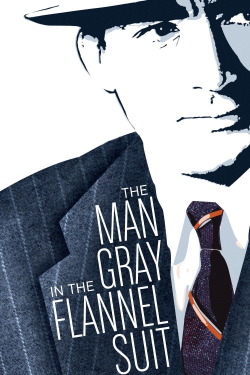
The Man in the Gray Flannel Suit is a sublime look into the lives of returning WWII war veterans. The Man in the Gray Flannel Suit, by Sloan Wilson, is a novel published in 1955 about the American search for purpose in a world dominated by business.
Some get elevator jobs, like a fellow war veteran of Peck's, while Gregory Peck gets the good job as an executive writer at some million dollar company. So starts our film.
Men leave America, indeed men leave homes all over the world, to kill or be killed or at least be a part of the killing. Our lead actor, Gregory Peck, is just one of many who lands a great job in corporate position in New York City, at a mere $7000 a year (salary adjusted this would be more like 70,000 a year).
Gregory Peck, and his nagging, pushy wife Jennifer Jones get things going in this film with their modest home (which always dissatisfied Jones hates) in the suburbs. Peck is ok with the home, but Jennifer whines and harps on Peck about her dislike of the home and her desire for Peck to be more ambitious, a fighter she says, like the one she married. (this scene made me vomit).
Of course, Peck who knew and admits in the film he killed 17 people up close and personal and not from a distance, has a different view of the world. Jones was a stay at home girlfriend of Peck who didn't suffer more than a paper cut, but she has the audacity to tell Peck how to act and how to do things. The book, we are told in the special features (watch it if you can), never had her being so "bitchy".
As the film progresses, we detect a huge difference between home and office. This is what the film is all about. The corporate head played by Fred March is atypical in my opinion. I have met in my corporate life vice presidents and lower who were never this socialable or kind. Of course, our lead actor Peck gets favorable treatment because he reminds our corporate head of a son he lost in the war. This stands Peck in good order as he gets fired from his new position by his unfeeling boss, only to hang on because of the Fred March connection.
Family or success, this is the ultimate question. March bemoans giving up his family life for the role he now plays and advises Peck to not neglect his family. Peck later refuses to obey March because of his strained marriage. It seems he had a child back in the war years with a girl he truely loved. Of course, this is a problem the married Peck must face at some point with the never understanding Jones.
Jones keeps pushing the honesty line on Peck, but when Peck gives her a dose of honesty she goes nuts and wants to leave Peck. He lets his secret be known to her after a girl he left behind during the war needs funds to live in Italy. There is a boy, not sure if its his (how could it be? He only knew her for a few days and she admitted at the time to him that she was pregnant).
This is a very powerful film built on a best selling novel at the time. Its about memories, secrets, money, ambition and peace of mind. Due to Gregory Peck's impecable performance, a necessary addition to any film student's library.
Highly recommended, it has no special effects, no perversion, no nudity, no profanity. It does have some WWII scenes which are pretty graphic and intense. It is undoubtly slow paced for moviegoers today but uses Cinemascope to great effect.
Most likely because of the above it would not have succeeded in todays market...
NOTES about the film:
1 In the end, it is a story of taking responsibility for one's own life. The book by Wilson was largely autobiographical, drawing on Wilson's experiences as assistant director of the US National Citizen Commission for Public Schools.
2 The film was entered at the 1956 Cannes Film Festival.
3 Both movie and book became hugely popular. The novel continues to appear in the references of sociologists to America's discontented businessman.
4 The Man in the Gray Flannel Suit II appeared in 1984 - by the time of the sequel a decade has passed in the story-line.
5 In an episode of The Honeymooners, Ralph Kramden is startled when Ed Norton emerges from a manhole in full sewer worker gear. Norton replies, "Who did you expect, the man in the gray flannel suit?".
6 Starring as Bones in TV's Star Trek, DeForest Kelley appears in this movie as a medic in one of the war scenes. Appropriately, his lines generally consist of variations of "This man is dead".
Cast.
Gregory Peck - Tom Rath.
Jennifer Jones - Betsy Rath.
Fredric March - Ralph Hopkins.
Marisa Pavan - Maria Montagne.
Lee J. Cobb - Judge Bernstein.
Ann Harding - Helen Hopkins.
Keenan Wynn - Sgt. Caesar Gardella.
Gene Lockhart - Bill Hawthorne.
Gigi Perreau - Susan Hopkins.
Portland Mason - Janey Rath.
Arthur O'Connell - Gordon Walker.
Henry Daniell - Bill Ogden.
Connie Gilchrist - Mrs. Manter.
Joseph Sweeney - Edward M. Schultz.
Sandy Descher - Barbara Rath.
Directed by Nunnally Johnson.
Produced by Darryl F. Zanuck.
Written by Nunnally Johnson (screenplay).
Sloan Wilson (novel).
Music by Bernard Herrmann.
Cinematography Charles G. Clarke.
Editing by Dorothy Spencer.
Distributed by 20th Century Fox.
Release date(s) May 8, 1956.
Running time 153 min.
This review of The Man in the Gray Flannel Suit (1956) was written by Monsieur R on 21 Sep 2017.
The Man in the Gray Flannel Suit has generally received positive reviews.
Was this review helpful?