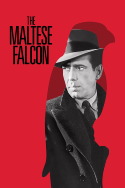
Review of The Maltese Falcon (1941) by Erik R — 12 Jan 2014
Yeah... so The Maltese Falcon! One of the penultimate classic films, only barely less so than (maybe) Citizen Kane & Bogart's later Casablanca. It is a classic, no doubt about it. It heralded the rise of Humphrey Bogart's career. It was John Huston's directorial debut and Sydney Greenstreet's acting debut. it began the natively American style of film noir. No one can seriously question the Maltese Falcon's place in film history.
But it is not 1941. I have already seen a great deal of noir and neo-noir films, complete with the anti-hero and all the other noir fixins. I have seen films in color and films with special effects indistinguishable from reality. The simple reality is that old films, once you get rid of the nostalgia factor, rarely hold up to modern film standards. Yet people talk about The Maltese Falcon as if it not only matches. but even exceeds, modern films.
Well... it doesn't.
Now don't get me wrong, there's a lot to like about this film. It has a snappy, quotable script (which was essentially lifted word for word from the Dashiell Hammett's novel - which I had read before seeing the film); there were some fine performances, particularly from Peter Lorre and Sydney Greenstreet. It's a spare, economic film; no wasted scenes, no wasted dialogue. I particularly appreciated that, as that's how Hammett - and my writing hero Raymond Chandler - write. And of course, I love noir itself. I love the anti-hero, the tough guy, the no-nonsense approach. I mean, the book I'm writing now is neo-noir for chrissakes. Noir to me is like honey to a bee and this film is plenty sweet.
The Maltese Falcon is also lauded for its cinematography, which tends to be the default criterion that people cite (next to acting) as a reason for a film's awesomeness. Course nine times out of ten, if you ask them to explain, they can't. TMF's cinemotography is OK. Particularly well-cited is a famous seven-minute shot. That's no mean feat, but I'd be more impressed had I never seen Children of Men. And anyway, solid camera-work does not a good film make.
So yeah, there's some nice high notes to The Maltese Falcon.
But there is SO MUCH WRONG WITH THIS FILM:
The film essentially begins with a long, expository speech from Mary Astor's character. Euuuuugh! Beginning a story with exposition. Gross. Now of course a lot of films do this: Star Wars' wall of scrolling text probably one of the more famous. It's easy, and gets the job done, but it's inelegant and boring. In the case of TMF, it sets the tone for the film...
...which is essentially a series of conversations held in particularly boring interiors. I mean, really boring interiors. I know that was on purpose, but overall the film is stylistically flat. Considering its status as the father of noir, I was expecting it to be dripping with style. It isn't...
...nor is it full of suspense or danger. The major 'threat' in the movie is such a joke that there's never any sense of danger. Which might have been better...
...with an actress other than Mary Astor playing the femme fatale of the film, Brigid O'Shaughnessy. Now, in the book, Brigid comes across as sexy, attractive, seductive. I, at least, found Mary Astor completely unconvincing. Not only is she not that attractive (certainly can't hold a candle to Casablanca's Ingrid Bergman), but she's not at all seductive...
...which especially becomes a problem when, near the end, Mary Astor and Humphrey Bogart start talking about "true love." That, after a single kiss and maybe an hour of time spent together. Now I'm not knocking the potential of flash love, but there is ZERO on-screen chemistry here. That love element feels totally fake and forced though it could have been better...
...except for the Hays code. In the book, Bogart & Astor's characters have sex. And at one point, Sam Spade (Bogart) makes Brigid O'Shaughnessy get naked to search her. Not here. Instead...
...we get a nod and a wink and the usual anti-women attitudes, common in that time. And that really sums it up to me. It's a good film, for its time. But these days...:
Final Say: With the Maltese Falcon, I came to realize that much of my strife with older films comes from their more theatrical leanings. You see, modern films are voyeuristic - the camera is meant to be a window into the lives of other people who are behaving as if there were no audience, no camera.
However, older film was much closer to its theatrical roots. A Shakespearean actor may not ever address the audience directly, but he's always aware of them, directing his words and his actions TO the audience. But even beyond that, the very sensibility of theater is more symbolic than naturalistic. It's meant to be a little stiff, a little histrionic, a little heavy-handed. It's art, damn you, and if its entertaining too, well good.
To my mind, that makes it inferior. There's a reason that film has evolved the way it has (and it's not because today's audiences are ADD, action-junkies thank you very much), just like there's a reason that films adopted sound, and then color. It makes the experience better, richer, more vibrant.
So, while I fully concede and affirm The Maltese Falcon's iconic status, I nevertheless suggest that - when compared on equal terms with today's film - it's really not that great. Frankly, the neo-noirs that it inspired blows it out of the water. I refuse to believe that anyone would ever tell me, with a straight face, that The Maltese Falcon is a more enjoyable movie watching experience than the likes of say, Bladerunner or Chinatown or Taxi Driver, or newer fare like LA Confidential or Brick or Kiss Kiss, Bang Bang.
How to Watch It: As a classic - with appreciation for its role in establishing film noir.
Or if you can have your memories erased of modern films - it'd probably be amazing then too.
Trivia: I earlier mentioned that the Maltese Falcon was restricted by the Hays Code, which was a series of moral guidelines created to clean up Hollywood's image as a corrupt institution. The basic concept was thus: "...if motion pictures present stories that will affect lives for the better, they can become the most powerful force for the improvement of mankind." I got a good chuckle out of that.
This review of The Maltese Falcon (1941) was written by Erik R on 12 Jan 2014.
The Maltese Falcon has generally received very positive reviews.
Was this review helpful?