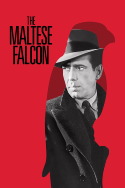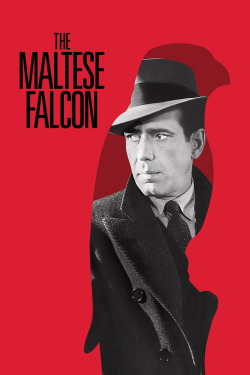
Review of The Maltese Falcon (1941) by Filipeneto — 08 Aug 2020
This is probably one of the most compelling classics in noir movies. It is a style that even today has passionate and faithful followers, and sometimes reappears in cinema, whether in the form of simple tributes or even in the form of a kind of "neo noir" that we can see in films like "Shutter Island", "The Black Dahlia" or "Mulholland Drive".
The story of this film revolves around a statuette of a falcon, made of gold and precious stones, an ancient artifact that an order of knights - which the film clarifies at the outset to be "the Knights Templar of Malta" (I will talk about this later) - offers in the 16th century to Emperor Charles V in exchange for the Mediterranean island of Malta. According to the story of this film, the object was lost and never reaches the hands of the emperor. In this film its the search for the artifact that motivates a crime that is investigated by a detective, alongside the police.
The biggest problem I had with this film lies in the historical premises on which the script was built. It may seem petty, but I am a historian and I value a certain historical rigour. That is why the expression "Knights Templar of Malta" gives me chills of horror as it mixes and confuses two orders of cavalry that should not be confused. One is the Order of the Temple, or the Knights Templar, which has nothing to do with this film, and the other is the Order of the Hospital, or Order of Malta. The Knights Templar were founded after the conquest of Jerusalem in 1099, at the end of the First Crusade. The order became very rich, acquired land, prestige and power, aroused envy. Persecuted by the French king Philip IV, it was extinguished by Pope Clement V in 1312. The Order of the Knights of St. John, or Knights Hospitallers, was also founded after the conquest of Jerusalem and also enriched but was never extinct and still exists today, with another name: Sovereign and Military Order of Malta. This is due to the fact that, when Jerusalem was lost by the Christians, the knights moved their headquarters to Cyprus, then to the island of Rhodes until, finally, they settled on Malta in 1518. The island, then part of the territories of the Crown of Aragon, was ruled by the Germanic emperor Charles V, who was also the king of Castile, Leon and Aragon (today Spain), as Charles I. Calling Templars to the Hospitallers Knights is, thus, a gross history error, almost like saying that Lincoln founded the United States of America, or that Napoleon I was the last king of France.
The film is dominated by the presence of Humphrey Bogart. A great actor from the golden age, he is excellent and I just found it difficult to keep up with him when he accelerated his speech and ran over words, making it difficult to understand what he was saying. I also liked the performance of Gladys George and Mary Astor, which surprises us in the end with an interesting but somewhat obvious twist. In turn, the character of Peter Lorre struck me as a bit of a caricature. The film has a lot of dialogue and it can be a bit boring, especially for those who expect a little action, but I handled it well except for Bogart, as I said.
Technically, its a discreet but very competent film, with quality production values. It has excellent cinematography, with impeccable and original shooting angles and camera work. Its relatively high contrast looks good on the screen and makes the film visually pleasing. The light and shadow effects and lighting are truly superb. The sets are routine but elegant, the costumes are excellent with all the raincoats and fedora hats we could wish for. Of course, cigarettes and alcohol couldn't be missing, and I don't see any problem with that.
This review of The Maltese Falcon (1941) was written by Filipeneto on 08 Aug 2020.
The Maltese Falcon has generally received very positive reviews.
Was this review helpful?