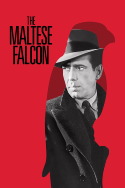
Review of The Maltese Falcon (1941) by Blake P — 19 May 2015
The Bible forbids us from murder, adultery, and theft, but the characters in "The Maltese Falcon" do not have the time to think about their eternal fates in the fiery pits of Hell. They do have time, though, to worship a little black bird statuette encrusted with the finest jewels in the world - and if they have to act against one of The Ten Commandments to get their paws on its onyx beak, so be it. Just thinking about The Maltese Falcon causes their eyes to glaze over, their mouths to water for the thirst of wealth.
As Roger Ebert points out in his glowing review of 1941's "The Maltese Falcon", the film isn't just a classic audiences have come to fawn over over the years. Consider film noir didn't exist before "The Maltese Falcon" was released. That Humphrey Bogart was still a character actor hiding in the shadows of James Cagney and George Raft. That Peter Lorre and Sydney Greenstreet were not yet the supporting player dream team doomed to live on the exaggerated pencils of caricaturists then and now. That John Huston had never directed a film before.
I saw "The Maltese Falcon" for the first time five years ago, sitting in the pitch-black room of my grandfather's study with his dinosaur laptop on a Saturday night. Then, I was just becoming acquainted with black-and-white films, only familiar with the likes of "The Big Sleep" and "The Major and the Minor". All too young then, I found "The Maltese Falcon" to be too talky, to not have enough action. In my original review (my second, to be exact), I cited it as an overrated classic. How times have changed.
It's talky, but not too talky; it's a classic, but not an overrated one. It's a cynical character study, the characters greedy, self-indulgent liars on the prowl for unfathomable riches. Instead of liking them, we're fascinated by their methodical actions. We don't connect with them on a human level; we feel the need to unravel their stacked façades, pulling apart the rambling lies and accidental truths spat out in an attempt to double-cross an obstacle.
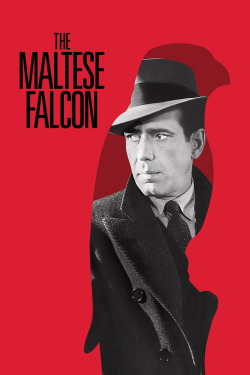
In his (arguably) career-defining role, Humphrey Bogart portrays Sam Spade, a smug private eye hired by the beguiling Miss Wonderly (Mary Astor). Wonderly claims that she is being hounded by a man named Floyd Thursby, needing immediate protection. Sam, nor his partner, Miles Archer (Jerome Cowan), believe her shaky story, but money talks, and she happens to have a lot of it. Later that night, while shadowing Thursby, Archer is shot to death in an alleyway. Thursby, as it turns out, was murdered that night too.
Like all great film noir films, things are much more complicated than they first appear. Miss Wonderly's real name is actually Brigid O'Shaughnessy, and O'Shaughnessy isn't just a sexy dame gliding into detective agencies with falsely dramatic stories. She is actually a sinner desperately trying to get her hands on an international treasure otherwise known as The Maltese Falcon. Encrusted with gleaming gems, it is worth thousands. Also frantic for the treasure is Joel Cairo (Peter Lorre), a mysterious European who walks around with a cane and flowery handkerchiefs, Kasper Gutman (Sydney Greenstreet), a cackling, walrus-sized socialite, and his sidekick, the mousy Wilmer Cook (Elisha Cook Jr.).
As the MacGuffin of the jeweled falcon hangs over the heads over the characters, all we can manage is a sense of bewilderment; they are so caught up in their lies, their temptations, that gone is their moral compass, their common sense. The masquerades they put on for Spade, who acts as both a potential fellow shareholder and an outsider, cross the line, in their own psyches, that is, between the real and the fake.
Though "The Maltese Falcon" was adapted twice before, once in 1931 and again in 1936 as "Satan Was A Lady", the 1941 version bears the most distinct personality. In a world of detective agencies, trench coats, cigarette holders, and femme fatales, it is a carnival of film noir tropes before film noir tropes were even a thing. The dialogue is fiendishly clever, all characters putting on an act for the other at all possible times; Huston's direction is equally intelligent, complementing the auras of the characters with subtle camera tricks while keeping a sense of humor hanging above the dark motives of the plot.
Just as unmistakable in memorability are the actors. Bogart's sniveling but tough persona is put to good use - in other films, he's a sort of grizzled good guy; in "The Maltese Falcon", he's an anti-hero perhaps as greedy as the men he's trying to dig dirt on. Astor is the ultimate femme fatale, always seductive, always untrustworthy; Lee Patrick, as Spade's faithful secretary, leaves an impression with her adept tactics. Greenstreet and Lorre completely subvert the pitfalls most character actors face, immediately so large in their presences that Bogart and Astor frequently feel like supporting actors.
Still more witty, unforgettable, and clever to me is "The Big Sleep" - "The Maltese Falcon" comes at a close second. While it isn't as labyrinthine as the former, it is much more sordid and embracing of its corrupt patina. There isn't anything like it - few crime films are as convincingly acidic.
This review of The Maltese Falcon (1941) was written by Blake P on 19 May 2015.
The Maltese Falcon has generally received very positive reviews.
Was this review helpful?