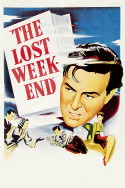
Review of The Lost Weekend (1945) by Edith N — 07 Jun 2011
I'm Up Here With the DTs.
You get odd looks from people if you tell them that you don't drink. I have observed this many times over the years, given that I don't. I've even stopped taking Polite Sips of Homebrew. And one of the reasons for this is that I spent my childhood at least in part with a roaring drunk. I still refer to the man as Drunk Uncle Paul, even though I'm given to understand he got sober. Though of course I don't know if it lasted. There are lots of other reasons I don't drink, but the fact is, I saw enough of Uncle Paul drunk, and he was pretty unpleasant. So I don't need that any time soon. I don't know if Uncle Paul ever ended up in a drunk tank; I assume he did at least once or twice. Still, I don't need to know if he did or didn't to know that alcoholism is not for me. What's more, I fight so hard for control of my emotions that I can't understand the level of giving it up voluntarily that you get when you get drunk.
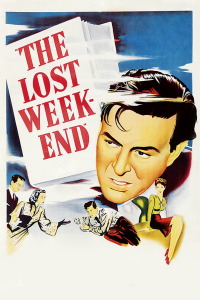
Don Birnam (Ray Milland) is supposed to go away for the weekend with his brother, Wick (Phillip Terry). This is because Don is ten days sober from a bender, and they want to get him out of town for a while. His girlfriend, Helen St. James (Jane Wyman), wholeheartedly encourages this. Wick has been paying Don's bills, and Wick and Helen don't want to stand around while Don drinks himself to death. But he manages to convince them to leave him alone, and then he steals the ten dollars Wick keeps in the sugar bowl to give the cleaning lady, whose name I don't remember, and goes off on a bender. Along the way, he does such things as steal a woman's purse and try to trade his typewriter for a drink. He even ends up in a drunk tank at Bellevue overnight, though he does manage to escape. To these depths has he sunk, and with luck, he will be Saved by the Love of a Good Woman.
I've read that I'm missing the real perils of that drunk tank--apparently, I'm supposed to see "Bim" Nolan (Frank Faylen) as gay and propositioning Don, but I don't. And, of course, there's the fact that Book Don would only mostly be upset about it. Or more accurately, his bender was caused by the fact that he wouldn't be upset about it, and that part upset him. If you see what I'm saying. Honestly, the only person Don comes across as being in love with in the movie is Don. Yeah, it's nice to have that Helen girl around, but he takes it for granted. He toys with Gloria (Doris Dowling), getting her to break off a "business engagement" and go out with him instead, except he gets drunk and stands him up. The drinking is tied up here with writer's block, but I'm not sure I believe the guy as a writer. And if he is, he's like Philip Boyes in [i]Strong Poison[/i], who thinks it's the duty of society to care for the Great Artist. After all, he takes it for granted that Wick will take care of him.
But it is rather surprising that the movie was made inasmuch as Don was an intelligent, middle class guy. He went to Yale. I'm not sure what Wick does, but it's something involving an office. They discuss the prospect of going to a country club while they're out of town. And honestly, even today, people like that don't tend to be Movie Alcoholics. That doesn't happen to People Like Us. William Powell can suck up thirty martinis over the course of a ninety-minute movie, but he isn't an alcoholic. He just likes to drink. And Nicolas Cage can drink himself to death in Las Vegas, but he isn't Like Us. He's . . . well, he's Nicolas Cage. But most of the time, you wouldn't notice anything was wrong with Ray Milland if you passed by him on the street. It's obvious as he searches for a pawn shop open on Yom Kippur that he needs money and needs it bad, but you wouldn't necessarily know it's because he needs a drink. When Helen meets him, he's desperate for the bottle of rye in the pocket of his coat, but she doesn't catch on. Though of course his landlady knows.
I think we're given the happy ending because the movie doesn't want to acknowledge entirely that there are People Like Us who are also alcoholics. Jane Wyman (we've been seeing a lot of her lately, haven't we?) will get him out of it. Everything will be okay in the end. Only I don't think it actually will. I think we're just seeing one more moment when things are looking up, and they're going to go back down again. Don says that he's tried various treatments, that they don't work for him. And it's possible that he just wasn't ready to quit. However, what I think is more likely is that everyone's getting their hopes up too soon. I mean, Nat the Bartender (Howard Da Silva) brings back Don's typewriter, for heaven's sake. The idea that all of that would happen at just the right moment for Don to put down the booze is a little far-fetched. A shame, really; the rest of the movie makes it look as though alcoholism is a real problem. But not, I guess, if you've got Jane Wyman on your side.
This review of The Lost Weekend (1945) was written by Edith N on 07 Jun 2011.
The Lost Weekend has generally received very positive reviews.
Was this review helpful?