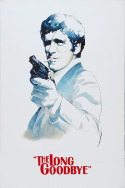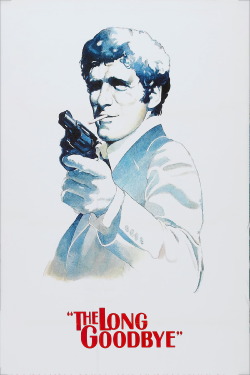
Review of The Long Goodbye (1973) by Stephen T — 22 May 2015
To get a sense of time and place, director Robert Altman experimented with The Long Goodbye. The film is not perfect by any means (questionable dialogue, questionable characters, etc.), but one thing is - the location: Malibu, California.
The location adds another dimension to the film. Dirty, corrupt, broken are all adjectives to describe the Southern California Philip Marlowe finds himself in 1973. He, his scruples, and his morals belongs to another generation, another age.
Marlowe (played laconically by Elliot Gould) is in desperate need of a moral cleansing. Malibu provides the perfect scenario: far from the hustle and bustle of Los Angeles, the exclusive beachside community harbors barren sandy beaches, which border a vast Pacific Ocean.
There is a scene towards the end of the film, which is appropriately satisfying for viewers: Marlowe chases a broken man into the sea; we cannot see his face; the sea is rough and unrelenting, pounding Marlowe as he attempts to save the man; maybe a man not worth saving.
In this critical few moments, we the viewers, realize the man Marlowe really is chasing is himself. Marlowe realizes this is not 1943, but 1973. It took virtual death and a whole lot of pounding before Marlowe emerges from the surf with a cynical truth about himself and the world he finds himself in.
Altman knows Malibu (he lived there for decades), he knows the power of location. Malibu never looked so sexy, dangerous, and inviting all at the same time on film. While he nailed the location and themes, Altman is hit-or-miss elsewhere in the film, such as acting and cinematography.
Elliot Gould is very good as Marlowe and interprets the role beautifully; Sterling Hayden is always a pleasure to watch; he is especially bombastic as a Hemingway-esque writer; Henry Gibson plays a great weasel; and final accolades go to Danish actress Nina Van Pallandt who comes out of nowhere to score as the femme fatal - Altman saw her on Johnny Carson and liked her for the part.
The Terry Lennox character is essential, but still a drag; and too much time is devoted to the Marty Augustine character (a fun, but unnecessary storyline). The cinematography is great 95% of the time, but cinematographer Vilmos Zsigmond sometimes gets too cute and distracts viewers.
Again, The Long Goodbye is an experimental film with an almost art-house status at the time. Today it is a classic of Hollywood's Second Golden Age - the 1970s and, unlike Marlowe, the film greets the coming ages well.
This review of The Long Goodbye (1973) was written by Stephen T on 22 May 2015.
The Long Goodbye has generally received very positive reviews.
Was this review helpful?