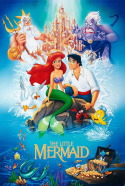
Review of The Little Mermaid (1989) by Shawn C — 19 Mar 2015
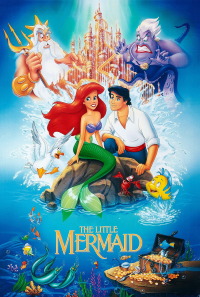
A Not Predicted Second Look Special: Disney's The Little Mermaid (1989).
Contains SPOILERS.
To start off, I appreciate The Little Mermaid for kicking off the Disney Renaissance, a decade spanning from 1989-1999 with animated features being released judged as Disney's grandest in the company's history with numerous popular entries. Namely The Little Mermaid, The Rescuers Down Under (1990), Beauty and the Beauty (1991), Aladdin (1993), The Lion King (1995), Toy Story (1995, with Pixar), The Hunckback of Notre Dame (1996), and Mulan (1998). These successful films brought Disney back into the public eye and re-established interest in The Walt Disney Company as a whole too. I'll argue that the Renaissance didn't officially cease in the year 1999 courtesy of The Emperor's New Groove (2000) which is in my opinion, one of the best traditionally animated creations Disney has ever done, period.
Now the teenage Princess Ariel is definitely a step up from previous female protagonists due to her rebellious though foolhardy nature. Interestingly, she calls Prince Eric "beautiful", a word most females wouldn't use to describe a guy's looks. That's cool. At that inexperienced age, everyone makes considerably egregious mistakes. Unfortunately, Ariel's errors resulted in dire consequences. "Now it's happened once or twice, Someone couldn't pay the price, And I'm afraid I had to rake 'em 'cross the coals..." Psst Ariel, Ursula's clearly lying. Or does she not recall being attacked by the garden of polyps earlier?
I've never been fond of her, obviously, ha ha.
On the other hand, the amount of positives from the villain in The Little Mermaid are significantly more astounding. Seriously think about it. Ursula is comfortable with everything about herself. She merely lusts for power, to be regal again: that's her lone motivation. It is a motive lots of humans can identify with. The scene where she's in disguise on the ship and looks at herself in the mirror is important since in the reflection it isn't the Vanessa form, it is Ursula because that's how she honestly sees herself. Design-wise, she's based off the appearance of Divine, a famous drag queen. She loves herself for who she is, she doesn't feel the need to alter herself physically. That's a wonderful message!
On top of that, during "Poor Unfortunate Souls", when she simultaneously mocks and convinces Ariel by singing her pitch, she shows evident disdain for an example she's helped before ("Lonely, depressed, and miserable...Pathetic!"). Ariel's voice as the chosen payment ensures that she'll fail from the get-go, so Ursula can sway King Triton by using one of his daughters as leverage in her desire for power. This is why "Poor Unfortunate Souls", for me, is tied for the best song with "Part of Your World". Basically, what Ursula is singing isn't the truth: underneath the surface her ideals are unique which is something I'm happy TLM did. Besides herself, the only other affection she displays, is remorse towards Flotsam and Jetsam after incidentally killing them.
Additionally, singing is an integral part of our protagonist Ariel, yet she never croons when there's an audience. With the exception of Flounder or Sebastian. She does hum incessantly after falling in love in front of others though.
"Part of Your World" shows Ariel yearning, expressing herself through song in secret. There's a reason this sequence is prominent around the world and why many are familiar with the lyrics associated with it. Being a fan of humans she just wished to know what it was like to do what they do, she doesn't mention love or anything close to that. Belle from Beauty and the Beast would share similar-ish feelings, seeking "something more than this provincial life". Neither character was looking for love, they unintentionally came across it.
Oddly, "Les Possions" is a dark but humorous song which shouldn't be in the film, yet there it is. I don't comprehend how anyone thought it was a good idea at the time. "Let's have this French chef gleefully chop up what could of been friends of Ariel, Flounder, or Sebastian. It'll be magnifique!".
Furthermore, The Academy Award-winning "Under the Sea" composed by Alan Menken and scribed by Howard Ashman is indeed insanely catchy, but kinda sexist (with a moment of racist in there too). "The blackfish she sings"? Really Ashman?! I kept waiting for Homer Simpson to swim by and consume all of the sea life throughout the song's duration.
Genuinely, I've got some misgivings about the song "Kiss the Girl" and its meaning. It is my least favorite, even though the animation throughout it is unbelievably gorgeous. Why? Since it says kiss her without saying a word...Yeah, no. Perhaps I just don't understand since I'm not good at reading people. I've been told that getting permission is a mood killer too. Admittedly, it is not a social situation I've found myself stuck in. Notably, Kristoff from Frozen (2013) asked before smooching Anna though. Maybe there is no easy answer, eh?
Following that, "Vanessa's Song" is the second villain song that has the antagonist explaining her intentions. It is special because we're given that important reinforcing body positive Ursula mirror scene. It'll make you completely forgot that merpeople are portrayed in three ways: skinny, strapping, and stout. There's no in-between shape apparently.
Strangely, the character that grows in The Little Mermaid is King Triton. At the beginning, he's a jerk that's not willing to listen to Ariel and has his other daughters sing songs of praise to him. Unlike most dads, he didn't seem to mind that his teenage daughter was in love. When it counted most he willingly surrenders his lofty patriarchal position to save his daughter's rapidly aging life after realizing he cannot blast Ursula's unbreakable contract to bits. The sea king also expresses real concern when Ariel cannot be found, blaming himself for her departure because he destroyed sections of her hidden human treasure trove she'd been collecting over time. Oh, and yelled furiously at her too. He's frightening, shudder.
His love for her allows him to let her go to live among humans despite his personal grudge against them. If it wasn't love his daughter felt, would King Triton still of transformed her in the end, I wonder? The final line from Ariel to him is fittingly a tearfully happy one of her telling him, "I love you, daddy" while in an embrace. Wait, why'd his magic make a dress for her then...? If he hates humans so much? That's bizarre.
Don't dwell on it Shawn, just keep swimming and don't glance back.
In conclusion, my level of vitriol towards this Disney animated classic that the majority of girls adore is a little less due to Ursula, King Triton's character development, and Ariel being rebellious for what she wanted (while still having agency to make the decision instead of playing another absolutely damsel in distress character). Even if she messed up and was rewarded at the end, ugh. I'm still not sure what Ariel saw in Prince Generic. That's how love works I suppose.
This review of The Little Mermaid (1989) was written by Shawn C on 19 Mar 2015.
The Little Mermaid has generally received very positive reviews.
Was this review helpful?