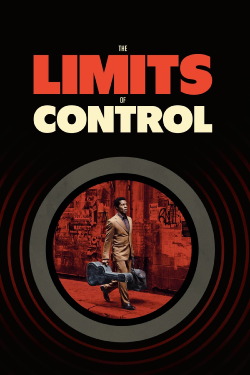
Review of The Limits of Control (2009) by Kevin M — 22 Jun 2009
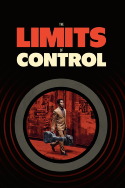
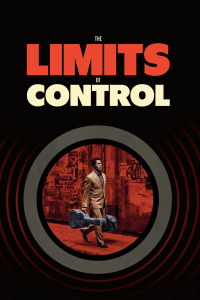
If Godard and Melville were to somehow drop acid, watch "Waking Life" and then hammer out a stream-of-consciousness screenplay, the result would not be too different from "The Limits of Control", a thematically heavy yet narratively slight genre deconstruction from Jarmusch. Metaphysical and philosophical ideas repeat frequently, spoken by many of the enigmatic personalities encountered by a stoic, nameless assassin as he travels though Spain on a very strange mission. French actor Isaach De Bankole (the ice cream vendor in "Ghost Dog") is the embodiment of cool, wearing some extremely sharp suits, projecting an air of badass authority even though he's just as powerless as we are, in the audience. More on that later. He rarely speaks, never uttering more than a sentence in any given scene, preferring to spend most of his screen time listening, silently observing his surroundings, drinking out of one of his two cups of coffee. We're free to invent a past, a name or a motivation for this character, but it might be better not to.
De Bankole's instructions are parsed out, one by one, from a mysterious source, as coded messages on a square of paper folded into a matchbook. Of course, we aren't privy to the content of his cryptic messages, and he immediately swallows the papers after reading them, washed down with coffee. Likewise, we haven't the foggiest idea what his unnamed contacts are talking about half the time. Their conversations could be psycho-science-babble, or they could be coded messages from an unknown overlord. Sometimes a haunting refrain is introduced, such as "He who thinks he is bigger than the rest should go to the graveyard. There, he will see what life really is: a handful of dirt." Perhaps utterly meaningless on first listen, the context of this quote is constantly changing. First it's spoken ominously by a shifty contact, then it's sung, forcefully, in a flamenco dance, then repeated once the endgame is reached in a lonely desert compound. Another quote, that comes in later on, is "la vida no vale nada" -- "life is not worth anything". Well, that might be pretty damn obvious in an ethereal universe such as that depicted in tLoC, where people cease to be "characters" and are instead used to represent abstract concepts or genre archetypes.
This must be part of what's frustrated a lot of critics. There is no artificial drama, no guns (except one, grasped suggestively by the assassin's perpetually nude lady companion, then hidden away forever), no chase scenes, certainly no explosions, not even much of Jarmusch's signature oddball deadpan humor. Instead of a thrilling fight to the death (no violence save for one tiny bit at the end), or a desperate race against time (our main character has nothing BUT time on his side) we have Tilda Swinton in a full-on albino cowboy/raincoat getup talking about "The Lady from Shanghai" (another neo-noir where the main character passively allowed the esoteric plot to jerk him along). She talks of her love of movies that are "like dreams you're not sure if you had before". tLoC is a stately affair compared to "Ghost Dog", which was far more entertaining but also far less visually astounding. Wunderkind Christopher Doyle's razor-sharp photography allows you to soak in every detail of the Spanish vistas and the artwork in one particular museum frequented by the assassin, which serves as a nice transitional motif and a possible indication of Dream Logic at work. How else to explain characters manifesting after a symbolic likeness is gazed upon? How else could the climactic scene with The American even have occurred? That whole concluding section of the film will be discussed in the following paragraphs.
After following the bread crumbs for a while, the nature of De Bankole's mission gradually comes into focus. Using the E string of an ancient guitar, he is to strangle Bill Murray, who is hidden in a sealed room, which is itself deep within a heavily fortified compound. After scoping the place for a bit, studying its blueprints and then setting them ablaze, he goes back to his safehouse for a nap followed by tai chi, which is his usual morning routine. His tai chi movements suddenly become ferocious, powerful, violent, yet the technique still maintains a balanced perfection. This is the closest we get to a "pump up" moment. Where 99% of directors would have their hitman gearing up, one gleaming firearm at a time, while "Eye of the Tiger" blasts in the background, Jarmusch has complete silence. Then, after returning to the place under cover of nightfall, he anticipates his approach. Suddenly he's sitting comfortably inside Bill Murray's inner sanctum, past all the guards and cameras and fortifications, without a scratch. One could say that it's just Jarmusch's way of saying "screw you for expecting an infiltration sequence, that's not how I roll", and that it's just more banal deconstruction. My preferred theory is that it's simply dream/movie logic. Unsatisfying, sure, and what could be more banal than that old copout? The assassin has his own explanation. When he illuminates himself, and Bill Murray flips out, demanding to know just how in the FUCK he got in there, De Bankole offers a terse reply: "I used my imagination". That some detractors of tLoC would see this climax denial as proof that Jarmusch failed to use his own imagination, is very ironic.
Yet there are trippy, disjointed and incredibly substantial movies that obviously take place in dream universes, ie "Waking Life", "Abre los Ojos", "Videodrome". This is another one of those. Why people are attacking it, some getting downright angry (Roger Ebert, most notably, acting as if the film had somehow inflicted pain on him) over the fact that tLoC travels under the guise of a thriller and delivers exactly zero thrills. Some have assigned political messages to the ending passages, finding it significant that Bill Murray is an American (well, duh) and going so far as to say his character is meant to represent Capitalism or The West. He's nameless and transitory like all the other characters, only his exit is more violent and serves to mark a particular end point. De Bankole moves on, putting his flashy wardrobe in his ever-present black bag, changing into street clothes and locking the bag away in a train station. His exit is much like ours, looking like some ordinary schlub instead of a dapper gangster, coming out through double doors into the light, into another stream of anonymous faces and out into the street.
This review of The Limits of Control (2009) was written by Kevin M on 22 Jun 2009.
The Limits of Control has generally received mixed reviews.
Was this review helpful?