Review of The Life and Death of Peter Sellers (2004) by Goran M — 19 Sep 2010
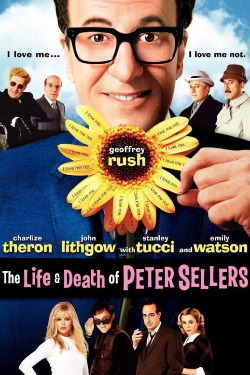
Geoffrey Rush as Peter Sellers as Everyone.
I have a book about the history of the Muppets; I think it's where I heard this story. When the show was originally on the air, they would do three things. Number one, they would let the guest star decide how much input they wanted to have; most let the writers do their thing, and John Cleese all but wrote his own episode. Number two, even for those who didn't want much input, they would let them pick which Muppet they wanted most to appear with--usually, of course, Kermit or Piggy. (I think I would have liked a musical number with Rowlf.) And they would include a segment where the star was just whoever the star was. They laid all this out for Peter Sellers, when Peter Sellers was the guest star. And he told them he couldn't be himself. He could be Queen Victoria, if they needed him to be, but he couldn't be Peter Sellers. So they dressed him up as Queen Victoria. And they continued to have no real Peter Sellers.
Once upon a time, there was a real Peter Sellers (Geoffrey Rush). He had a radio show and a wife (Emily Watson) and kids (Geoge Sicco/James Bentley and Eliza Darby). He had a mother (Miriam Margolyes). He made a few of those British art house comedies that hardly anyone in America saw. And then one day, he met Stanley Kubrick (Stanley Tucci), and Stanley Kubrick cast him first as a minor character in [i]Lolita[/i] and then as everyone in [i]Doctor Strangelove[/i]. And so Stanley Kubrick made him a star--but who was the star, Peter Sellers or those characters? Peter Sellers lost the Oscar to Rex Harrison, which he shouldn't have done. Either way, though, Peter Sellers began to lose who he was. He left his wife. He married another one (Charlize Theron). They had a baby. She didn't like how he treated her and the baby, and so she left him. And then Peter Sellers became even more invisible and vanished into the characters.
I have to say that Geoffrey Rush did an amazing job in the role. It's hard to capture that energy and those characters--and the film gives him even more characters than Sellers himself portrayed, since he's constantly stepping into the lives of the people around him. Blake Edwards is played by John Lithgow, but Geoffrey Rush as Peter Sellers can play the role briefly to show us how Sellers perceived what was happening. Not only that, but he must convey thirty years' worth of Peter Sellers over the course of 122 minutes. It doesn't quite extend to the end of his life, choosing to end with Chance (he lost to Dustin Hoffman in [i]Kramer Vs. Kramer[/i], and Hoffman didn't think he should have), but that moment in the credits wherein Geoffrey Rush tells us we can't come into the trailer kind of sums up the end of Sellers. It's as though the door, which of course says Peter Sellers on it, is the inside of the man, where no one could go.
With very few exceptions, the attitude most of the other performers must show tends to be despair, regret, and/or frustration. Peg Sellers is bursting with pride over her brilliant son, but his very brilliance takes him away from her. This is a man who misses his seven-year-old's birthday, so he sends her a Triumph she won't be able to ride for another ten years. And so even Eliza Darby as Sarah must hit those notes. It's a wonderful present which is completely worthless to her. None of the other kids have one, but what on Earth would they do with it anyway? Charlize Theron must start as confused, move on to happy, then concerned, then frustrated and angry. Then again, we already know how talented she is. About the only person who gets to be satisfied through the whole thing is Stephen Fry as Maurice Woodruff, the psychic advisor. And even he's taking cash from Blake Edwards to convince Sellers that he really wants to play Inspector Clousseau again.
I didn't much care for [i]Being There[/i]. I thought it was rather pretentious, actually, and I disagree with its basic theme. However, the more you learn about Peter Sellers the man, the more right for the character he was. Take away the characters. Leave just the man. Only by the time he died, there wasn't a man. We are talking about someone who allowed his children, upon his death, to inherit just £800 each. And yes, all right, he was supposedly in the process of changing his will, but he allowed there to be a will wherein that happened. (If you follow the inheritance trail, not once does it trace back to the Sellers family.) The joke of [i]Being There[/i] is that, in any realistic sense of the term, Chance the Gardener wasn't. Or if he was, it was in a merely physical sense. You projected your own view onto Chance; that was the point of the character. He became famous because he let you believe what you wanted to and think a wise man agreed with you. There was no Chance Gardner; there was no Peter Sellers.
This review of The Life and Death of Peter Sellers (2004) was written by Goran M on 19 Sep 2010.
The Life and Death of Peter Sellers has generally received positive reviews.
Was this review helpful?