Review of Bread and Tulips (2000) by Katie C — 28 Apr 2004
Here we'll contrast two movies on the same topic: self-actualization, that is, the feeling of fulfilling all of one's potential and being a peak performer, by means of adultery. Specifically, bored middle aged women ditching their husbands for a fling. One movie treats it in an intelligent way, the other in a nauseating and improbable one that drove me nuts.
"A Walk on The Moon" takes place in the summer of 1969 in upstate NY. The same summer as Woodstock and the fateful landing on the moon. Diane Lane is a bored house named Pearl, married to TV repairman Liev Schreiber. They pack up the car and take the kids to a bungalow for the summer. Young daughter Anna Paquin is about to become a woman, introduced to dating and periods, while Diane Lane is somewhat bored and wanting to experiment within her humdrum married life. Soon, with her hubby away, she goes into the arms of salesman Viggo Mortensen, and they start doing hippy things. As the tensions rise between her, husband, grandmother and kids it all has to get sorted out.
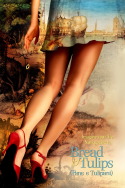
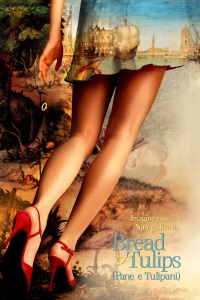
"Bread and Tulips" is an Italian film that was a big hit both domestically and internationally. The film starts with a housewife (Licia Maglietta) on vacation with her family in the South of Italy. She misses her bus back with them, and through various complications and decisions, decides to get a little excitement in her life and go to la Serenissima, Venice. Her bored existence gets a charge when she meets restauranteur Bruno Ganz, who is great as always, and she begins to explore the city with him and continue to spend time apart from her family. She starts working at a flower shop and cultivating her private life, while the family hires a bumbling PI to find her and bring her back.
On the surface, they are quite close. Bored house wife, leaving the nest, a fling, and repurcussions. Yet they are aiming at wholly messages and artistic points. "Bread and Tulips" is light and breezy with no higher claims rather than escapism for viewer and main character alike. "Walk on the Moon" cloaks the characters' experiences into a metaphor for America as a whole in 1969, namely, how does normal middle class America deal with the counterculture?
"Bread and Tulips" initially interested me with its long-suffering protaganist being quickly established and her routine displayed as somewhat stifling. A little sojourn by herself for a couple days in Venice would seem to be all she needs. Then it goes downhill. The film caters to every cliche in the book: the mysterious man with a past, maybe a family. The long tortured history. The bumbling PI. The obnoxious relatives. The family eventually gets her back, and she does some ironing and hanging with her kids. After a while though, she returns to Venice to dance.
This is possibly the most un-Italian film ever made. Allan Epstein in his book "As the Romans Do" quotes stats that over 60% of Italians have had affairs while married. Yet, the divorce rate is under 10%. The culture excuses little bursts of physical pleasure, and would have begrudgingly accepted the trip of her in Venice for a night or two. But to return to her family, and then abandon them, is a mortal sin in that country. Her obligations, duty, and honor all depend on being there for her children and husband, and they have been abrogated. Yet instead of doing the Italian thing and seeing any guilt or shame in this action, the movie *celebrates it* as a positive step to her personal happiness. The culture of instant gratification has gone spinning wildly out of control. That message is the main reason for my extreme dislike of the movie. By contrast, the early 1970's De Sica film "A Brief Vacation" features an even more put upon protaganist with a loveless marriage who goes to the Alps for months to recover from TB. No thoughts of abandoing her family; and then she returns to her life down below to renew the battle . Her bravery is to be admired, rather than the cowardice of the protaganist in "B&T".
The other is its list of technical problems. The structure is far too plodding. The cinematography is interesting in that it's medium color, but with soft lighting and tight shots. It can't decide to be glittery and showy, or natuarlistic, and just ends up being blah and distracting. In regards to the script, certain characters are too hammy, unnecessary, or unbelievable. The PI is far too one-sided to be interesting. The dippie new age masseuse gets old fast. Bruno Ganz is fascinating, like anyone who quotes "Orlando Furioso", but he remains alone. The family is portrayed in ways that are hard to believe: as just weights on her time that invoke no satisfaction. All these elements play out in a far too long running time that recycles too many jokes (the cell phone!) and wears out our patience. [i]Basta cosi[/i], don't even think of renting it.
"A Walk on the Moon" is fascinating by contrast. The movie has a terrific structure, where three things are tied together in metaphor. One, you have the family, a normal American 1960s family on summer vacation at a retreat in upstate NY. Simultaneously, we have the moon landing by the US astronauts and the occurence of Woodstock. Diane Lane's character is supposed to be a stand-in for America. The walk on the moon is akin to middle class America and the alien world of the hippies. Woodstock is the other world which has to be recognized and assimilated by Americans. Also embodying the counterculture is Viggo Mortensen's character, selling t-shirts out the back of his bus.
Diane Lane effortlessly channels the impression of a woman who started early with children and family and has been at it her whole adult life. She tells us that she never had any long term boyfriends or experiences and was just dropped into this routine. Now, she is dreaming and wondering of the road not taken. There is the desire for sexual experimentation, new men and other things. The salesman fulfills all of those different experiences.
Yet, that is only a limited part of it. Her affair is quickly discovered by her mother in law, a voice of prudence. Mentoring Diane Lane, she mentions the experiences of her husband and his sacrifices. "You think you're the only one who has dreams that didn't happen?" she implores, trying to get to recognize the selfishness of her actions. The affair builds and builds while the father is away; she continues to see the salesman in strange places and they finally go to Woodstock itself, where she frolics and body paints and loses herself totally. The mother in law alerts her son to come home and face the consequences.
The confrontation is all about the dreams and sacrifices the family has made, their duties to family, and the promise of instant gratification. The film concludes with the couple reconciling while listening to Jimi Hendrix. Liev Schreiber's character confesses he doesn't yet know how to dance to it, but he has to learn over time.
There is the film in a nutshell. The family trying to right itself from the crisis of counterculturalism. The film comes out cautiously optimistic on the topic, seeing the damage done to the culture, but recognizing that the family can endure. Perhaps it now sees a good balance in America; instead of being like those in the 1950's and starting too early, or being hostile to a family like those of the late 1960's, it recognizes both poles and sees the best life as the one which encompasses both paths. Repression just sows the seed of its removal later on.
On a more visceral level, the impact of the various scenes along the way is terrific. The guilt, anger, lust and other emotions come across powerfully. The cast is exceptional, the writing leading us through the various way stations to get right to the desired effect. The film withholds judgement for the most part, and the withheld opinions keep the viewer involved with the characters and their eventual decisions.
This film, in contrast to the other, does not see self-actualization through familial abandonment. It is more interested in exploring a certain part of the psyche of its lead female, while cloaking a broader metaphor. Its answers on the topic are far more complex and interesting to the perceptive viewer. This film is fascinating, well made, and highly recommended.
This review of Bread and Tulips (2000) was written by Katie C on 28 Apr 2004.
Bread and Tulips has generally received very positive reviews.
Was this review helpful?