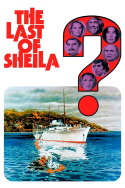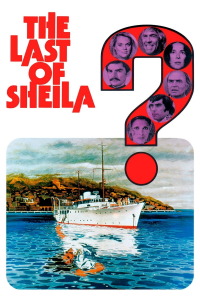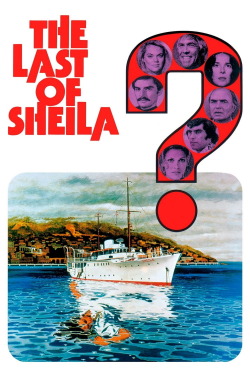
Review of The Last of Sheila (1973) by Jake G — 19 Feb 2010
Ponderous, dull, and slow-moving: three things any murder mystery worth its salt is not. MURDER ON THE ORIENT EXPRESS sizzled to great benefit from its taking place on a moving train, surely conducive to suspense, and the underrated FRENZY saw Hitchcock at his most diabolical. THE LAST OF SHEILA, a top-notch mystery movie and a Rubik's cube of a film, deserves a spot in those rankings.
Murder mystery on ice, served with a dash of cold blood and a dazzling wit: that, without spoiling anything, is THE LAST OF SHEILA's allure. And thanks are principally in order, unlikely as it might sound, to a little Broadway and Hollywood schizophrenia. Screen legend Anthony Perkins (PSYCHO) and composer Stephen Sondheim (SWEENEY TODD), a true odd couple writing team, take up the pen and ink for a screenplay that's chock-fill of complexity, smarts, and witticisms. It's a sturdy, leak-proof ship for a talented ensemble cast to sail on.
And while the screenplay, creative as it is, is far from the first to balance humor and intrigue, it's a fine peg to hang your hat on in that department. Few mystery/suspense films, as masters like Hitchcock realized early on, can work well without light moments, chances for audiences to take a collective breather before being put on tenterhooks by the plot's twists and turns. Not only do Perkins and Sondheim realize this, they walk the tightrope between the genres the best way-- in style. The duo, who would never team up in writing a film again, used their mystery fanboy interests to good use, netting an Edgar award in the process.
As flesh and blood to the screenplay's pulp and paper, the veteran cast of THE LAST OF SHEILA does a more valuable service than Hitchcock, with his 'cattle,' would perhaps admit to. Acting in the film is superb, a veritable treat. The cast is, alphabetically: Richard Benjamin, Dyan Cannon, James Coburn, Joan Hackett, James Mason, Ian McShane, and Racquel Welch, a convincing ensemble of 70's Hollywood A-listers.
Benjamin, who in a touch of deja vu also appears in WESTWORLD, masterfully plays Tom, a dapper everyman who's quick mind is well-suited for the evening games. Dyan Cannon is Christine, a rich playgirl with an infectious laugh, in a role that seems not too far from reality. James Coburn, in the best performance I've seen him in, is the low-level sadist Clinton, a wealthy producer whose taste for "games" gets us in trouble in the first place. Joan Hackett plays Tom's wife, Lee, an earnest, sweet natured woman who looks patently out of place among the other two bombshells. James Mason, whose affected pedophilia earned him fame in films like LOLITA, here is in classic shape as Philip. Ian McShane plays Ian, a British expatriot and Hollywood manager with anger issues, whose girlfriend is Racquel Welch, who puts her limited acting chops to best possible use as Alice.
Clinton is a wealthy producer who enjoys games, or rather, humiliation-- and it's clear he wants a little of both when he invites his wealthy socialite frenemies for a week on his sleek yacht. Each player is assigned a card with a dirty character attribute, like "you are a shoplifter" or "you are an alchoholic," and it's evident early on that the cards have a real world bearing of their own, and that the "Sheila Green Memorial Gossip Game" has a sinister edge. The alleged purpose of the week is to shoot a movie about Clinton's late wife, Sheila, who was killed by a hit-and-run driver he has reason to believe may be among his "friends." As the suspense piles up, so do the bodies.
Herbert Ross (of STEEL MAGNOLIAS and PLAY IT AGAIN, SAM fame) deserves to be remembered for this one, a riveting 70's whodunit that is by far the best of its era. His direction boasts loads of flourishes like interesting camera angles, spooky cutscenes in which anything might happen, and a few particularly well crafted shots. His filmography reveals a solid cadre of films, mostly commendable 70's flicks that have both gone and been forgotten. He was nominated for a few films in his heyday, but never quite got the recognition he deserves. His cinematographer, Gerry Turpin (whose camerawork was also used in 1960's PEEPING TOM) gives us that great dark Technicolor feel, best seen in the castle scene. Ross can thank his editor, too, for adding short cuts and timely pacing into the mix.
Billy Goldenberg's atmospheric score sets the tone from the very beginning, to haunting effect. In sound it resembles many of the horror movies made in the 70's, a shiver-inducing score whose fright-might enhances many a scene's power. It's minimally used throughout the film, used sparingly but wisely to accent certain parts. Ross was smart enough to know when he didn't need it, though, and the film is quiet to good effect in much of the latter part of the film. When Bette Midler's "Friends" plays during the closing credits, it's both a shock and worth a hearty laugh, after all the back-stabbing that has gone on.
Filmed in the south of France, THE LAST OF SHEILA has a great romantic feel that helps to transcend the one set, mystery theatre feel of so many films in its genre. As a footnote, the beautiful location adds a disparity between the lush paradise outside and the in-fighting going on within the yacht.
THE LAST OF SHEILA is not only the last hurrah of the archetypal 70's mystery thrillers, which would be parodied for their predictability in films like MURDER BY DEATH, it's arguably the genre's shining moment. In a film that feels like a dash of PSYCHO combined with a touch of comedy, THE LAST OF SHEILA makes a film entirely one of a kind: a riddle of a film that, so rare to Hollywood nowadays, is not scared to make the viewer think. Next time you have a craving for some murder and mayhem, try this little known classic.
This review of The Last of Sheila (1973) was written by Jake G on 19 Feb 2010.
The Last of Sheila has generally received very positive reviews.
Was this review helpful?