Review of The Juror (1996) by Jerry M — 06 Dec 1996
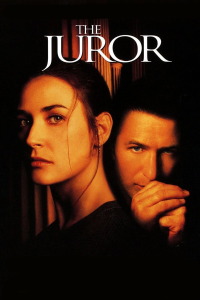
[font=Trebuchet MS][size=-1][i] The Juror[/i] seeks to be a classic thriller in an era where the genre has slid away from drama towards cheap suspense. Though a noble impulse, director Brian Gibson is simply not the match of the film he wants to make. His sensibilities rest firmly in the modern horror flick; when he directed [i]Poltergeist II[/i] (probably his next best-known ouevre), these meshed well with the material, but in [i]The Juror[/i], the story and director are an unpalatable blend. The cinematography is completely nondescript, with few exceptions. All signs would point from first glance to a thoroughly mediocre movie.
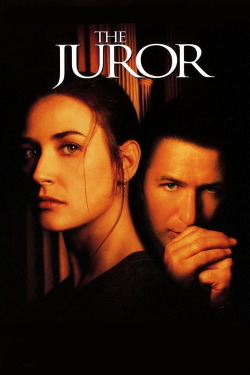
And he [i]Juror[/i]'s tale seems at first glance to be acceptably plebeian. Annie Laird (Demi Moore) is a working mom--a sculptress, actually--who is called for jury duty in a major Mafia trial. A man who is known only as "The Teacher" (Alec Baldwin) is his usual strong, silent type, the ombudsman/hired killer for the Mafia crew, and immediately seizes on Annie as a "smart one." He himself is quickly established to be a scholar and gentleman in a sea of filth--or at least, a man who believes himself to be so. Still, he's clear about how he works, threatening to kill her wide-eyed young son if she does not cooperate. He wants only two words from Annie: "Not guilty.".
Events degenerate as Annie, egged on by her doctor and confidante Juliet (Anne Heche), tries to do the honorable thing. And as the level of the Teacher's retaliatory strikes escalates, so too dos his fixation on Annie herself. Stressed by pressure from the family and his growing obsession with his charge, he very visibly (as measured by the amount of sweat on his forehead) transitions from cool confidence to madness. By the time the Feds get involved, the Teacher has gone over the edge completely.
Events transpire at an orderly if frenzied pace under Gibson's heavy handed transitions. Every sequence is neatly bookended from superficially sedate beginning to adrenaline-pumping end, at which point a new crescendo begins anew. Only at one point in the film does he crosscut between simultaneous events; every moment in his film is sequential and, ultimately, predictable. Even his single crosscut, occuring at the very end of the film, is so painfully contrived in its "suspenseful" catharsis that it's a cure worse than the disease--and this catharsis is happening in a Guatemalan temple. You just can't take the content seriously.
Alec Baldwin only contributes to the slightly surreal sense of outrageousness. His initial portrayal of the Teacher as calm and collected in the face of strain is successful, evincing a Keanu-Reeves-like ability to not alter his facial expression for a half hour of screentime. Still, as for the latter in the Matrix, that skill was precisely called for. But as the Teacher breaks down, so too does Baldwin's talent at acting. The Teacher hunting down Annie by the end of the film is as unbelievable as the lengths to which he goes. Teacher's contact in the Mafia, Eddie (James Gandolfini) is far more reasonable, probably more so my juxtaposition with Baldwin's character. But that character is left completely undeveloped, existing only as a mirror for Baldwin; the fact that such an uncompelling characterization appears so vivid is testament to both Baldwin's poor performance and Gandolfini's virtuosity at the role.
The saving grace of the film comes from Demi Moore, who puts forth one of the best emotional performances of her long career. Her character leaps out at the beginning of the movie as the driving force: a mother forced to ever greater resolve to protect herself and, as is visibly more important to Moore, her child's. As compelling as Moore's performance is from the start, it only deepens as events force her to more Machiavellian machinations. Her performance is particularly striking opposite Baldwin's, who is evolving in parallel throughout the film but less convincingly. Moore is ably assisted by Jason Gordon-Levitt, who does a good job of looking scared but too innocent to really understand the scope of the tribulation his mother is undergoing for his sake.
It's hard to judge a film poorly concieved and executed, which nonetheless manages to evoke a powerful character. The laughably shallow characterization and choppy scene changes and segues are somehow lent gravity by Moore's mere presence, and the film remains intense throughout. An audience expecting a profound experience will leave disappointed, but those looking for a classic thriller may be interested. This is no HItchcockian plot of intrigue, but it does rely on character rather than suspense, on the evolution of Annie and the Teacher in tandem. There's still a good performance here to be watched, if only from one of them. When Demi Moore is the saving grace of a film, it can't be too compelling, but neither is this a complete waste. At a few points, especially the spectacularly terrible ending, laughs may be heard in the theater. It's a price that has to be paid for Demi Moore's skill.[/size][/font].
This review of The Juror (1996) was written by Jerry M on 06 Dec 1996.
The Juror has generally received mixed reviews.
Was this review helpful?