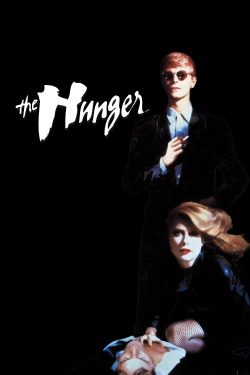
Review of The Hunger (1983) by Blake P — 18 Jul 2016
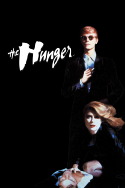
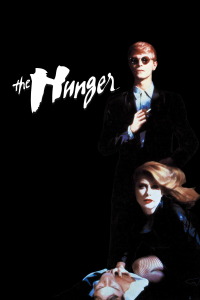
I love to look at 1983's "The Hunger" much more than I like to experience it as a film. It's alarmingly stylized - almost fetishistic in its vogue veneer - and it's enormously effective aesthetically, strikingly mixing goth punk and lavishly produced soft core. It takes cues from Josef von Sternberg's infamously overproduced 1934 masterwork "The Scarlet Empress," and reminds one, stylistically that is, of the hairless carnality of Madonna's "Erotica" and the cobalt coldness of David Lynch's nightmarish "Inland Empire," both to come later. I instantaneously take a liking to films akin to "The Hunger," which are garishly materialistic and titillatingly pleasing to the eye. But in viewing did I find myself becoming increasingly detached from the fervor that once held me so close to it - while it's sensorily soigné, it has trouble translating itself into something cinematic rather than fashion magazine oriented in breadth.
But its style - oh god, its style - is so meticulous and so autoerotic that "The Hunger's" floundering in storytelling, not to mention its unevenness in tone, are forgiven; there is nothing, and there will probably never be nothing, quite like it. The directorial debut of Tony Scott, the brother of Ridley and the helmer of such seminal blockbusters as "Top Gun," "True Romance," and "Crimson Tide," his having to do with "The Hunger," which is insanely flashy in comparison to his mostly crowd-pleasing body of work, makes as little sense as it does perfect sense. A filmmaker so willing to go overboard in their artistic inhibitions is oftentimes better suited for bombastic pieces that require a daring backer to really work.
And daring with "The Hunger" Scott is: when most directors would be hesitant to accommodate their creative extravagancies within the confines of a single film, Scott goes into overdrive, ensuring that the movie be a portfolio comprised of his most provocative imagery. Since the screenplay isn't his - it is, rather, the work of Ivan Davis and Michael Thomas, adapted from the novel of the same name by Whitley Strieber - we can conclude that his treatment of the material is shamelessly exceptional. If only the substance could live up to the style that drowns it out.
Not that the substance is anything worth wanting more of; since "The Hunger" is a vampire movie with more in common with kinky sadomasochism than predictable cinematic horror, expected is fantasticalness that never quite sells. The movie, after all, concerns the exploits of Miriam and John Blaylock (Catherine Deneuve and David Bowie), lovers (and centuries old vampires) who have enjoyed each other's presence since the eighteenth century.
The alpha of the relationship is Miriam, whom is ancient and has, throughout her existence, cycled through the same mission of finding, and then turning, potential mates, basking in their company until time runs out. Time runs out because Miriam, despite promising her string of companions that immortality will become them, cannot actually give a human everlasting life. Her blood can allow them to live youthfully for a few centuries, but there comes a point in which their biological clock practically collapses. Suddenly, and without warning, do they find themselves withering away into dusty carcasses. Trouble is, they remain conscious, even after they resemble one of the fiends of "Zombi 2.".
In "The Hunger," we're witness to the rebirthing of the succession: minutes into it does John begin to notice that he's aging at a terrifying rate. Unaware that he's merely meeting the same fate as Miriam's collection of lovers, he desperately runs to Dr. Sarah Roberts (Susan Sarandon), a gerontologist on the verge of a breakthrough in her ability to manipulate the speed of one's biological clock, for help. But nothing, it seems, can stop John from succumbing to an eternal, living death. Fortunately, the attention brought onto Sarah also attracts Miriam, who is, of course, looking for a partner to take John's place.
I suppose the storyline of "The Hunger" sounds compelling in writing, as if it's a weird combination of old-fashioned melodrama with fetching dashes of vampirism and sexual fluidity to invigorate it. But instead of exploiting the operatic possibility of the source material, Davis and Thomas keep everything moving at a snail's pace, which is so languid and so slow that any sort of machination that makes its way onto the scene seems far-reaching. That's more likely the result of the heavy imbalance between style and substance, but vampire movies are never that much fun to begin with, anyway - they seem to consistently smother glamorization with unbecoming violence. And so "The Hunger," which is imminently too fanciful to ever really work as much more than an experiment in style, never presents itself besides a film that's a hell of a lot of fun to look at. But there is a charged sex scene between Deneuve and Sarandon, too, and that's perhaps even worth the rental in itself.
As I live in a cynical day and age where emotional attachment seems to be the very thing that propels a film to classic status, it's intoxicating to watch a movie with the emptiness of a one night stand; "The Hunger" is trivial and vain and maniacal and strange, but I'll be damned if I find a project as spectacular on the eyes.
This review of The Hunger (1983) was written by Blake P on 18 Jul 2016.
The Hunger has generally received positive reviews.
Was this review helpful?