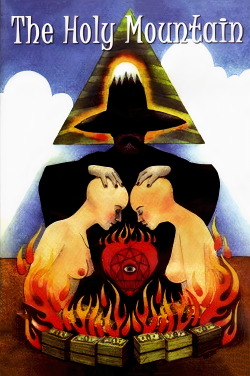
Review of The Holy Mountain (1973) by Alonso A — 05 Oct 2016
Bless Alejandro Jodorowsky for being so in touch with the idiosyncrasies of his boundless imagination. For being so candid with his views on political radicalism, militarism, consumerism, sexual exploitation, and religious fanaticism; for so supplely blurring the lines between the beautiful and the grotesque, the dramatic and the ironically comedic. For making "The Holy Mountain," an artistically revolutionary masterpiece pioneering in its surrealism, its ideas, and its cinematic breakthroughs.
Come 1973 and Jodorowsky had become one of the most exciting new filmmakers to pique the interests of the more adventurous of cinephiles. His 1970 classic, "El Topo," warped the insides of the western and metamorphosed it into something philosophical and psychedelic - a game-changer both intellectually and visually, it became a target of ecstatic word-of-mouth on the underground film circuit, made fans out of John Lennon and George Harrison, and turned Jodorowsky into a cult sensation.
But upon "The Holy Mountain's" highly anticipated premiere at the Cannes Film Festival, the hype surrounding Jodorowsky all but dissipated. Cutting twenty minutes from its run time to eliminate as much dialogue as possible, reviews of the movie were mixed and therefore kept Jodorowsky trapped in the same cultish bubble he found himself in after "El Topo's" initial release. Post-Cannes, the film still did decently well - it was an immensely popular midnight movie, playing for sixteen months straight following its 1973 showcasing at the Waverly - but today is "The Holy Mountain" better looked at as a forgotten masterwork, an overlooked provocateur of the celluloid never to be untangled but always mystified and maybe even repulsed by.
The thought of a storyline is laughable - the movie's a rant, an illogical ramble doomed by its nonsensicality. For the sake of brevity and avoiding swimming in paragraphs of indecipherable "plot" description, I'll say that "The Holy Mountain," more or less, is a satire of religious practice, esotericism, and cultural exoticism, finding its many layers through various vignettes that involve several individuals' attempts to find fulfillment or reach some sort of vague sort of enlightenment in their already fitful lives.
But "The Holy Mountain" is not as cerebrally minded as the works of societal criticizer Luis Buñuel, whose movies seem conventional when compared to Jodorowsky's. Whereas Buñuel attacks his figures of interest through cutting dialogue matched by clever imagery, Jodorowsky relies heavily on his photographic techniques, his set design, and his staging - though Godardian narration sometimes guides us in the direction of assorted conclusions, all moments of monologue and dialogue do little to enhance the effect the imagery already has on us.
And there's power in that. As a purist with a small capacity for films that prefer style over substance, phenomenal is the way Jodorowsky's able to so persuasively provoke with his images. What they all mean would require deep analyzation I'm to apathetic to undertake as of now, but his frequent marrying of beauty and violence are confidently mounted and extraordinary to experience. Like Federico Fellini, perhaps the only filmmaker that seems to bear any sort of similarity to him, Jodorowsky is adept at making his flurries of hallucinatory set pieces carry strong scents of meaning, inviting us to dig deeper into their essences instead of letting them get lifted away into the throes of the purgatory that is masturbatory directing.
But "The Holy Mountain" never feels masturbatory because Jodorowsky is so giving in the sharing of his vision. There's wacky humor to be found within his labyrinth of color and crypticness, and getting lost in the film's symbols and allegories aplenty is an enticing notion, not a materialistic thought. Sure the movie eventually loses its momentum - no picture of its byzantine aptitude should have the long running time that it does - but before we begin to feel fatigue are we incapable of forgetting that sense of bracing erraticism that fell beforehand. You'll never see anything like "The Holy Mountain," and I'm sure you'll never want to.
This review of The Holy Mountain (1973) was written by Alonso A on 05 Oct 2016.
The Holy Mountain has generally received very positive reviews.
Was this review helpful?