Review of The Heiress (1949) by Edith N — 03 Apr 2009
I recently read [i]Reading Lolita in Tehran[/i], by Azar Nafisi. One of the books she and her students read in it was [i]Washington Square[/i], the book this movie is based on. I have not read any James, I'm afraid, so I can't compare book and movie. However, if Nafisi's summary of the plot is accurate, the movie does not sway from the book much. It is a continual mystery to me that Olivia de Havilland kept getting cast as women described in the original books as plain--no, she's not exactly Vivien Leigh, but who is? Still, you're not really going to get a Hollywood actress of the time put any great effort into appearing as plain as the book says the character is. I'm kind of curious as to whether Nafisi has seen the movie or not, and if so, what she thinks of it.
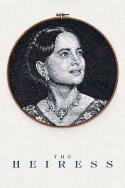
Catherine Sloper (de Havilland) is plain and mousy and a spinster. I am unable to find out exactly how old she is, but it's pretty clear within the context of the story that she is, as they say, beyond her first youth. Her father, Dr. Austin Sloper (Ralph Richardson) resents her, in that old-fashioned way, because her mother died of complications of childbirth. Her mother was bright and beautiful and clever, everything that Catherine herself is not. And one day, at a party, she meets Morris Townsend (Montgomery Clift), who is young and handsome. He courts her. She falls for him, probably in part because no man has ever wooed her before. Dr. Sloper, however, disapproves heartily, because he believes that Morris is only pursuing her for her fortune; she is the doctor's only heir. He takes Catherine to Europe to make her forget about Morris. It doesn't work. She makes arrangements to run off with Morris almost as soon as she gets home, telling him that she will let herself be disinherited if only she can be with him. Of course, Morris does not run away with her.
What I had not realized is that Olivia de Havilland (born 1916 and still alive) is only four years older than Montgomery Clift (born 1920 and dead since 1966). They feel as though they belong to totally different generations. He was, realistically, old enough to play one of those young soldiers in [i]Gone With the Wind[/i]. I mean, Scarlett and Mellie were supposed to be young themselves; if I recall the book correctly, Scarlett was three years [i]younger[/i] than Clift was at the time. I think of de Havilland as a product of the thirties and forties, yet I think of Clift as a product of the fifties. And, indeed, his first movie role wasn't until 1948, nearly ten years after her first Oscar nomination. Though, of course, he did get [i]his[/i] first nomination for it. Those years he spent on Broadway make him seem so much younger than she; I think of her with Leigh and Davis, and I think of him with Dean and Brando.
Olivia de Havilland won her second Oscar for the role, and (although I haven't seen any of the competing films), I think she really deserved it. I don't want to give away the ending if you don't already know it, but the last scene is heartrending because of all the things you can see going through her mind. She is mourning for the past, afraid of the future, trying to make herself numb about the present. She has suffered for years, and this assuredly isn't a happy ending, but the look on de Havilland's face indicates, to me at least, that she will endure. All through the movie, her emotions have been written plainly on her face, but in this moment, her whole body shows what she is feeling. Clift and the others are good, too, but de Havilland's performance is brilliant.
So here's the odd thing about the film. Aaron Copland, after having been nominated for five other Oscars, finally won for this one and was never nominated again. He didn't compose much afterward, eventually dying of Alzheimer's in 1990. At any rate, he did, he said, compose a score for [i]The Heiress[/i]. However, he was pretty clear about the fact that the score he composed was not the score that was actually used in the film, even writing a letter to the [i]New York Times[/i] on the subject. However, not even IMDB seems willing to speculate about who actually wrote it. So far as everyone but Copland is concerned, he wrote the score and got the honours for it. If it's true, if he didn't write the score, I can't help wondering about that Oscar. Did he accept it? Did he pass it on to whoever-it-was? Did even Copland know?
This review of The Heiress (1949) was written by Edith N on 03 Apr 2009.
The Heiress has generally received very positive reviews.
Was this review helpful?