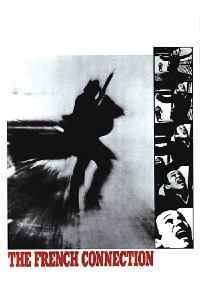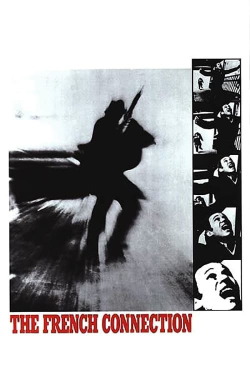
Review of The French Connection (1971) by R.c. K — 11 Jun 2009
On a message board I used to wander daily, there were a number of action film fans, and the subject of the best car chase ever filmed often came up. Naturally this was often down to some famous contenders, and two titles in particular tended to stick in my mind, being some of the most renowned for their car chases in general: Ronin and The French Connection. I'd never seen either, but when they kept coming up, the titles would get just a little more firmly ingrained in my mind, and I'd at least be overtaken with curiosity by wondering what exactly these movies consisted of, and how one rated these car chases as better than any others. I saw Bullitt a few years back, so I've already seen that chase, as well as Ronin's (which I also saw a few years back). Now I've completed the trio of films most recognized and, more important for me, the pair that I heard about so many times.
Jimmy "Popeye" Doyle (Gene Hackman) and Buddy "Cloudy" Russo (Roy Scheider) are two cops in Brooklyn who work in narcotics, who are trying to get somewhere nearer to an actual source of heroin. Popeye's pursuit of the job even in the face of time off leads them to a bar where a man flashing money around catches his eyes. The men he's with are familiar faces to Popeye, so they begin to tail the man, Sal Boca (Tony Lo Bianco), until they stumble into Weinstock (Harold Gary), a man who smells dirty to everyone but comes out clean every time. They convince their superior Simonson (Eddie Egan, the actual cop Popeye is based on, his partner Sonny Grosso appearing as Bill Klein) to let them pursue things further, and find that the source is a Frenchman, Alain Charnier (Fernando Rey), who has arrived with actor Henri Devereaux (Frédéric de Pasquale) as a cover and cold-blooded assassin Pierre Nicoli (Marcel Bozzuffi). Two wiretaps are how they luck into this and a meeting time for Boca and this source. Simonson gives them federal agent Mulderig (Bill Hickman, an actual stunt driver), who dislikes Popeye--who has no love for Mulderig either--and reveals Doyle's iffy past with "hunches." Charnier is smarter than the folks that Doyle and Russo are used to and easily makes them, making things difficult for everyone. Now Charnier has to find a way to make his deal with Boca in time for a real estate deal back in Marseilles, France, while Doyle and Russo must catch Charnier, Devereaux and Boca.
The only other factoid I had about this film as I sat down for it was that the chain of Popeye's restaurants actually had nothing to do with E.C. Segar's amusing cartoon strip creation and everything to do with Gene Hackman in The French Connection. This was news to me when I heard it a couple years back, and was almost the most intriguing thing about it. I never really connected the film as a Best Picture winner (or Best Actor, Best Screenplay and Best Director, really), and understood the car chase to be a car chase with two cars. I didn't remember the Academy Awards until I had already finished watching the movie, and had no idea about the chase until I saw it. I knew Hackman and Scheider were in it (which is fine by me, I like both of them a lot) and that Friedkin directed it, but Friedkin I know in a strange way, as I didn't enjoy The Exorcist when I watched it some years ago, and I've only seen Sorceror since then, and To Live and Die in LA, which I was severely disappointed by (though more because of a lead I disliked than anything else). Still, I have an intellectual respect for Friedkin by reputation that comes from respectable sources, so I counted it as a plus anyway.
As soon as it starts, the movie is filled with an immediacy driven by an unusual score from Don Ellis (who composed the soundtrack for the also-Scheider-starring The Seven-Ups, though that score bothered me) that is very light on melody, heavy on rhythm and sound. It's perfectly in keeping with the "induced documentary" feeling that Friedkin says he aimed for in making the film. It's an accent and a supporting prop, loud and brassy without being obnoxious or off-putting. It shows up momentarily and often almost out of the blue, playing underneath scenes that don't immediately show a need for that emotional intensity, thus giving it to them, being uncommon enough to let us know that this is something important without giving the slightest hint of what's about to happen. It's a pretty amazing effect, especially for a film nearly forty years old, because no one seems to have undercut this effect by overusing it--though I do feel like it has been tried. It makes you uneasy and uncomfortable and ramps up the tension even when nothing about the way things are acted or cut changes the feeling of what is being visually portrayed.
From there, it's clear that Friedkin has made a no-nonsense, perfectly economic film. Never is any time wasted, but at the same time it's not rapid cutting and brief, terse moments for cuts or scenes. Each cut and scene lasts just as long as it needs to for events to roll along and put forth all the information necessary to understand them. Similarly, dialogue is not built purely for exposition, but never lingers long enough to fall into any kind of forced, intended characterization. Friedkin does come from documentary work, but I almost disagree with the tone he says he intended. As I watched, I did not get the idea that this was documentarian, but at the same time it had the right tinges of it to build a fictional-story-based-on-fact into something that screamed of reality even as it was clear that it was only something that resembled it. The camera doesn't seem to know where everyone is going to be, or even everything, yet at the same time they're edited in to cut out the chaff of pondering a building while we wait between moments that drive the story. It's a perfect line between pure fiction film and documentary, creating some strange amalgamation of the two that is utterly fascinating for its hook of dramatic tension and the exciting tinge of real events--the reason people see a movie "Based on true events" or studios market them as such. It almost doesn't even matter that it actually is, because Friedkin has perfectly conveyed the idea anyway.
Hackman and Scheider are not used to carry the film because of this, because it would destroy the feeling of reality. Neither one is an actor who tries to steal the screen, though, with Hackman especially more interested and real acting and Scheider always seeming a cool character who just slides into roles and then back out of them and into the next one. It's not quite the same thing as a devoted character actor like Hackman, but it has the same feeling of relaxed reality to it. Their characters are not wonderful people, especially Doyle, and this is something that was once new--not that old at this point, in fact. Doyle is racist and obsessive, uninterested in anything but doing his job. He takes Cloudy along on bar trips to scope out possible targets for surveillance or busts, he criticizes his techniques on the job and spends days and nights on his surveillance without concern for much else. Cloudy is loyal and more passive behind Doyle's crass, smart alec obsessiveness, but strong enough to break up Doyle's conflicts and support his moves. Charnier is a strange counterpoint to this, an ultra-slick, suave and cosmopolitan sort of villain, neither twirling his moustache nor combing it into an ultra-slimy configuration. He knows what he's doing and it's what he does, the only thing he really shares with the two cops pursuing him. Rey is successful despite the mix-up that led to his hiring and his poor--by his admission, at least, prior to the film--French.
So, of course, I started talking about this film by bringing up the car chase. I'd say "you're probably wondering..." but I think things like car chases are silly to talk about, as I know I never got a handle on what was cool about any particular chase that I had never seen, so I don't expect anyone to want to hear what it's like or about. What it IS, though, is absolutely breath-taking. Popeye is not chasing another car but an el train above his car. The filming of this scene is unbelievable, clearly filmed in live traffic and swerving and diving at rapid speed through screeching cars as he lays on the horn. Like many of the truly great chases, there's not much music behind this. It's almost all engine sounds and the constantly blaring horn of Popeye attempting to keep people from driving into his path. Like the rest of the film, there's never a feeling that it's prepared and calculated, even as the camera knows exactly where it needs to be, even if it's just a bit behind or a bit ahead or a bit off. It never looks sloppy, but it always looks like it was dropped into the moment, capturing something already existing, even if it wasn't real.
This film was absolutely amazing, and I don't think I was expecting that. I thought it would be good, I thought it'd be engaging, but it was absolutely thrilling, the way thrillers rarely actually are. Usually they're too slick and calculated and fake to really entangle you, but the effect Friedkin creates is affecting and more than engaging, it's captivating--and I mean that in the sense of holding the viewer prisoner. There's no way out of the scene because it draws you in and locks you down and forces your eyes to watch, not because you necessarily want to know what happens next, though you may very well want to, but because you just absolutely have to know. It's not a possible lack of want that comes from a sick sense of pessimistic unease, but because you really don't know what's going to happen--you can tell it could be just about anything, this is too real to have a calculated ending (even though it does, of course, and a brilliantly enigmatic one--not lacking in closure and yet somehow open and inexplicable) and so maybe they won't catch him, mabye he won't get away, maybe he will--who knows? You have to know, though, because it's so well put together that you can't just turn away and shrug and let it go. Do yourself a favour: let this one drop its hooks into you and watch it straight through. Probably the most frenetic, kinetic film of this laidback kind, that has such energy without forcing it that it's almost unbelievable.
This review of The French Connection (1971) was written by R.c. K on 11 Jun 2009.
The French Connection has generally received very positive reviews.
Was this review helpful?