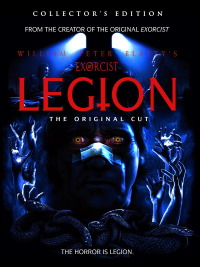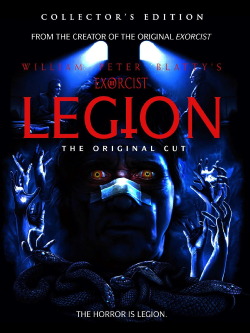
Review of The Exorcist III (1990) by Al P — 12 May 2010
The Exorcist films present an interesting paradox as the first two installments represent both the zenith and nadir of cinematic horror, respectively. The William Friedkin original was as instrumental in furthering the genre as Murnau's Nosferatu or Hitchcock's Psycho, while the second was an overproduced late-70's romp where the only real scare was the raw disco chic terror floating off the screen on Richard Burton's acidic booze breath. Some franchises just don't wait to jump right off a cliff. It would be thirteen years before anyone felt clean enough to touch the series again, and it is appropriate that William Peter Blatty, the writer of the novels and the screenplay for the original film, would be given the reins to guide the story back into the light. And so in 1990 he gave us The Exorcist III - a curious title given that the film completely ignores the events of John Boorman's pitiful second outing. In hindsight, a more apt title would probably have been "How to Bounce Back Without Anyone Really Noticing".
Now, allow me to spew some apostasy your way. Though its plot construction -- with particular regards to its third act -- is less so, The Exorcist III is an eerier, stranger, and in many ways more frightening movie than Friedkin's masterpiece. Blatty takes a break from Friedkin's pseudo-documentarian, urban grit style and goes for something more dreamlike and quiet. This is a movie where the air itself seems corrupted by unseen horrors, and evil lurks through the halls of churches and madhouses alike. Yes, there is a certain bit of nonsense that comes from fiction like this, what with the whole idea of demons swirling about to chomp on our souls, however the idea that there is good and evil in the world is a fairly universal one and Blatty is just a terrific writer. The material probably doesn't deserve him, but here he is marshaling snappy dialogue, fine performances, and dripping atmosphere that gives the whole fantasy more teeth than it should have.
George C. Scott picks up fifteen years after Lee J. Cobb left off in the original as Lt. Kinderman, a Georgetown homicide detective whose gruesome work over the years has left him tired and faithless, despite the insistence of his friend Father Dyer (Ed Flanders) that God is in his heaven and in control even as serial killers decapitate young boys and priests. A strange set of murders has rattled Kinderman to his core, not so much because of their gruesome nature, but rather because they follow the exact pattern of a killer that was supposedly put to death also fifteen years prior. The modus operandi is that of the Gemini Killer James Venumin (a magnificent Brad Dourif) who paralyzed his victims with neurotoxins and then brutally tortured and murdered them before desecrating their remains. The pattern is convincing to Kinderman because it follows the Gemini's behavior that was not disclosed to the press, and when Father Dyer himself ends up on the wrong end of the killer's intent, Kinderman must peer through the fog of his own fear, anger, and disbelief to see the supernatural evil that often lurks right in front of his eyes.
The strangest development, however, is the man in isolation in the psych ward at the hospital where two of the murders have occurred. You may or may not remember the ending of the original Exorcist, and I won't give it away here, but it is shall we say less than likely that Father Damien Karras (Jason Miller), who drove out the demon fifteen years prior, would be holed up in a sanitarium. Which makes for a shock when Kinderman incredulously deduces that the man in isolation is indeed Damien Karras. What's even stranger, however, is that Karras is claiming to be the Gemini Killer.
Whether Karras is mad, or is even Karras, or whether the Gemini Killer is still alive are all possibilities I will defer to the film for disclosure, but, unlike the first film, it isn't the plot developments that drive this movie home. There are no spinning heads here. Instead, Blatty focuses his efforts on tone, and his movie drips with more atmosphere than the last ten horror movies I've seen because of it. If you stuck your hand in this movie it would come out cold and terrified. I know a lot of people were horrified by The Exorcist, but it was always the cruel hospital scenes that gave me the chills more than any amount of flying split pea soup. The Exorcist III brings the ethereal into the hospital, where the nightmares of needles and demonic possession can walk hand in hand, and the lines between the empirical and the spiritual begin to blur. The result is, yes, scarier than anything in Friedkin's movie, if less shocking and with muddy impact because of the botched and producer-infected final reel. This is a movie that doesn't deserve its final scenes. Its last moments that seem inflicted rather than played out, and studio tinkering looms over the finale like, well, demonic possession. What's encouraging, though, is that Blatty is good enough of a writer and director to let his story weather this intrusion. Silly though it is when juxtaposed against the rest of the picture, the special-effects-laden ending still works even if largely due to the strength of scenes that came before it.
I've mentioned that the writing is good in the movie, but I should spend a word on the performances. Scott's Kinderman is a more solemn affair than Cobb's almost mischievous gumshoe. I say this with love, but Scott always was something of a ham and Blatty doesn't really force him to break that streak, though in the end he does just fine coming across as a man on the verge of utter defeat. The real delivery work in the movie, however, comes from Brad Dourif who's Gemini Killer is given the movie's best scenes and its best dialogue and he still manages to make it look like a day's work. I have always felt that Dourif is an underrated talent and if I cite One Flew Over the Cuckoo's Nest as exhibit A, then Exorcist III is a resounding follow up. The Chucky movies fall somewhere high on some other scale, I'm sure.
The constant between Exorcist III and its progenitor is Blatty's insistence that faith in higher things is necessary to combat actual evil. Like Father Karras in the first film, Kinderman is helpless against the rising tide of horror around him because of -- and specifically because of -- his disbelief in goodness in the world. Though that sounds myopic on the surface, I don't think it takes a Bible-believing Christian to get something from the notion of hope in the better angels of our nature. Indeed, Blatty is a fiercely devout Catholic, but like any good Catholic he's not concerned with turning you into one. These films are stories about good and evil and about how each side must believe in what it is doing in order to overcome the other. One of the film's best moments comes when a clearly possessed man chastises Kinderman for his failure to believe. The demon, you see, is always devout.
SCORE: 8 / 10.
This review of The Exorcist III (1990) was written by Al P on 12 May 2010.
The Exorcist III has generally received mixed reviews.
Was this review helpful?