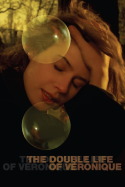
Review of The Double Life of Véronique (1991) by Liam B — 17 Dec 2011
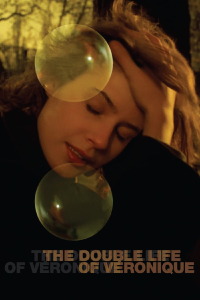
The Double Life of Veronique is a fascinating film which questions our understanding of free-will and self-identity. Director Krzysztof Kieslowski is better recognised for his acclaimed Three Colours films, in which human psychology is explored via a series of dramatic life-altering events, but before this he was already exploring similar themes and The Double Life of Veronique places the notion of duality under his unique filmmaking microscope.
The events of the film are presented through the eyes of two young women, each living on different sides of Europe. In Poland, we meet a talented young singer named Veronica (Irene Jacob) who travels to Krakow to visit her aunt and while there, her beautiful voice is noticed by a choir director and is subsequently chosen to sing at a concert. Walking around town, Veronica is astonished to see a woman on a bus whose appearance is identical to her, but unfortunately this woman is too busy taking photos to notice Veronica. This unusual introduction presents the filmâ(TM)s other protagonist, a French schoolteacher named Veronique. While watching a marionette performance with her students in Paris, Veronique seemingly falls in love with a puppeteer but the veracity of her feelings seem uncertain as this new love brings her a mystifying sadness. The puppeteer Alexandre (Philippe Volter) lavishes her with gifts and tape recordings and after a series of emotional denials she eventually admits her love for him, her confusing behaviour explained by her metaphoric and outwardly literal claim of â~â(TM)all my life Iâ(TM)ve felt I was in two places at the same timeâ(TM)â(TM). As the film progresses there is both tragedy and celebration, culminating with one of Krzysztof KieÅ>lowskiâ(TM)s trademark moving yet ambiguous conclusions.
The Double Life of Veronique explores the long-held belief that somewhere on earth we all have a â~doppelgangerâ(TM), another person who is physically identical to us. The doubling of a single person (such as that of Veronique) causes us to consider the true definition of individual identity. If there are two copies of a person, what distinguishes one from the other and can they ever really be considered unique? Does physical appearance reflect individuality or is it only present in the consciousness of our mind? Anyone approaching this film seeking a Hollywood-style passive viewing experience has simply found the wrong film to watch. The Double Life of Veronique is a challenging piece of work from start to finish. KieÅ>lowskiâ(TM)s narrative relies heavily on a rich tapestry of symbols, metaphors and hidden meanings. He creates a world into which the viewer can read endless interpretations.
The use of cinematography is striking throughout as Kieslowski and his long-time friend and colleague, cameraman Slavomir Idziak, employ a large quantity of colour tints and strange optical filters, a frequent convention of their collaborations, evident in Three Colours Blue. These colours paint both the cities of Krakow and Paris as enigmatic and gothic otherworldly dreamscapes which donâ(TM)t just create the tone of the film but express the conflicting sentiments of their inhabitants.
The Double Life of Veronique pushes European mainstream filmmaking to its most refined limits, without ever neglecting basic filmmaking fundamentals, such as Zbigniew Preisnerâ(TM)s poignant background score. The presence of an attractive and talented leading actress certainly doesnâ(TM)t hurt the appeal either. Winner of the 1991 Cannes Film Festival award for Best Actress, Irene Jacobs manages to generate both intensity and vulnerability in her dual roles and is clearly the perfect performer to complement KieÅ>lowskiâ(TM)s vision, her facial expressions and body language often compensating for the minimal dialogue of his screenplay. This powerful connection between actor and director was highlighted again by their collaboration in Three Colours Red several years later.
However, The Double Life of Veronique doesnâ(TM)t entirely satisfy. Despite Irene Jacobsâ(TM)s excellent performance and all of Kieslowskiâ(TM)s beautiful mise-en-scene, the focus on characters is sadly lacking at times. The film would have been more enjoyable if there was greater exploration into the persona of Veronica, a character just as intriguing as Veronique but whose screen-time pales in comparison. Furthermore, the slow pace of the film with its long drawn-out silences can be a bit taxing on a viewerâ(TM)s patience and is certainly not helped by its vague ending. An ending which seemingly presents the notion of whether our actions are just an act of chance rather than an expression of subconscious desire which ultimately provokes the question, â~â(TM)does free-will truly exist?" Making his film shortly after the fall of East-European communism and the establishing of democratic elections, this deliberation certainly appears to be one of great personal importance to the Polish born Kieslowski.
Alas, the director has no intention of providing definite answers to the many questions this film produces. To deliberate on their endless possibilities is a far more interesting prospect for a filmmaker of his calibre. In the opening scene of the film, a child is shown gazing at the stars in awe of their beauty, perhaps a symbolic reflection of Kieslowskiâ(TM)s amazement at the world we live in, where analysis can sometimes disrupt the magic of simply being.
This review of The Double Life of Véronique (1991) was written by Liam B on 17 Dec 2011.
The Double Life of Véronique has generally received very positive reviews.
Was this review helpful?