Review of The Candidate (1972) by Monsieur R — 28 Jul 2010
Is it enough to justify Michael Ritchie's The Candidate by explaining that it works by posing questions instead of answering them? I think so. On the other hand, I feel as if I've watched a movie that's emptier than I logically know it is. It doesn't seem to create drama as much as make room for it in little wedges allowed by the complex civic process that purely comprises the plot. But that process is so bogged down by spin control, mob mentality and plain human subjectivity that a film merely depicting it realistically and pragmatically should be substantial and effective enough.
Starring Robert Redford, who is assigned the task of carrying the movie on the same attributes with which a candidate must carry his campaign, the movie underlines myriad grievances of contemporary American politics, such as money and image being the top priorities in the election political candidates. Above all, the atrophy of McKay from an visionary public-interest lawyer working for thankless and then-obscure causes (the young environmentalist movement, civil rights for Latinos, integration through busing) and staunch views on all issues into a contrivance of his campaign, headed by asinine slogans and a disheartened worrywart to boot.
The eponymous hopeful is found not to be registered to vote and does not have a clear-cut policy-oriented message to send. But there are issues he is concerned about ("saved some trees and got a clinic open" as Boyle plainly states) and this chance provides a public platform and the facility to be in a position to express his ideas. In agreeing to run, after Boyle assures him that he'll lose, he unknowingly sells his soul, which will automatically lead to his principles being drowned during the cycle of campaigning.
McKay innocently thinks that Boyle will allow him to go where he wants, do what he wants and say what he wants. As the story goes, this guaranteed autonomy vanishes, his principles corrode and he is sold out. His "straightforward stands on issues" are watered down in interview rehearsals: He is pro-choice but told to say that he is contemplating what his stance should be. When he does go off-book, and expresses his own words, especially at the memorable end of a television debate with his opponent, it is viewed with the same communal shock as an actor forgetting his lines in the middle of a performance. While there are some early scenes in which the candidate rambles onto a beach to shoot from the hip with young people about environmental issues and doing walkabouts in Watts, by the end of the film he's standing at podiums and platforms spouting a coached speech in front of bourgeois garden parties and factory workers. McKay switches the social classes he talks to so as to win votes. He is even quoting the campaign slogan in the stump speech.
McKay becomes deluded, yet it is somewhat his own doing. In a pivotal scene, he is called into Boyle's war room and shown the results of a poll in which he is declining fast, he asks why that's a big deal because he was going to lose anyway. Boyle asks him if he's sure he wants to be humiliated. McKay answers, "That wasn't part of the deal." Even when he tries to outrun the political machine, he breaks into forsaken laughter while attempting to record a television announcement, and ridicules his own stump speech. It is evident that he's worried about his own image, particularly in the eyes of the voting public. When gossip circulates that his father, whom he's so far excluded from the campaign, is backing Jarman, his opponent, he briskly pays him a visit in order to get a statement released. With ease his deterioration into politics becomes boilerplate. It is visually implied that he's going to be late for a big meeting with a labor leader after a quick romantic bout with a campaign worker.
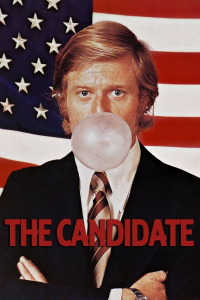
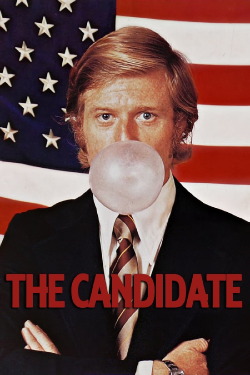
Interestingly, in a film so immersed in and defined by political and electoral process, the symbols and imagery inevitably identified with a campaign, especially the American flag, seldom show up save for a few crucial shots in order to stress the artifice of the candidate. McKay is separated even from red, white and blue through much of the film. Ironically the poster for the film has Robert Redford front and center with the flag in the background. In the movie though, his campaign banner is in green and yellow and at the rallies organized by his own campaign team, the colors of the flag are nowhere to be seen. The sole use of the flag itself in the film occurs near-subconsciously during an archive television commercial for his Republican competitor. When the colors do ultimately show, draped over a car during a tickertape parade with McKay, it highlights that the candidate's approach has completely transformed. By this time he has accommodated the normal symbolic representations of a political campaign and is cooperating with conventional standards.
One key point the film clearly makes is that the business of campaigning has dominated the circumstances of taking office. The drawback is that the voter doesn't plainly see the repercussions of the campaign. And the conflict for Ritchie was to draw conclusions for these indictments of media power and sound bite manipulation, not just let it emphatically end the way it does. So I ask again, is it enough to justify the film by explaining that it works by posing questions instead of answering them? I doubt, for one, that supplying explanations would skew the questions themselves by oversimplifying the intricate process that portrays them. And that would destroy the film.
This review of The Candidate (1972) was written by Monsieur R on 28 Jul 2010.
The Candidate has generally received positive reviews.
Was this review helpful?