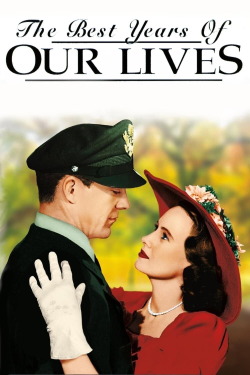
Review of The Best Years of Our Lives (1946) by Kevin L — 08 Jan 2013
In The Best Years of Our Lives, an important element was William Wylerâ(TM)s use of subtle social commentary and a plot which lends itself to cultural diplomacy. The films lead characters, Fred, Homer, and Al, are changed forever after their experience in World War II.
Homer looses his hands, Fredâ(TM)s lack of commercially-viable experience relegates him to working-class jobs, and although Al gets to return to life as usual, his war experience leaves him sympathetic to the struggles of veterans.
Importantly, tension is created when the embodiment of the charactersâ(TM) shared experience with war clashes with mainstream society. Al is forced to explain his leniency toward a veteran seeking a loan, Homerâ(TM)s wife leaves him because sheâ(TM)s unable accept that heâ(TM)s on the low-end of the economic ladder, and Homer struggles to reconcile his relationship with his fiancà (C) for fear that his disability will bring her shame.
The film attempts to create a sense of community by bridging the gap between the veterans and society by anchoring the story in universal experiences of friendship, family, and love to illuminate the theme that true love is that which is found within people who are able to understand and accept one for what one is.
I was particularly moved by the scene where Homerâ(TM)s fiancà (C), Wilma confronts him at home, demanding an answer to whether or not he wishes to stay with her. During Homerâ(TM)s most vulnerable moment when he reveals the extent of the impact of his disability, she shows her love and affection by buttoning Homerâ(TM)s shirt, offering to take care of him, and stating that she will never leave him.
Another moving scene was one where after an argument between a war-isolationist and Homer, Fred knocks out the isolationist. Both scenes emphasize a desire for communityâ"Al and Fred are empathetic to one another due to their shared experience in war, while Wilma welcomes Homer into her community through her expression of unconditional love.
I was particularly moved by the scene where Fred enters an old wartime fighter jet, reminiscing his days of service. This scene highlights yet another theme in Wylerâ(TM)s filmâ"change is necessary.
My critiques include: the slow pacing and unnecessary dialogue, and the dissonant music.
This review of The Best Years of Our Lives (1946) was written by Kevin L on 08 Jan 2013.
The Best Years of Our Lives has generally received very positive reviews.
Was this review helpful?