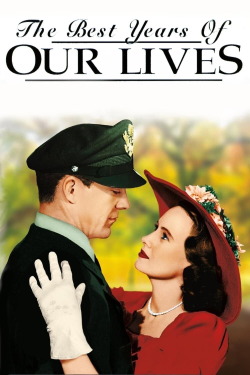
Review of The Best Years of Our Lives (1946) by Cameron J — 19 Jul 2014
"You'll think it's tragic when that moment arrives, - ah - but it's magic, it's the best years of our lives!" I figured I'd go with the much less popular Steve Harley & Cockney Rebels song, because I'm tired of Modern Love's "Best Years of Our Lives", and because the Cockney Rebels song's release is a little closer to this film's. Well, maybe I could have gone with the Modern Romance song when you look at that way, for although this film was released back in 1946, I think that it bled over into 1982. I see that they abridged this film's title from "The Best Years of Our Lives... in Real Time". Well, clearly, back in the '40s, people didn't have much to do, because this three-hour-long opus was the most-watched film since "Gone with the Wind", although, in all fairness, it's not like anyone who went to see "Gone with the Wind" had much time to see anything else afterwards. I'd say that MGM sure knew how to get people interested in punishingly long dramas which were partly about war, during a time of war, and I think I know what their secret was: ...making the film good. So yeah, this film is far from a waste of three hours (Now, after 36 years, it might get on your nerves worse than Modern Romance's "Best Years of Our Lives"), but it's still no "Gone with the Wind", for a number of reasons.
Well, actually, this film may be less histrionic than "Gone with the Wind", and it is certainly less histrionic than many other films of its type, although it remains more melodramatic than it probably should be as a generally genuine portrait on the struggles of war veterans, hitting certain touches in dialogue, characterization and dramatics which suffer from classic, dated sensibilities. Robert E. Sherwood's written dramatics are not the only ones to have fallen short with the test of time, for William Wyler, even with all of his subtle touches, gets a little carried away with his handling of the unsubtle writing and Hugo Friedhofer's emotive scoring, until sentimentality sets in, betraying the unique grace of this drama by falling back into the conventions of the time. Really, formulaic storytelling holds this film back in a number of ways, because whether it's melodramatic or not, the familiarity of this film sort of blands up a primarily engrossing affair, whose conventions can at least be appreciated for standing among the handful of consistent aspects in the plot. Perhaps I exaggerate the unevenness of the focus to this narrative, but storytelling ambitiously tackles three separate portraits on the struggles of a man returning from war, and does so with a certain inconsistency that convolutes the sense of importance of each story, and derives from the film's lack of tightness. Falling just short of three hours, this film's runtime is questionable, and seeing as how as big a problem as anything in the final product is bloating, Sherwood's script is packed with fat around the edges that drags filler to the point of meandering, and taints material with excess that it typically of a melodramatic, or formulaic, or focally uneven nature. Pacing proves to be the root of all issues in this film, and on top of that, it keeps you around longer than it probably should, and no matter how compelling the final product always is, this drama falls short of what it could have been under the weight of an ambition too great to transcend limitations of the time. Still, like I said, the film compel thoroughly throughout its questionable course, even though its story concept promises to really enthrall.
Alcoholism, financial struggles, finding new love amidst the collapse of the old, and coming to terms with limitations one brings home are all conflicts found by veterans returning from war to a world which was not what they dreamed of, and that makes for an overblown and melodramatic, but powerful story concept that helps a great deal in making the final product so rewarding. Of course, it does ultimately come down to the interpretation of intriguing subject matter, and when it comes to that, Robert E. Sherwood drops the ball in a lot of places as screenwriter, getting melodramatic and excessive, but tight where it counts, making sure that there's enough going on to prevent dull spells, and putting a then-daring and still-powerful deal of attention into the heavy depths of this dramatic subject matter. Although genuineness lapses at times, where this script could have really succumb to dramatic superficialities of the time, it's not afraid to get relatively edgy, and even on paper, it engrosses in its capturing the hope, anguish and other layers of memorable, humanized characters which are further sold by a strong cast. The material may be a touch too dated for the performances to really prove outstanding through the years, but everyone delivers, and that especially goes for the leads, whether it be Dana Andrews as a traumatized man who struggles both to satisfy his wife and with feelings for another woman, or Fredric March as a now-alcoholic family man, or the particularly unevenly used and, in my opinion, show-stealing Harold Russell as a good-spirited, but ultimately handicapped veteran who must learn to live with his limitations and how his peers interpret them. There's a lot of emotional commitment put in each one of these performances, and although they were more remarkable at the time, they remain piercing to this day, much like an offscreen performance by William Wyler that can make or break the engagement value of this drama. Sure, this film flirts with flat spots, thanks to Wyler's sentimentality and failure to completely compensate for pacing issues through tight scene structuring, but Wyler never allows entertainment value to abate, holding your attention until moments of dramatic realization which range from compelling to penetrating in a fashion which was ahead of the time. This film could have gone far if it was even more realized, but as things stand, the final product is never less than engrossing as a conceptually important and ultimately rewarding drama.
In conclusion, some histrionic and formulaic writing and sentimental direction shake the genuineness of this drama, while uneven focus and an excessive structure which stands at the root of most all of the issues shake the momentum of the final product, until it falls short of what it could have been, yet by no means so short that worthy subject matter, audacious scripting, compelling performances and inspired direction fail to make "The Best Years of Our Lives" a rewarding classic of a portrait on the painful struggles war veterans found in themselves and the world around them upon returning home.
3/5 - Good.
This review of The Best Years of Our Lives (1946) was written by Cameron J on 19 Jul 2014.
The Best Years of Our Lives has generally received very positive reviews.
Was this review helpful?