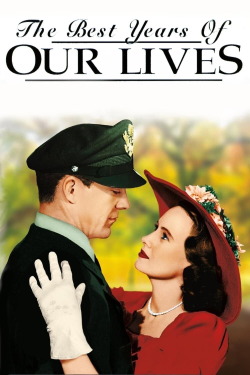
Review of The Best Years of Our Lives (1946) by Chrismizerak — 05 Feb 2020
The best kind of film you can possibly come across is one that you know next to nothing about, and yet completely surprises and enchants you every single step of the way. The less you know about the film going in, the more rewarding it will be when you find a valuable treasure on your hands. And that is exactly the situation I experienced when watching "The Best Years of Our Lives" for the first time many years ago.
I knew it won many Oscars including Best Picture over "It's a Wonderful Life" the same year. I recall it being directed by William Wyler, who brought us the big screen spectacle "Ben-Hur" from 1959. The rest I had to discover for myself. What I ended up getting was something more emotionally tender, down-to-earth relatable, and packed in relevance than I initially expected. And ever since then, "The Best Years of Our Lives" continues to maintain its special impact on yours truly.
As someone with Asperger's syndrome, a disability nowhere near in the same realm as using hooks for hands, I sincerely appreciate and respect a film like "The Best Years of Our Lives" existing to help reassure disabled people (of all kinds) in need. In the case of one of our three main storylines following Homer (played by an impeccably cast Harold Russell), a Navy officer who lost his hands during World War II, this statement especially holds true.
Harold Russell, too, lost his hands due to a tragic accident during his service in World War II. Now whereas the film character Homer suffered from burns on his sinking ship, the real-life actor Russell accidentally detonated explosives with defective fuses in a demolition exercise as an Army instructor in 1944. Even with different situations considered, the feeling of not fitting in despite the best efforts of everyone involved is effectively conveyed in Russell's performance.
This is made all the more impressive, considering that Russell had no acting experience prior. And yet it resulted in the rare occasion that the same actor won an Oscar twice for the same role: one for Best Supporting Actor and the other as an Honorary Award for inspiring fellow war veterans. But all this praise I'm bestowing to Russell and his character Homer might give the impression of me selling the rest of the film short. Let's not forget about Dana Andrews, for example.
His character Fred's struggle to maintain a happy lifestyle with his dissatisfied wife, played by Virginia Mayo, as well as his sweet yet forbidden relationship with Peggy, played by Teresa Wright, just goes to show you that not every war veteran has it lucky after their service. Peggy's father is also fellow war veteran Al, played by Fredric March, who can't comprehend how much time has passed since he's seen his wife, played wonderfully by Myrna Loy, and kids and is still unsure if all of this is real or not.
The way these three storylines come together and the relatable struggles each one has to face remains satisfying. The cinematography by Gregg Toland, of "Citizen Kane" fame, delivers some imaginative and inspiring visuals and imagery such as the fighter plane graveyard, the panning mirror shot, or Al's return home to his wife shot in deep focus. As Fred reassures Homer at the end of this film, when it comes to films like this, "I'd stand up for you 'til I drop".
This review of The Best Years of Our Lives (1946) was written by Chrismizerak on 05 Feb 2020.
The Best Years of Our Lives has generally received very positive reviews.
Was this review helpful?