Review of The Bad and the Beautiful (1952) by James H — 18 Jan 2010
Turns Out Not Actually Worth the Wait.
I started to watch this ages ago when it was on Instant Play on Netflix. And then suddenly, it wasn't--they may have told me it wasn't going to be anymore and I missed it, but either way, it was gone. I was displeased, but oh, well. I put it on my actual physical queue, the one where the discs come in the mail, and a couple of weeks ago, I bumped it to the top, because hey, Kirk Douglas. I'd finish it this time. Only the DVD didn't work. So I told them this and sent it back, and they sent me another copy. Which didn't work. Lather, rinse, repeat. The disc I watched this evening was the fourth one I've gotten from them, and it's the first time my DVD player would do anything other than tell me it was a "bad disc." Normally, I have no trouble with Netflix, as you know, but I'm kind of mad right now, especially given that the only way I can tell them all of this is by phone.
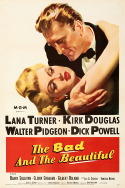
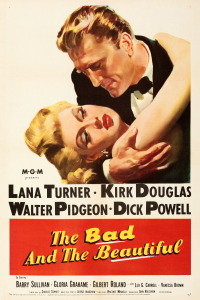
Anyway. Studio head Harry Pebbel (Walter Pidgeon) summons three of the great names of Hollywood to his office--director Fred Amiel (Barry Sullivan), actress Georgia Larrison (Lana Turner), and screenwriter James Lee Bartlow (Dick Powell). All three had, early in their careers, association with producer Jonathan Shields (Kirk Douglas). Each one of the three considers themselves to have been screwed over by Shields during the association, and none of them have spoken to him in years. But now, he's hard up--no one in Hollywood will touch him, largely because he's such an enormous pain. However, he made Pebbel a lot of money, and Pebbel's going to help him out. Each of the three have the story of their association with Shields told, and it's explained how, really, they're better off for having known him. Because of course future success outweighs everything. I mean, sure, probably the most traumatic experience of Bartlow's life was indirectly Shields's fault. He got a great book out of it, right?
Actually, honestly, Bartlow has the least room to be upset. Yes, all right, Shields did arrange for his wife, Rosemary (Gloria Grahame), to go away on a trip with Victor "Gaucho" Ribera (Gilbert Roland, an actual Mexican who also played a Russian and a couple of Arabs), a Latin lover whom Shields has gotten a few meatier roles. Shields was taking Bartlow away from all this into the quiet of his place at "the lake" so Bartlow could write a screenplay without interruption. What happened after that was not Shields's fault, and it's unjust to suggest that it was. However, he gets no such pass for what he did to Fred, and what he did to Georgia was frankly inexcusable. I mean, it's made pretty clear what could have happened to Georgia after the way he treated her, and it's only for the convenience of the framing device that it didn't. Maybe he shaped her into a great actress, but he couldn't have counted on his technique's not backfiring after he did that to her.
Kirk Douglas rightly lost the Oscar to Gary Cooper that year, but at the same time, he does have a knack for this sort of character. Shields has bags of krisma, but unlike dear Captain Carrot, he uses his power for, if not evil, certainly self-aggrandizement. His greatest artistic triumph, at least of what we're shown, comes because he's too broke to do the film any other way. (It is also, as it happens, a reference to a horror movie we've covered before and which is really good--and the technique was used by Spielberg for similar reasons.) He isn't interested in Bartlow's good or Fred's or Georgia's and certainly not Rosemary's. (Gloria Grahame won, but should have lost to Jean Hagen as Lina Lamont.) Shields in many ways represents the Hollywood which is always just under the glamour. It's no coincidence that Shields, our hero and villain all at once, is a producer. For one, most people aren't even sure what producers do. No, the other three are the visible arts, leaving Shields to be the bastard behind the scenes.
It is also interesting to note that hardly any of these people really got where they are, at least initially, because they were good. Shields was the son of a movie mogul who died broke, and he got back into the game by losing a ton of money--probably on purpose--to Pebbel, who hired him as a way to get his money back. Fred, who had been a paid mourner at Shields the Elder's funeral, made an impression on Shields as a man. Georgia was the daughter of a man who had known Shields the Elder, and Shields felt some sort of connection and even responsibility toward her. Bartlow was, yes, established to be a good, if sensational, writer, but there's no reason to believe that translates to being a good screenwriter; he's there for the name. Pebbel is blatantly only in it for the money. But for the people who went to see a movie made by any of them, that didn't matter. Someone I know online is asking why people are so interested in fiction, and I think part of it is that it's so easy to slip into the world a really good creator of fiction shows us. It's easy to picture any of these characters letting us do just that.
This review of The Bad and the Beautiful (1952) was written by James H on 18 Jan 2010.
The Bad and the Beautiful has generally received very positive reviews.
Was this review helpful?