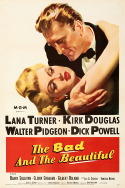
Review of The Bad and the Beautiful (1952) by David F — 29 Jun 2014
Melodrama and slow pacing undermine this otherwise excellent inside look at Hollywood.
*** This review may contain spoilers ***.
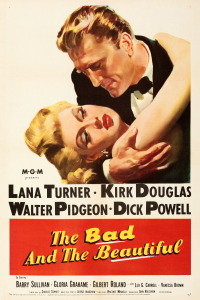
'The Bad and the Beautiful' has three protagonists whose recollections constitute the film's narrative. The three are the successful Hollywood heavyweights Director Fred Amiel (Barry Sullivan), Actor Georgia Larisson (Lana Turner) and Writer James Lee Bartlow (Dick Powell). They've been called in by Studio Executive Harry Pebbel (Walter Pidgeon) to see whether they're willing to work with the legendary Producer Jonathan Shields (Kirk Douglas) who they all are alienated from after having bad experiences working with him in the past. As the three head into the studio grounds, Georgia pauses and draws a mustache on a Coat of Arms which graces the entrance to the studio. This moment foreshadows Shield's tough love approach toward everyone who's ever worked with him?in the case of Georgia, Shields drew the mustache on a photographic portrait of Georgia's father who she couldn't break free from despite his death ten years earlier, leading her to an ugly bout with alcohol.
The first sequence (and best part of the film) focuses on Amiel's recollections who broke into the film business with Shield's help. Right away we learn that Shields is the son of a well-known Hollywood silent picture director who was broke at the time of his death. In a rather over the top scene, Ameil badmouths Shield's father at his funeral as Jonathan pays mourners to attend. Shields won't pay Amiel after hearing him disparaging his father but later Amiel shows up at the Shields mansion (about to be sold) to apologize. This marks the beginning of their friendship.
The Amiel recollections grow more fascinating. Shields borrows money from his friends and loses about $6,000 in a poker game with some big-time Hollywood executives. But instead of setting him back, Shields convinces Harry Pebel to give him a job as his assistant with the proviso that he garner his pay check in order to pay back the poker debt. More 'insider' peeks at the film business: Shields and Amiel work on their first big success, "The Doom of the Cat Man" as well as the inner mechanics of 'audience testing' (just like today, ratings cards are handed out to pre-screeners).
Shields and Amiel pay a visit to the now shuttered mansion of an actor who used to work for Shield's father. Curiously, Shields never knew he had a daughter and they find her there drowning her sorrows in alcohol (we never see her face, only her legs dangling over a trapdoor in the attic). Soon, the studio honchos green light Shield's work on 'The Faraway Mountain', an "A" picture based on a well-known novel. Shields wines and dines the big-time Latin actor, 'Gaucho' to star in the picture but he ends up drinking too much and passing out. That's an example of one of the many different sides of Shield's character we see throughout the film. The 'Amiel' sequence concludes with him being forced out by Sheilds who is pressured by the studio executives to hire an established director, Van Ellstein (perhaps modeled on Von Stroheim or Otto Preminnger), wonderfully played by Ivan Triesault.
The film begins to lose steam in the second sequence narrated by Georgia Larrison. She's the girl Shields discovered at the mansion. The idea of the big Hollywood producer shaping the career of an unknown actress may have been taken from the relationship between David O. Selznick and Jennifer Jones. Selznick and Jones did marry and remained together until his death. In this story, Shields has no intention of marrying Georgia. At one point she asks him, "Would you marry me?" and Shields classically replies: "Not even a little bit!". Georgia's obsession with her legendary actor father is the tired reason for her alcoholism and the 'bout with the bottle' takes up too much time in a sequence which can be best described as 'cliched'. The sequence is not however without its classic moments: Shields dumping Georgia in the pool and the completely over the top 'almost' car accident where Georgia speeds away from the Shields mansion after finding him with his latest bimbo.
Equally uninviting is the third sequence, narrated by Dick Powell's James Lee Bartlow. It's hard to believe that Gloria Grahame won the Best Supporting Oscar for her role as Bartlow's Southern Belle wife. It's not a difficult part but since it was perhaps so different from characters Grahame was usually cast as, that's why they gave it to her. The focus is usually on the rise of actors in Hollywood films so it's refreshing to see the story of how a writer becomes successful. But most of the 'Bartlow' sequence is slow-moving, especially the tedious scene at Bartlow's home. Without its one 'shocking' scene, the entire sequence probably would not have worked at all?and that's the revelation of Gaucho and Rosemary Bartlow's death in the plane crash, very reminiscent of the death of Clark Gable's wife, Carole Lombard. Before Bartlow becomes alienated from Shields (after Shields inadvertently blurts out that it was his idea for Rosemary to go with Gaucho on the plane trip), there's an excellent scene where Van Ellstein resigns as director on one of Shield's big pictures. It's the type of personality clash that still happens often in Hollywood.
The cast of 'The Bad and the Beautful' are equally wonderful. I particularly liked Gus, Georgia's over emotional agent, played by Sammy White. Kirk Douglas is excellent as Jonathan Shields although it should be noted that the part of Shields is just as much protagonist as antagonist. This is no 'poison pen' letter to Hollywood at all. As alluded to before, Shields administers 'tough love' to his minions and as Walter Pidgeon points out to the three 'supplicants', they all owed their careers to Jonathan Shields.
'The Bad and the Beautiful' is a well-made film with top notch performances. It could have been a classic except that it descends into melodrama and falls victim to slow pacing once it reaches its midpoint.
This review of The Bad and the Beautiful (1952) was written by David F on 29 Jun 2014.
The Bad and the Beautiful has generally received very positive reviews.
Was this review helpful?