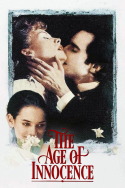
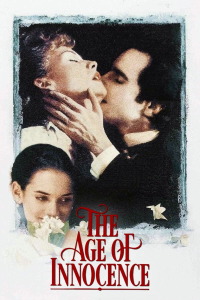
Review of The Age of Innocence (1993) by Chad S — 28 Aug 2007
Edith Wharton called it an age of innocence, a time when social constructs and expectations superseded individual wants and desires. The phrase was ironic because the basic human instincts remained: lust, greed, and selfishness. But they were hidden amongst a strict social code that everyone adhered to but no one read or was taught. Each member of this society learned the code through experience and patience. Hand gestures, facial expressions, choice of clothing, house decor, and dinner menus were all important. The slightest behavioral anomaly was admonished by society. It wasn't simply unacceptable; it was dangerous to the stability of their way of life.
Newland Archer lives in this world. It is the 1870s in growing New York City. We see houses of Victorian splendor, wardrobes of luxury, and facial expressions of precise choice. All spoken words are particular and thought out. Nothing is said or done without a strict interpretation of this society's code. And Archer appears to live comfortably in this world. He has asked May Welland for her hand in marriage. The engagement is accepted and celebrated by both families. There is not love between the two, but there is fondness. Archer and May say they love each other, but there is a sense of family loyalty. The families are marrying, not the couple. Marriage was about keeping the society going, a self-preservation of life hidden under layers of public expectations.
Archer then meets one of May's cousins at an opera. Her name is Ellen Olenska, and she has the most troubling of reputations. She has made two particularly bad choices. She first married a man outside of the society and moved to Europe. She then separated from him and returned to New York City. Her unacceptance was not spoken of but was instead observed through a silent neglect. Invitations to a dinner were ignored. Conversations were even more purposely chosen to glorify a more accepted "member's" successes while quietly scorning her failures.
Archer is taken with the countess. He admires and soon adores her independent thought. Olenska is clearly a deviant of sorts. She remains a member of the society, but she is bold enough to tell Archer of her troubles with it. She is a free thinker and acts upon such thoughts and feelings. He soon begins to peel off the layers of social behavior. Their love is rarely spoken of but immediately observable. Simple stares or choice words are all that is necessary to reveal this mutual love. What is interesting is that this love continues to feature many of the social mannerisms as anything else even though it would be so richly abhorred by the rest of their society.
As their love continues to grow, we begin to see the layers of resentment and horror peel off the others. May, who at first glance appears to be somewhat aloof and ignorant of their love, is instead fully aware of the love between Archer and Olenska. Her actions, premeditated and intelligently crafted, congeal with the other members of her family and her neighbors to separate the two of them. The methods are cold and unflinching. Furthermore, they are never spoken of. Everything is done in secret, behind closed doors. The code is at work here through an instinctive defense. Dinners are prepared, well-timed revelations are spread through the neighborhood, and all Archer and Olenska can do is to react in the interests of their society.
[i]The Age of Innocence[/i] is a story about choosing society over individualism. It is a story of unrequited and forbidden love. The most poignant of love stories immerse themselves in selflessness and despair. The most maddening and heartfelt love stories are those that focus on the interdependence, the mutual need, and the dreaded threat of loss. Director Martin Scorsese is aware of these facts and carefully crafts this wonderful film around these constructs.
If [i]After Hours[/i] is Scorsese's forgotten masterpiece, [i]The Age of Innocence[/i] is Scorsese's neglected one. Countless critics revere the film as one of his most brilliant. But the story never caught on with the public at large. When watching the film, it is not surprising. The society Scorsese presents doesn't equate in any way with the society we now live in, one glorifying the individual desires and passions over the societal needs. Scorsese's sophisticated, careful presentation of each social event and conversation was probably too much for an impatient present public to take. Too bad. This is a film of genius observation and remarkable social commentary.
[i]The Age of Innocence[/i] is told with a silent but powerful message. The quiet, rigorous society of facades and empty rituals and expectations is just as brutal as the mean streets of a pathologically "individual" society emanating throughout the globe today. Both social constructs contradict the simple human instincts running our emotions and motives. A society cannot be an exaggeration of itself or of individualism. Because at the heart of each type is the loss of the true human desires of happiness and love.
As May's plans to foil Archer's and Olenska's plans to fall in love and move away are revealed, we see Scorsese's purpose at work. Olenska moves away, back to Europe, only revealed to Archer through a string of social events and gestures that place him in a helpless turmoil. He lives on with May, has children, and lives through the society's strict codes. May dies several years later, long after Olenska has left. Archer's children have grown up. One of his children wants Archer to go to Europe. He wants Archer to see Olenska. Archer has never told his son the story and has not seen Olenska since her departure to Europe the many years before.
And as they wait outside to go up to Olenska, Newland sits on the bench and tells his son to go up without him. His son is incredulous and does not understand the decision. Newland tells his son, "Tell her I'm old-fashioned." So he goes up. The camera sits on Newland, his face full of regret, despair, and resignation. He then gets up and walks away. The scene is a master stroke, one of the greatest in all of film. Never has unfulfilled love seemed so tragic. Newland chose society and not himself, and he lost everything because of it. But even now, he remains tied to his societal norms. He has never escaped it.
The acting in the film is superb. Daniel Day-Lewis plays Newland Archer with reserve, with his character's urges squirming under the surface. Michelle Pfeiffer plays Olenska with a bemused anguish. She gives the countess an air of rebellious scorn of the society she stills clings to. And Winona Ryder plays May at first with one-dimensionalness, only slowly revealing her true intelligence and complexity. These performances must be pitch-perfect because the tone of the movie would fall apart without the nuances the characters require.
And Scorsese's direction is brilliant. His restless camera here has a stubborn patience, with very slow continuous motion in the cinematography. Each scene feels like a curiosity, almost like a person stretching his/her neck in to her the secret one is telling another. Scorsese also employs theatrical lights, colors, and sounds to emphasize scenes of particular importance, especially when an individual's choice is made in the rigid facade of the social codes the film demands. Scorsese's attention to detail here is astonishing.
I have seen this film many times. I like it more each time. It is perhaps Scorsese's greatest work. Each of his films is a meditation on individual desires in surroundings that do not allow for them. Never has it felt so demanding, so painfully tragic, so excruciatingly poignant as in this film. When I look at Newland walking away from that bench, walking away once again from Olenska and the life he really wanted, I remember a line he uttered earlier in the film: "You gave me my first glimpse of a real life. Then you asked me to go on with the false one. No one can endure that." And I remember that Olenska was the only one who ever had the decency to ask him to.
Rating: 9.75/10.00 or ****.
This review of The Age of Innocence (1993) was written by Chad S on 28 Aug 2007.
The Age of Innocence has generally received very positive reviews.
Was this review helpful?