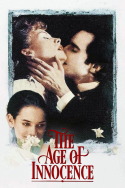
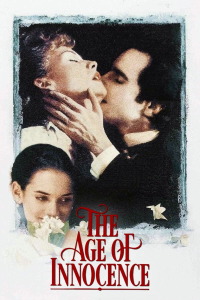
Review of The Age of Innocence (1993) by Brandon H — 18 Mar 2011
In high school I was introduced to Edith Wharton. We were assigned to read "Roman Fever," one of her most popular short stories And although it remains one of only two fiction pieces of Wharton's I've ever read, the language of that story has stuck with me through the years; her authorial voice has a distinct regal feel, one of elegant precision and careful vocabulary. This care results in a slow-paced rhythm that feels right for her extremely wealthy, extremely traditional 19th century characters, who are all churning and alive underneath their skin, but around other people say things like "Yes indeed, I'd very much like to visit Paris again someday." So the stories become heavily narrated to give the reader tension. You will not find any explosions or sword fights in an Edith Wharton story. These are stories about complex people who are angry but are trapped by an endless cycle of maintaining social norms.
So the question is, how do you tranform a story consisting mostly of small talk at dinner parties into a watchable 2.5 hour film? Or perhaps the real question before getting to the "how," is why?
I have no answer. Maybe Martin Scorsese had already beaten that day's crossword and required a new challenge. And "The Age of Innocence: THE MOVIE" is born.
Being familiar with Wharton's style, then, I was not exactly surprised when the film turned out to be a little exhausting to sit through. I was also not surprised that the film relies heavily on off-screen narration, which unfortunately makes a substantial contribution to the tedious experience. It's difficult to find the same enjoyment in some undisclosed off-screen narrator telling me how the characters are feeling, and why, rather than seeing it happen on the screen with my own eyes. But I understand the dilemma: for much of the first half of the film, we viewers would be lost without some narrative help. In the opening segment, for instance, we learn about 30 names in almost as many seconds. We are told their brief histories, their "positions" in our setting (New York city), and even in some cases their opinions, behaviors, and tendencies. Nearly all of this information is relevant at some point in the story. Or at least, the surface-story.
And by surface-story I mean the story we don't care about. Yes, that's the small talk at dinner parties. And oh, how many dinner parties there are, and while they're elaborately and artfully designed (the art direction and cinematography in this film is fabulous), this is not a story about dinner parties. This is a story about a man who loves Woman A, whom he can't have, because he is instead getting married to Woman B (Woman A's cousin), whom he finds painfully uninteresting (and so do we).
So the story goes of his inner struggle. Woman B and our protagonist are both in love, but they can't possibly fully realize that love because of their social restrictions. The moments when the two of them are together are the best and most engaging in the film, because we don't need a narrator telling us what to think. These are the scenes of raw emotion and drive the "real" story forward. This is the story we want to see unfold. This is the story that brings us to the conclusion. The other half of the movie, those gosh darn all-consuming dinner scenes, are sprinkled in between the "real" story scenes and weigh down the film. They start to become a burden on us, the viewers. We start to feel the horrible emptiness of this constant social upkeep, right along side our protagonist.
Eventually (spoiler!) Woman B leaves New York because she can't take it anymore. And "it" could mean many things. "It" could be that (spoiler!) Woman A becomes pregnant with the protagonist's baby, and she realizes their impossible happy ending will never be realized. Or "it" could be her inability to fit in with these phony, elitist New Yorkers. It's probably a combination of both. I was a little glad when she left town, because then I knew the story was coming to a close for me, too. Yes, that's a cheap shot, but you know what? It's hard to watch fancy dinner scenes for 2.5 hours on an empty stomach. It really is.
This review of The Age of Innocence (1993) was written by Brandon H on 18 Mar 2011.
The Age of Innocence has generally received very positive reviews.
Was this review helpful?