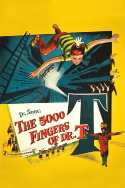
Review of The 5,000 Fingers of Dr. T. (1953) by Edith N — 20 Apr 2010
Kids are weird. They just are. The world inside a child's head is not the same as the world inside an adult's head. Oh, mind you, some people manage to remain close--and Dr. Seuss always seemed to be one of them! However, one can see the . . . call it unawareness of adults to how children think in most movies involving them. We've talked about the horrible shrill movie children. We could talk about all sorts of stereotypical movie children as well. It just happens, I guess. I've noticed that I have a hard time writing male characters, and most people write characters from their own ethnic, social, or national group. We just do. It's what we're comfortable with. And we think, well, we [i]were[/i] children, so we know what they're like. But I've seen a lot of people who clearly don't.
Bartholomew Collins (Tommy Retig) doesn't want to learn how to play the piano. (Dr. Seuss does like that first name!) His mother, Heloise (Mary Healy), has hired Dr. Terwilliker (Hand Conried) to teach him; the titular Dr. T. is upset at Bartholomew's tendency to fall asleep at the keyboard, as is Mrs. Collins. Bartholomew appeals to the plumber, August Zabladowski (Peter Lind Hayes), who somehow convinces the kid that Dr. T. is a conman or racketeer or something--and, after his mom makes him go back to practicing . . . the kid falls asleep at the keyboard. His dream world, designed by Seuss himself, is a horrible nightmare vision of Dr. T.'s compound, in which Dr. T. has an enormous piano--and a cellblock. He's planning to make 500 boys sit at the piano and play his music, and then will presumably lock them up and make them do it again. Horribly, it turns out that he's brainwashed Mrs. Collins, who is going along with it now.
Now, I didn't like practicing my viola. I was awfully good at playing it, but not half so good as I could have been had I put about half an hour's effort into it a day. I acknowledge this freely; I suspect quite a lot of talented musicians could. I loved to play, but practicing alone was [i]boring[/i]. How much worse on piano, when there's no real way to practice in a group. And the kid doesn't even seem to love the piano. He's playing because his mom thinks he should be able to. Clearly, this is why she joins Dr. T. in the nightmare world, but because the kid loves her and cannot believe that she'd do anything that was bad for him, she has been brainwashed into this and it is Dr. T. alone who is evil. And Zabladowski, who cannot save him from the piano, cannot save him from Dr. T.'s compound.
Frankly, the kid ought to be off writing books or something instead. Painting. Something that will use that imagination. Yes, I know; music can. But when you've been playing for a very little time and are still playing tedious beginning piano music, not so much. It only starts getting really creative when you're more experienced and learning about improv and composing. And even then, you have to love the music first. I think Bartholomew likes listening to it, but I don't think he's ever going to love playing it. I understand that his mother thinks he should know an instrument, and I can even understand why. I do think it helps to make a well-rounded person. And hopefully, she will at some point see that he doesn't like it and let him give up. I'll also admit that I'm curious if there's a less . . . scary piano teacher in town.
I think this is one of those polarizing movies. Either you like it or you don't. And if you like it, you probably like it a lot. And I do, in fact. Oh, it's got its flaws--why doesn't Bartholomew take off the Hated Beanie and leave it somewhere? And I'm not sure why the kid thinks a plumber he barely knows is his salvation, except inasmuch as there's really no one else. But he also seems awfully determined that his mother should marry the plumber, even though there's no sign anywhere in the story--in real life [i]or[/i] the dream--that he and Mrs. Collins even really seem to know one another. I have to say, though, it's got one or two really great musical numbers, that twisted Seussian set, and various other shining points. You have to get into Bartholomew's head, and that may be difficult for some people, but I think it's worth the effort.
This review of The 5,000 Fingers of Dr. T. (1953) was written by Edith N on 20 Apr 2010.
The 5,000 Fingers of Dr. T. has generally received positive reviews.
Was this review helpful?