Review of Tender Mercies (1983) by Ashley H — 22 Nov 2014
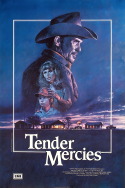
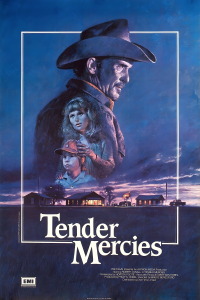
"Tender Mercies" is a kind-hearted character study, but it doesn't have much in that vein to study. Everyone in the film, both the ones on screen and the ones who are simply allusions, is a perfect archetype. They are simple figures whose traits are summed up in no more than an adjective or two: an alcoholic country singer, a pious and patient widow, a glitzy but troubled Opry singer. To the film's credit, its shoe fits: the simplicity of the people is matched by a terseness of expression and a plain setting somewhere outside of Austin-not in one of that city's prettier Hill Country environs, either. The dialogue is especially direct in the case of the intensely personal questions that flow ceaselessly from a young boy to his widowed mother and stepfather. It's helpful, and rare for a serious drama which might be expected to strive for nuance and ambiguity, to know exactly what characters are thinking and feeling.
The tradeoff is that what the characters think and feel is, to go back to this word, pretty simple. It's almost painfully uncomplicated, like a screenwriter's perception of what common, everyday folks' lives are like, but without being accidentally patronizing. The movie has no elitism, no detachment that could hint at superiority: it is warm and forgiving and non-judgmental to its characters, perhaps to a fault in the case of Robert Duvall's protagonist. The movie passes lightly over his history as a domestic abuser, a fact that might not be so uncomfortable if our knowledge of the women in his life were not so filtered through his eyes. One of the best scenes in the film takes place when he is away from home for a day and a night, and his wife and stepson are left to talk to each other. Most of the time, though, we see what he sees in pretty much the way he sees it. Could our perception of the Opry singer who was his ex-wife be limited to "glitzy but troubled" if we saw her in the long years of her single parenthood rather than in the emotionally-fraught circumstances that are the only intersections between her and Duvall's character? Similarly, his young adult daughter is written in a way that says more about him than her, and her arc seems to exist primarily to give him a reason to comment on his arc. She is the quintessential teen trying to grow up too fast in a manner that is thought to add depth to males but bring females to tragedy, just another example of moralistic fiction trope stretching back centuries.
The plotting, then, is unsatisfying, and the characters too. The acting is capable, but it's nothing mold-breaking for Duvall, who nevertheless won an Oscar for it. A generation later, the movie "Crazy Heart" (2009, also featuring Duvall, but in a supporting role) would take the very same subject matter and throw in a few new twists and a couple of big, chewy, Oscary scenes that won its star Jeff Bridges the same award. The music alone is a sufficient reason to watch "Crazy Heart," which did for outlaw and alternative country what "O Brother, Where Art Thou?" (2000) did for American traditional folk. The music in "Tender Mercies" is also worth a listen, especially for fans of classic country in the Nashville and Bakersfield modes. The songs don't quite make it a must-see, but they are highlights of a pleasant enough hour and a half.
This review of Tender Mercies (1983) was written by Ashley H on 22 Nov 2014.
Tender Mercies has generally received positive reviews.
Was this review helpful?