Review of Taxi Driver (1976) by Cary R — 23 Apr 2014
Now regarded as a cinematic classic, I have to admit that Martin Scorsese's "Taxi Driver" was always a film that left me as isolated as it's lead character. The first time I saw it, I thought it vastly overrated. Admittedly, I was in my teens at this point and never managed to fully grasp it's themes. With each viewing it, admittedly, grew in stature but I could never really get over my initial judgement. It's not often that I'll backtrack on my opinion but I have now come full circle and can appreciate just how good a film it is and why it's regarded as one of the true greats of American cinema.
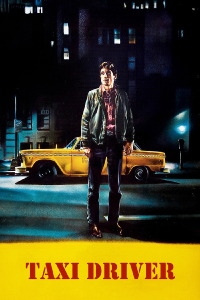
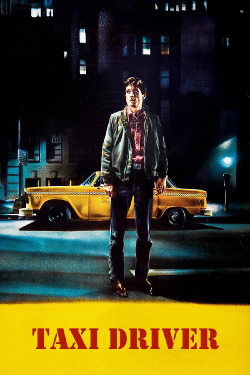
Travis Bickle (Robert DeNiro) is a lonely, mentally unstable taxi driver who scours New York City every night where he becomes increasingly disgusted with the seedy cesspool around him. He attempts to strike up a connection with local presidential campaign worker, Betsy (Cybill Shepherd) but when that falls flat, he takes it upon himself to change things and fails again in an assassination attempt on the Senator himself (Leonard Harris). Determined to make a difference, he turns his mind to rescuing Iris (Jodie Foster), a preadolescent prostitute from the clutches of her pimp and lover, Sport (Harvey Keitel).
Opening with Bernard Herrmann's distinctive and sleazy score, we are thrust into the nightlife of New York City where there's a blaze of neon light reflected on the streets and rainswept windscreens. The grim debauchery of the city's nightlife is captured to perfection by Michael Chapman's striking cinematography. As much as Herrmann and Chapman play a major part in the proceedings, though, so too does the unsettling delivery of DeNiro in a bravura show of restraint and suggestion. The film wastes no time in introducing us to his iconic Travis Bickle: a 26 year old, Vietnam veteran and insomniac who struggles to socially connect. This truly is one of DeNiro's finest moments onscreen. He would receive, a well deserved, Oscar nomination and to actually win the award would not have been out of place either. It's a captivating performance and it's hard to avert your eyes from his intensity. Speaking of eyes, it's easy to lose count of the amount of times that DeNiro acts with them alone. At times, he doesn't even need to speak as his eyes, either directly or indirectly, speak volumes. We often get a glimpse of them as he observes the city's inhabitants through his rear view mirror and there's a lot going on. Behind them, a simmering menace and desperation are so expressively captured and Scorsese is wise to focus on them. Essentially Travis' eyes are our own in this debauched and immoral world of degenerates. Even DeNiro's (now infamous) "You talkin' to me?" ad-lib stems from him observing himself in the mirror and playing out his deranged fantasies. Whether intentional or not, Scorsese's use of mirrors play quite a significant part in reflecting Travis' alienation and paranoid psychosis.
As for the Big Apple itself, Scorsese has regularly been known for his ability to capture it in the minutest detail but "Taxi Driver" has to be the most descriptive he's ever been. Through Travis' perspective, he depicts it as a nightmarish, hell on earth; the steam rising from the street vents and crime and prostitution at every corner. This is a city that's depicted with dark and repugnant depths as the dirt and grime oozes from it's pores. Our troubled protagonist struggles to come to term with it as we observe his increasing frustration and distance. We feel his alienation and through his diary entries we are allowed to hear his innermost thoughts. It's unnerving to see Travis' decent and the dangerous fragility of his mental health. When he finally attests to having "... some bad ideas in my head", we realise that the depravity of this environment is dangerously permeating this man's psyche.
At one point Travis is compared the lyrics of Kris Kristofferson's song He's a Pilgrim: "... a walking contradiction, partly truth and partly fiction.
Taking every wrong direction on his lonley way back home" which is cleverly dropped in at an early point in the film but only makes complete sense when his odyssey is over. It's moments like this that only serve as a reminder of the layers in Paul Schrader's script. This isn't simply about one man's struggle with society but an astute, psychological character study that ambiguously treads a fine line between redemption and damnation while leaving us to question our interpretation of events. The denouement is particularly interesting and although Schrader himself has stated that the closing "could be spliced to the first frame, and the movie started all over again" suggesting that what we've witnessed falls more into the damnation element of Travis, there also exists a sequence that could arguably be claimed as redemptive which would leave Travis Bickle as on of cinema's most intriguing (and contradictory) anti-hero's.
Almost 40 years on and now firmly part of American film culture, this still has as much staying power as it had upon its release. It's just a shame that it's taken me all of 20 years to fully appreciate it. A reappraisal of this film was always a major requirement of mine but by going into it with a more open mind, I can honestly say that I feel I have experienced "Taxi Driver" as if it was my first time and that experience was, simply, magnificent.
Mark Walker.
This review of Taxi Driver (1976) was written by Cary R on 23 Apr 2014.
Taxi Driver has generally received very positive reviews.
Was this review helpful?