Review of Sunset Boulevard (1950) by Alexandria X — 30 May 2010
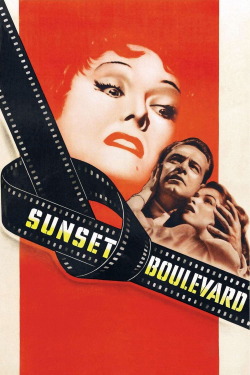
I was a little speechless after I first finished watching Sunset Blvd. I had an idea of what to expect, but I didn't expect that a film made over half a century ago would be so sharp, so artistically compelling, and so tragic while still containing a blistering sense of humor. In some ways it was ahead of its time with its satire, ironically in a film that looks to the past with a sense of sad, but honest nostalgia. Gloria Swanson, the star of the film, plays a woman who is a star still in her old mind, Norma Desmond. There are a handful (how big the hand is depends on the particular viewer) of films where you have a character or characters that are not only unforgettable, but become so trenched in the public consciousness its hard to think of mistaking it for anything else. Even as a kid and knew that line "I'm ready for my close-up, Mr. DeMille" was a basic, but dead-on swipe at ego, or at least stardom. That it was in this context makes it all the more comic/tragic. That Sunset Boulevard also has the distinction of being in the film-noir tradition along with having some satirical grounding solidifies it one of the really unique films of the Golden Age of post World War 2 America.
The story starts with our protagonist and past-tense narrator, Joe Gillis, who is a struggling B movie screenwriter in Hollywood. Fate, or maybe just odd luck, pits him into the driveway of a big, almost archaic estate that almost looks haunted to him on first sight. He meets Norma Desmond, whom he doesn't recognize as once being a big silent movie star. "I am big," she says in one of her trademark lines, "it's the pictures that have gotten small." She confides in Gillis, after he tells her who he is and why he's there (hiding out as it were), that she has a screenplay she wants DeMille to direct as her 'comeback'. He very reluctantly agrees to do it, and very soon gets sucked up into her world, becoming disconnected to his small circle of Hollywood friends. But he still has one, as a kind of secret almost, Betty Schaefer (the beautiful Nancy Olson), who is an aspiring screenwriter. One can maybe guess what might happen as this goes on, but like with Wilder's other great films, the unexpected moments and keen revelations/coincidences are the best parts; Erich von Stroheim as Max, Norma's 'butler', is surprisingly good.
I've seen Sunset Blvd. several times now, but I can't forget how much I laughed the first time around; I wondered why it was even considered in the 'film-noir' tradition (not that it didn't have its stylistic or character bearings, but compared to Double Indemnity it didn't seem as pumped up). I really took it as a kind of pioneering black comedy, with Norma Desmond as the delusional, self-fulfilling has-been. For example, when Gillis first arrives and Max and Norma bury her pet monkey- it's not just the image of the dead monkey and the reverence paid to it, but also as they bury it Gillis' wry narration. The narration in this film is another great trademark, with that kind of snappy later 40's/early 50's wit that helped move from the kind of wit that was in earlier Hollywood films. And of course there are some other absurdities that bring out a few good laughs, in particular when Norma visits DeMille in the studio, and gets suddenly by some surreal miracle all the attention she's been having in her head.
In repeated viewings, the film does show itself as darker, with a lot more thought put into the themes and real problems in the characters. Not just Norma, but also Joe, who little by little becomes more like the sneaky son of an overbearing mother than a real collaborator. The final scenes, which link up to the "end scene at the beginning", and then the sort of crazy, classic epilogue of Norma on the staircase, more of the film-noir elements come through. The 'average Joe', so to speak, in over his head; the sinister elements that are around him (more so here psychological than criminal); and of course the 'black widow' in Norma Desmong. Swanson, in what should've been her Oscar winning role, never misses a beat. Through her delusions of grandeur and overwhelming nostalgia for the old days (another great scene is when she makes him watch all her old silent films), there is also a vulnerability that doesn't make her a totally hateful character.
And through all of this is one of the best screenplays that's ever come out of the Golden Age of Hollywood. As I mentioned the narration is sharp and observant, as in a sort of Pulp-noir novel, and the dialog for the time isn't very unconvincing. The relationships, like the one between Joe and Betty, is handled gently, so that the punch that's given to the viewer at the end has more of an impact. Max, as well, is maybe even more a complex character than Norma; why stay as a butler for a woman who is almost in a time warp? Perhaps he is too. Maybe that's one, perhaps subtle, message to the film- as much as it is fascinating to look to the past, to get locked into it is something very detrimental. But the film may not have a very clear-cut message, as it is a dense film with different appeals to different people (like a Kubrick film)- it's funny, it's romantic, it's sly, and at times very weird. I can't wait to see it again.
9.8/10 (It's my 2nd favorite film of all time).
This review of Sunset Boulevard (1950) was written by Alexandria X on 30 May 2010.
Sunset Boulevard has generally received very positive reviews.
Was this review helpful?